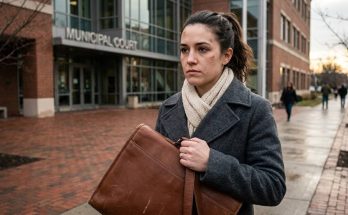
The first day of David's hearing, I almost didn't go.
I stood outside the courthouse for several minutes, staring at the doors while people moved around me. Lawyers hurried up the steps with folders tucked beneath their arms. Reporters waited behind a barrier. Cameras pointed toward anyone who looked important enough to become tomorrow's headline.
My father stood beside me.
“You don't have to go inside,” he said.
“I know.”
“You don't owe him your presence.”
“I know that too.”
I looked at the building.
For most of my life, a courthouse had meant something abstract to me. My father's workplace. A place where other people's disputes were decided.
Now it was where the consequences of my own marriage were being measured.
“I want to hear it,” I said.
My father nodded.
We went inside.
David looked thinner when they brought him into the courtroom.
For one terrible second, my mind ignored everything that had happened and remembered the man I had married. The man who used to make coffee on Sunday mornings. The man who had once rubbed my feet when I was pregnant. The man who knew exactly how I liked the bedroom curtains opened in the morning.
Then I remembered the broken phone.
The granite countertop.
The blood.
The empty space where my baby should have been.
The memories stopped hurting less when I looked at him.
They simply became harder to deny.
The prosecution presented the evidence methodically.
The security footage came first.
The courtroom watched Sylvia shove me.
Then watched David enter.
Then watched him move the chair.
Then the gesture.
Two fingers to Sylvia's lips.
Silence.
The prosecutor paused the video there.
“What does that gesture mean?” the judge asked.
The investigator explained that its precise meaning had never been established, but its timing was significant.
I didn't need to know what Sylvia meant.
I knew what happened afterward.
David removed my phone.
He hid the chair.
He refused to call an ambulance.
He tried to make me say I had fallen.
The broken phone was displayed next.
The casing.
The separated SIM card.
The damaged memory card.
The photographs of where David had hidden the pieces.
Then came the messages.
The courtroom heard Sylvia asking whether I had access to my father's money.
They heard David discussing the pregnancy.
They heard the line about the baby making me harder to control.
I looked at David.
He kept his eyes lowered.
The prosecutor then presented the financial records.
Michael's payments.
Eleanor's transfers.
The private investigator's invoices.
The surveillance photographs.
The trust documents.
The December 20 marital settlement David had prepared without my knowledge.
The insurance policy.
The suspicious beneficiary documents.
One by one, the pieces formed a structure that was impossible to explain away as a series of unfortunate mistakes.
Then came the brake evidence.
The mechanic testified.
He explained that the damage was deliberate.
He described the industrial lubricant.
He identified the tools recovered from Michael's property as consistent with the work.
Then the prosecution played Thomas Grant's recording.
David finally looked up.
His face had lost all color.
The recording filled the courtroom.
“The daughter is the key.”
Then:
“Her husband will handle it.”
I felt my hands shaking.
My father reached over.
I didn't look at him.
I kept my eyes on David.
Because I needed to see whether he would still deny it.
He didn't.
When the recording ended, David closed his eyes.
His lawyer leaned toward him.
David whispered something.
The lawyer shook his head.
David said it again.
The judge asked whether the defense intended to challenge the authenticity.
David's attorney stood.
“No objection.”
The courtroom went silent.
It was the first honest thing David had done in months.
The next witness was Michael.
He entered under heavy security.
He looked at David before taking the stand.
There was no friendship left between them.
No loyalty.
Only resentment.
The prosecutor asked Michael about the original plan.
Michael admitted everything.
He described how he had investigated me before the wedding.
How he had approached David.
How Richard had supplied legal information.
How Eleanor had provided confidential information.
How Thomas had financed the later stages.
He described the trust deadline.
He described the pressure placed on David.
Then he described Christmas.
“We were supposed to make her leave,” he said.
“Was physical violence part of the original plan?”
“No.”
“Who changed that?”
Michael hesitated.
“Me.”
The word seemed to shake the room.
David looked at him.
“You knew she was pregnant,” the prosecutor said.
“Yes.”
“You knew the brakes had been tampered with?”
“Yes.”
“You knew she was being monitored?”
“Yes.”
“You knew she was supposed to be frightened into leaving?”
“Yes.”
“Why did you allow the situation to escalate?”
Michael swallowed.
“Because I thought fear would make David more useful.”
I felt something inside me go still.
The prosecutor asked, “Did you instruct Sylvia to push Anna?”
“No.”
“Did you know Sylvia intended to confront her?”
“Yes.”
“Did you know David intended to remove Anna's chair?”
“Yes.”
“Did you know Anna would be left standing while pregnant and in pain?”
“Yes.”
“And when the push occurred?”
“I knew almost immediately.”
“Did you call for medical assistance?”
“No.”
Michael lowered his head.
“I told David to keep her quiet.”
I closed my eyes.
There it was.
The final piece.
Not an order to kill me.
Something more chilling.
An acceptance that my suffering was an acceptable consequence.
After the hearing, I walked outside alone.
Reporters called my name.
I kept walking.
One shouted whether I blamed my father.
I stopped.
I turned around.
“My father didn't cause this,” I said.
Then I continued toward the car.
That evening, David's lawyer contacted my attorney.
David wanted to speak to me.
I refused at first.
Then I changed my mind.
Not because I wanted reconciliation.
Because there was one question I still needed answered.
I met him in a monitored room.
He sat across from me.
For several seconds, neither of us spoke.
“You look tired,” he said.
I almost laughed.
“So do you.”
He nodded.
“I deserve that.”
“No.”
He looked confused.
“You deserve the truth,” I said.
He swallowed.
“I know.”
I placed my hands on the table.
“Did you ever love me?”
He stared at me.
“Yes.”
“Before or after you knew who my father was?”
“Both.”
“Did you love me before you knew about the money?”
“Yes.”
I studied his face.
“Then why did you investigate me?”
“I was afraid.”
“Of what?”
“Losing you.”
“That isn't an answer.”
He looked down.
“I wanted to know what I was getting into.”
I felt something break inside me.
“What you were getting into?”
He closed his eyes.
“I said it wrong.”
“No. You said it exactly right.”
He began to cry.
“I loved you.”
“You also calculated me.”
He nodded.
“Yes.”
That was the most painful answer.
Not because it surprised me.
Because he finally stopped trying to make the two things mutually exclusive.
He had loved me.
And he had used me.
Both could be true.
“Why didn't you stop them?” I asked.
He stared at the floor.
“Because every time I thought about stopping, I thought about the debt.”
“Your debt?”
“Yes.”
“How much?”
He told me.
It was substantial.
But not impossible.
I looked at him.
“You destroyed our marriage for an amount of money you could have worked your way out of.”
He didn't answer.
“You destroyed our child.”
His face crumpled.
“I know.”
“No, David.”
I leaned closer.
“You know the words. You don't know what it means.”
He began crying harder.
I didn't comfort him.
I couldn't.
“Who told Sylvia to push me?”
“Michael.”
“Who told you the brakes were damaged?”
“Michael.”
“Why didn't you tell me?”
“I thought I could fix it.”
“When?”
“After Christmas.”
I shook my head.
“That sentence is the entire reason I can never forgive you.”
He looked at me.
“I know.”
I stood.
Before leaving, I asked one final question.
“If I had never been pregnant, would you have gone through with the plan?”
He didn't answer immediately.
Then he whispered:
“Yes.”
I walked out.
For the first time, I didn't need another explanation.
The truth was complete.
Click here to continue reading: PART 18: I Returned to the House Where My Marriage Had Collapsed, and What I Found in the Nursery Finally Let Me Say Goodbye to the Life I Had Lost
By Christmas Evening, I Had Become Invisible in My Husband’s Family, and One Empty Chair Finally Exposed What They Really Thought of Me
Part 17 of 20