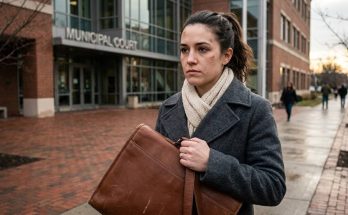
The sentencing hearing took place in early summer.
The courthouse looked exactly as it had months before.
But I was different.
I walked through the doors without fear.
My father was beside me.
This time, I wasn't entering to hear what had happened to me.
I was entering to decide what I wanted to say about it.
David stood at the defense table.
He looked older.
Not dramatically.
Just enough that I could see how much time had passed.
Michael sat several rows away.
Eleanor was there with her attorney.
Richard was not permitted to practice law while disciplinary proceedings continued.
Thomas was transported separately.
The judge called the room to order.
The prosecutor presented the final recommendations.
Then I was asked to speak.
I walked to the podium.
My hands were steady.
I looked at David.
For a second, I remembered our wedding.
The photographs.
The flowers.
The promises.
Then I remembered the kitchen.
I began.
“I spent a long time trying to understand why this happened.”
The courtroom was silent.
“I thought perhaps I had missed something. Perhaps I trusted the wrong person. Perhaps I should have recognized the signs.”
I looked at David.
“But I don't accept responsibility for another person's decision to betray me.”
He lowered his eyes.
“I didn't cause the plan.”
I paused.
“I didn't cause the old dispute between our families.”
I looked toward Thomas.
“I didn't cause the financial scheme.”
Then toward Michael.
“I didn't cause the surveillance.”
Then Sylvia.
“I didn't cause the assault.”
Finally, I looked back at David.
“And I didn't cause my husband to choose silence when I needed him most.”
David began crying.
I continued.
“My child died because violence was brought into my life by people who believed fear was a tool they could use.”
My voice shook.
“But my child was not a mistake.”
I looked down for a moment.
“My baby was loved.”
The courtroom remained silent.
“That matters.”
I breathed slowly.
“I don't want revenge.”
I looked at the judge.
“I want consequences.”
The prosecutor nodded.
“I want the truth recorded accurately.”
I looked at David again.
“And I want the people who did this to understand that what they called strategy was not strategy.”
I paused.
“It was cruelty.”
When I returned to my seat, my father took my hand.
The judge sentenced David to a lengthy prison term.
Sylvia received a separate sentence for the assault.
Michael received a substantial sentence after cooperating and providing evidence, though his cooperation did not erase his responsibility.
Eleanor was convicted for her role in the conspiracy and unlawful use of confidential information.
Richard avoided the harshest criminal consequences because of his cooperation, but his career in law was effectively over.
Thomas received the most severe sentence.
The court described his conduct as a deliberate campaign of retaliation that had crossed every boundary between grievance and criminal violence.
When the judge finished, I felt no triumph.
Only exhaustion.
Outside, reporters waited.
One asked whether I was satisfied.
I thought about the word.
“No.”
She looked surprised.
“Why not?”
“Because no sentence brings back my child.”
That was all I said.
Then I left.
Months later, the estate proceedings were completed.
The trust remained protected.
The assets designated for my child were transferred according to the legal provisions that had been created before the attack.
Because my child had not survived, the trust provisions required careful interpretation.
My father's lawyers handled it.
I refused to let money become the center of my life again.
Some people expected me to use my inheritance as revenge.
I didn't.
I established a small foundation instead.
Its purpose was simple.
Support women who needed legal assistance when they were trapped in controlling relationships.
The first grant went to a woman whose husband had hidden her financial records.
The second helped someone leave an abusive household.
I never used my story in the organization's publicity.
I didn't want my pain turned into a brand.
I wanted the work to matter more than my name.
My father supported the decision.
“You've built something useful from something terrible,” he said.
“I didn't build it alone.”
“No.”
He smiled.
“You didn't.”
One evening, we had dinner together.
Just the two of us.
There were no lawyers.
No detectives.
No reporters.
No court documents.
My father asked whether I had heard from David.
“No.”
“Do you want to?”
“No.”
He nodded.
“Good.”
I laughed.
“You sound relieved.”
“I am.”
We ate quietly.
Then he asked, “Do you still think hiding who I was from David was a mistake?”
I considered the question.
“Yes.”
His eyebrows lifted.
“Really?”
“I think I had the right to privacy.”
He nodded.
“But I also think secrecy made it harder for me to recognize the people who were studying me.”
“That isn't the same as blaming yourself.”
“I know.”
I looked at him.
“I don't blame myself.”
That was true.
For the first time, it was completely true.
I had spent years believing strength meant handling everything alone.
Now I understood something else.
Strength could also mean asking questions.
Walking away.
Saying no.
Letting people help.
And believing yourself when something feels wrong.
A year after Christmas, I returned to the cemetery.
Not Sylvia's.
My mother's.
I carried flowers.
My father came with me.
We stood beside my mother's grave.
I placed the flowers down.
“I'm okay,” I said.
My father smiled.
“She'd be glad.”
I looked at the stone.
“I finally understood her letter.”
My father asked what I meant.
“She wasn't telling me to be afraid.”
I touched the edge of the stone.
“She was telling me not to ignore myself.”
We stayed there until sunset.
Before leaving, I looked at my father.
“Do you think Mom would be angry?”
“About what?”
“That I still miss David sometimes.”
He thought for a moment.
“No.”
“Why?”
“Because missing someone isn't the same as wanting them back.”
I smiled.
“That sounds like something she would say.”
“It does.”
We walked toward the car.
The past was still there.
It always would be.
But it was no longer standing in front of me.
It was behind me.
And that distinction mattered.
Click here to continue reading: PART 20: One Year After Christmas, I Finally Understood What Surviving Had Given Me, and I Chose a Future No One Else Could Control
By Christmas Evening, I Had Become Invisible in My Husband’s Family, and One Empty Chair Finally Exposed What They Really Thought of Me
Part 19 of 20