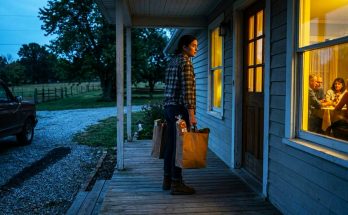
Twenty minutes later, I was back at my parents' house.
The same driveway.
The same sedan.
The same SUV parked beside it.
But the house felt different when I walked toward the door.
Every light was on.
I could see into the front room through the window, and nobody appeared to be moving around.
I carried the brown folder under my arm.
For most of my life, arriving at my parents' house had meant walking into a familiar routine.
Mom would ask whether I wanted coffee.
Dad would mention something that needed fixing.
Ranata would tell a story about something happening in her life.
I would listen, answer a few questions, and eventually leave.
That evening, I knew there would be no ordinary conversation.
I opened the door and stepped inside.
Nobody greeted me.
The silence was so unusual that I stopped just past the entrance.
Dad sat at the kitchen table.
Several sheets of paper were arranged in front of him.
Mom sat nearby with both hands around a mug.
She wasn't drinking from it.
Ranata sat across from them, looking down toward the island.
Her husband, Desmond, stood beside the sink.
He kept shifting his attention between the papers and the people around the table.
Nobody seemed certain what to do with me.
I placed the brown folder beside my chair.
Then I sat down.
Dad studied me for a moment.
He looked older than he had when I saw him earlier that afternoon, though I knew the difference was in the way he held himself.
He seemed to be choosing his words carefully.
“Fay, I need you to tell me something honestly.”
I looked at him.
“All right.”
He drew one sheet away from the others.
“Has Ranata ever passed along money from us to you?”
I turned toward my sister.
She looked up immediately.
For years, Ranata had been comfortable speaking about my circumstances.
She could describe my supposed problems at family dinners without looking at me once.
She could make a comment about my truck and leave me to decide whether answering was worth the trouble.
But now she was watching my face.
There was no familiar smile.
I answered my father.
“No. She hasn't.”
Mom's hands tightened around her mug.
Dad looked down at the papers.
I could hear the clock on the wall.
It was an ordinary kitchen clock, the kind that had been there so long that nobody noticed its sound anymore.
That night, every second seemed louder.
Dad pushed the first page toward me.
I leaned forward.
There were dates and amounts arranged in neat rows.
Beside each entry was a brief explanation of why the money had supposedly been sent.
Farm expenses.
Equipment repairs.
Help with household bills.
Temporary assistance for Fay.
I read the first entry.
Then I moved to the next.
The descriptions were simple enough to understand.
They were also completely unfamiliar.
I had never asked my parents to pay for farm equipment.
I had never asked Ranata to arrange money for repairs.
I had never been told that my parents were covering any of my expenses.
Yet the papers made it look as though there had been an ongoing arrangement.
I picked up the second page.
There were more entries.
More dates.
More amounts.
I looked at the notes beside them, trying to find something I recognized.
I found nothing.
The records were not vague memories of a conversation.
They were written down.
Someone had taken the time to record the payments and describe their purpose.
My father watched me read.
My mother remained silent.
Desmond looked toward Ranata.
She kept her eyes on the table.
I turned to the last page.
At the bottom, there was a total.
I read it once.
Then I read it again.
I did not say the number aloud.
I couldn't.
The amount made the conversation on the porch feel even more unreal.
My parents had apparently been sending money because they believed I was struggling.
They believed I had accepted their help.
They believed I owed them repayment.
And the person sitting across from me had been the one telling them how much I needed.
I looked up at Ranata.
She did not meet my eyes.
I wanted to ask her what she had told them.
I wanted to know how long the arrangement had been going on.
I wanted to understand why she had spoken about my financial situation as if she knew things I had never shared with her.
But I could not make myself start with those questions.
There was something more basic I needed to establish.
I turned back to Dad.
“I've paid my own expenses for years.”
My voice sounded steadier than I felt.
“I haven't borrowed money from you.”
Dad nodded slowly, but he didn't look relieved.
He glanced at the papers again.
Mom finally set her mug down.
The bottom touched the table with a small, hard sound.
I noticed that she still had not asked me about the farm.
She had not asked how I was managing.
She had not asked whether I had been keeping up with the bills.
All of those questions had already been answered for her by somebody else.
I looked at the pages again.
The money had been described as help for me.
But there was no evidence in front of me that I had received it.
I could feel the edges of the brown folder beside my chair.
I had brought it because I thought the sale documents might become relevant.
Now I wasn't sure how to explain why I had brought them without changing the conversation.
The sale was real.
The money was real.
But telling them about it would not answer the question sitting in the middle of the table.
Where had the other money gone?
Dad followed my gaze to the folder.
He had noticed it when I entered, but until then he had said nothing about it.
Now he looked from the papers in front of him to the folder beside my chair.
His expression changed slightly.
“What did you bring with you?”
I rested my hand on the cover.
“Some paperwork.”
He looked at the folder for another moment.
Then he raised his eyes to mine.
“What is it?”
I didn't answer immediately.
The documents inside would tell him something about my life that he had never thought to ask about.
They would explain why I had not needed the help my sister claimed I had been receiving.
They would show that the daughter he believed was falling behind had been able to sell her farm for thirty-nine million dollars.
But that was not the only reason I had brought them.
I had come to my parents' house that afternoon expecting to deliver groceries.
I had left because I heard my family discussing money I had never received.
Now I was sitting at the same table where the records had been laid out, looking at a total that did not belong to any debt I remembered.
My father waited.
Ranata remained silent.
And the brown folder sat between my hand and the edge of the table.
Dad pointed toward it.
“Fay, what's in there?”
Click here to continue reading: PART 5: The Papers on My Parents’ Table Told a Story About My Life That I Had Never Lived, and I Finally Understood Why Nobody Had Asked Me
I Went to My Parents’ House With Groceries, Believing I Knew Exactly Where I Stood in My Family Until I Heard My Own Name
Part 4 of 9