By the following morning, I had learned how to move through the hospital without looking at every closed door.
I still noticed footsteps.
I still checked the corridor whenever someone stopped outside Lily's room.
But I was no longer startled by every sound.
Lily had begun asking for small things again.
She wanted her own socks.
She wanted to know whether she could have her hair brushed before breakfast.
She wanted to draw a picture for my mother and put it in her handbag.
These were ordinary requests.
I welcomed them.
They reminded me that my daughter was still a little girl with familiar habits and small plans for the day.
I did not want the fear surrounding us to become the only thing she remembered.
The medical team continued assessing her needs.
The professionals involved in the investigation continued their work.
I followed the instructions I was given and tried not to demand answers before they were available.
That was harder than it sounds.
I wanted to know what Emily had witnessed.
I wanted to know what Daniel had said to her.
I wanted to know whether there was anything else in our house that I had failed to notice.
Every question seemed to lead to another.
When my mother stepped out to make a phone call, I took a moment to look through the photographs on my own phone.
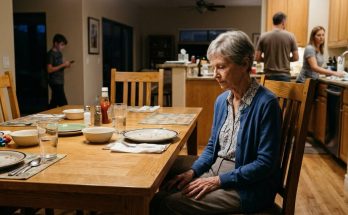
I found one from Lily's birthday.
She stood in front of the kitchen table wearing a paper crown.
There was frosting on her cheek, and she was laughing at something outside the frame.
Daniel stood behind her with one hand on the back of her chair.
Emily was beside the table, holding a plate.
I stared at the photograph longer than I meant to.
There was no obvious sign of anything wrong.
It looked like a family celebrating a child's birthday.
That was what made the uncertainty so difficult.
I had always believed that if something serious was happening in my home, I would recognize it.
I thought there would be a moment when the truth became impossible to miss.
Instead, I was left reconsidering ordinary scenes.
A closed door.
A child going quiet.
A relative who suddenly changed the subject.
None of those details could explain the whole situation by themselves.
I put the phone away.
I would not turn a photograph into proof of anything.
A little later, a staff member told me that the investigators might need further information from me as their work continued.
I said I would cooperate.
Then I returned to Lily's bedside.
She was sitting with her rabbit and looking at the picture she had drawn the day before.
“Can we keep these?” she asked.
“Of course.”
I placed the drawings in a folder so they would not get bent.
The paper had softened at the corners from being handled.
I did not know whether the drawings had any significance beyond being something Lily had made while she was frightened.
I kept them because they belonged to her.
That was reason enough.
My mother returned and sat beside us.
She had been quiet that morning.
I could tell she was thinking about Emily, too.
“Do you think she was afraid to tell us?” she asked.
“I don't know.”
“Daniel can be difficult when he's angry.”
I looked at her.
She did not sound as though she were defending him.
She sounded as though she were trying to understand something she had seen for years without naming it.
“He doesn't like people questioning him,” she added.
I thought about the way I had learned to choose my words around him.
I had often prepared a conversation in my head before bringing up something that mattered to me.
I had considered his likely objections and tried to answer them before he spoke.
I had believed I was preventing arguments.
Perhaps I had also been learning to make myself smaller.
I did not know what that meant for the future.
I only knew that I wanted Lily to grow up believing she could speak without first calculating whether someone would be angry.
Later that day, I asked Karen whether there was anything new I needed to know.
She explained that the team was continuing to coordinate with the medical staff and the authorities.
She did not offer details that were not appropriate to share.
I appreciated that she was honest about what she could and could not tell me.
“Should I talk to Lily about Emily?” I asked.
Karen advised me not to raise the subject in a way that might influence Lily's account.
If Lily brought up her aunt herself, I could listen without asking leading questions.
Otherwise, it was better to let the professionals guide the process.
I agreed.
I wanted Emily to explain herself.
But I did not want my need for answers to become another source of pressure on Lily.
The next time I saw Emily, I would have to decide what to say carefully.
For now, I would wait.
That evening, my phone rang.
It was Daniel.
My mother looked at the screen and then at me.
“You don't have to answer.”
I knew that.
Still, my hand moved toward the phone automatically.
For years, I had answered his calls because I believed ignoring them would make things worse.
I had treated his displeasure as something I could prevent if I chose the right words.
But I could not control his reactions.
I could only control my own decisions.
I let the call ring out.
A message appeared shortly afterward.
Daniel wanted to know when he could see Lily.
He said he was worried about her.
For the first time, the message contained words that sounded like concern.
I read it carefully.
I did not know whether his worry was genuine, whether he was trying to influence me, or whether both things could be true.
I would not decide that from a text.
I showed the message to the officer and followed the existing plan.
I did not reply directly.
My mother watched me put the phone down.
“How do you feel?”
I thought about the question.
“Confused.”
“That makes sense.”
“I don't know what to believe about him.”
My mother did not tell me what I should believe.
She simply took my hand.
“You don't have to settle that today.”
I looked toward Lily.
She was listening to a story read by a nurse.
Every so often, she looked at the pictures in the book and pointed at something she liked.
I wanted to keep my attention on her.
But my mind continued returning to the study.
I imagined the door at the end of the hallway.
I imagined Emily standing nearby, hearing Lily cry.
I imagined Daniel telling her to stay out of it.
Then I stopped myself.
I had no right to fill in the missing details with scenes I had invented.
The investigation would have to establish what happened.
I could be worried without pretending I already knew the answer.
That distinction became important to me.
Fear had a way of turning possibilities into facts if I let it.
I would not do that.
When the nurse finished reading, Lily asked for her rabbit.
I handed it to her.
She pressed its soft body against her chest and looked at me.
“Are we still staying with Grandma?”
“For now, we're following the plan the doctors and other people helping us have made.”
She frowned slightly.
“Will we have to move?”
I sat beside her.
“We may need to stay somewhere else while things are being worked out. We'll explain what happens when we know more.”
She was quiet.
Then she asked, “Can I take my drawings?”
“Yes.”
“And my rabbit?”
“Yes, sweetheart.”
She nodded as if those were the two things she most needed to understand.
I realized that I had been thinking about the house as if it were the center of our lives.
The furniture.
The photographs.
The clothes in the wardrobes.
The study at the end of the hallway.
Lily was thinking about her rabbit and her drawings.
She needed familiar things.
She needed to know she would not be forced into a situation that frightened her.
I could help with that.
I could gather the things she wanted when it was safe and appropriate to do so.
I could make sure she had her brush, her pajamas, and the book she liked to read before bed.
I could not promise that we would return to the same home.
I could promise that she would not have to face the uncertainty alone.
Later, after Lily fell asleep, I sat with my mother in the waiting area.
We spoke quietly about practical matters.
She had offered to let us stay with her if that became necessary.
I told her I might accept.
She did not ask me to decide immediately.
She only said that there would be room for us.
I looked at her and felt tears rise again.
I had spent so long believing that asking for help meant I had failed to manage my own life.
Now I understood that needing help was not the same as being incapable.
It was part of how people got through things they could not handle alone.
I leaned back in the chair.
For the first time in days, I allowed myself to think beyond the next phone call or the next conversation with an investigator.
I thought about Lily going back to school someday.
I thought about making breakfast with her.
I thought about a morning when she could wake up without worrying about who might be waiting for her.
I did not know when that morning would come.
But I wanted it for her.
And I was prepared to make difficult decisions to help her reach it.
Source: psndaily.xyz
Click here to continue reading: PART 8: The More I Remembered About Our Life Together, the More I Understood That Trust Could Not Replace the Truth We Still Needed
My Daughter Would Not Let Go of My Sweater, and Every Message From Her Father Made Me More Afraid of What Waited at Home
Part 7 of 8