I woke up early the first morning in my new house.
For a few seconds, I didn't know where I was.
The room was unfamiliar, and the light coming through the window fell at a different angle from the light in Daniel's house.
Then I remembered.
I was home.
My home.
I lay still and listened.
There were no children running down the hallway.
No cupboard doors opening in the kitchen.
No hurried footsteps from someone trying to get ready for work.
The quiet was complete.
I had wanted that quiet for months.
Now that I had it, I wasn't quite sure what to do with it.
I got out of bed and went to the kitchen.
The boxes were still stacked against one wall.
I hadn't unpacked everything the previous day, and there were a few things I needed before I could make the room feel settled.
I found a cup.
I found the tea.
Then I stood at the counter, waiting for the kettle to boil.
Nobody needed breakfast.
Nobody needed a lunch packed.
Nobody needed me to check the time or remember an appointment.
I could drink my tea while it was hot.
That should have been an ordinary pleasure.
Instead, I found myself feeling guilty.
I had spent so long arranging my mornings around other people that having nothing urgent to do felt almost wrong.
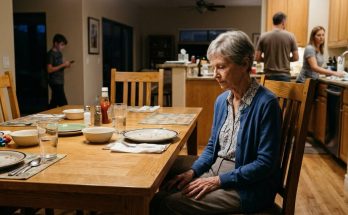
I sat down at the kitchen table.
The cup warmed my hands.
Outside, a bird landed near the shade trees and disappeared again.
I watched it for a while.
Then I laughed at myself.
I had won eighty-nine million dollars, bought a house, and finally moved out of my son's home.
Yet I was sitting in my own kitchen wondering whether I ought to be doing somebody else's laundry.
Old habits were stubborn things.
I finished my tea and began unpacking.
There were practical matters to attend to.
I needed to decide where the dishes belonged.
I needed to arrange the pantry.
I needed to find a place for Harold's photograph where I could see it without having to search through a box.
These were small decisions, but they belonged to me.
That made them feel important.
I put the cups in a cupboard near the kettle.
I arranged the plates on a shelf I could reach easily.
I set aside a drawer for the things I used every day.
Then I carried Harold's photograph into the living room.
I stood there holding it.
The photograph had been taken years earlier.
Harold was smiling at something beyond the camera, and I was looking at him instead of at the person taking the picture.
I remembered that afternoon.
I remembered how ordinary it had seemed.
We had no idea that one day the photograph would become one of the few things I could hold when I wanted to feel close to him.
I placed it on a shelf.
Then I moved it a little to the left.
I stepped back and looked.
It seemed right.
For the first time since leaving our old house, I had found a place for something that belonged to our life together.
I didn't have to hide it in my bedroom.
I didn't have to worry that it would be in somebody's way.
I could see it whenever I wanted.
That small freedom brought tears to my eyes.
I let them come.
There was nobody to reassure.
Nobody to explain myself to.
I could be sad without turning the sadness into a problem that needed solving.
After a while, I wiped my face and went back to the kitchen.
I made a list of things I still needed.
Nothing extravagant.
A few household items.
Some groceries.
A lamp for the room where I planned to read.
I looked at the list and noticed how different it was from the lists I had made in Daniel's home.
Those lists had been filled with things for other people.
The children's food.
The groceries Renee needed.
The things Daniel had forgotten to pick up.
Now I was writing down what would make my own life more comfortable.
It was a small change.
But it felt like a beginning.
Later that morning, I went outside.
The porch was one of the first things I had noticed about the house.
I had liked the shape of it, the shade from the trees, and the way the front of the property seemed to invite someone to sit for a while.
I brought a chair into a comfortable position and sat down.
I thought about Harold's old porch in Tucson.
He had sat there most mornings with his tea before work.
Sometimes I would join him.
Sometimes I would remain inside, pretending to be busy while listening to him move around outside.
We had thought there would always be another morning.
That was how people lived.
They assumed the ordinary things would continue.
I hadn't known how much I would miss them.
Now I was sitting on another porch, at another house, beginning another part of my life without him.
The sadness was there.
So was something else.
Possibility.
I didn't have to decide what the next ten years would look like.
I only had to decide what to do that day.
I could go shopping.
I could unpack.
I could read a book.
I could sit on the porch until lunchtime.
For once, none of those choices needed to be justified.
I chose to sit a little longer.
By noon, I had begun to feel more comfortable.
I went inside and made myself a simple lunch.
I ate at the kitchen table and washed my plate afterward.
Then I called my attorney to confirm that the remaining administrative details were proceeding as expected.
He answered my questions and told me what I needed to know.
I wrote down the information.
Before ending the call, I thanked him.
He had helped me make decisions at a time when I was vulnerable and uncertain.
I was grateful for that.
But I also understood something I hadn't understood before.
Professional help could protect my interests.
Money could give me options.
Neither could tell me how to live.
That part was still mine to work out.
In the afternoon, I received a call from Daniel.
I looked at the telephone for a moment before answering.
I had wondered when he would call.
I had imagined different conversations, some difficult and some ordinary.
I had even rehearsed what I might say if he asked me why I had left without discussing it further.
But when I answered, he sounded much as he always did.
He asked how I was settling in.
I told him I was doing well.
He asked whether I had everything I needed.
I said I had most of it.
There was a pause.
Then he asked whether I had managed the move without too much trouble.
I told him the arrangements had gone smoothly.
He didn't ask how I had paid for the house.
He didn't ask what the purchase had involved.
He didn't mention the company name.
The conversation stayed on ordinary matters.
I listened to him talk about the household.
He mentioned the children.
He mentioned work.
He asked whether I had found the grocery store nearby.
I told him I had made a list of things to buy.
It was a perfectly normal conversation.
That was what made it difficult to judge.
Daniel had called.
He had asked how I was.
There was concern in his voice, or at least an attempt to show concern.
I didn't want to dismiss that.
But he still hadn't acknowledged what had happened at dinner.
He hadn't asked whether I was hurt.
He hadn't asked whether I had felt unwanted in his home.
Perhaps he didn't know how to begin that conversation.
Perhaps he believed that my leaving had settled the matter.
I couldn't know.
I wasn't ready to force an answer out of him.
So I kept my voice calm.
When the call ended, I set the telephone down.
I felt a familiar urge to explain myself.
I wanted to tell him that I had found a good house.
I wanted to tell him that I was comfortable.
I wanted to reassure him that I wasn't angry.
Then I stopped.
Why was I already trying to make him feel better?
I had just moved into my own home.
I was allowed to enjoy it without managing my son's feelings about it.
I returned to the porch.
The afternoon light had shifted across the front yard.
I sat with my notebook and turned to a blank page.
I wrote down what I wanted from this new life.
Peace.
Privacy.
Time with my grandchildren.
A relationship with Daniel that did not depend on my living in his house.
The freedom to help without being expected to do everything.
I read the words.
They seemed reasonable.
I didn't want to punish my family.
I wanted to have a family without losing myself inside it.
That evening, I made dinner in my own kitchen.
I ate slowly.
Afterward, I washed the dishes and put them away.
Then I turned off the kitchen light.
The room was quiet again.
This time, I didn't feel guilty.
I had done enough for one day.
And I was learning that enough could be enough.
Click here to continue reading: PART 10: My Son Called Again, but the Questions He Avoided Told Me More Than the Ones He Finally Found the Courage to Ask
I Thought Moving In With My Son Would Help Me Survive Losing My Husband, but I Never Asked What It Would Cost Me
Part 9 of 12