The first person I called was an attorney.
I didn't tell Daniel.
I didn't tell Renee.
I didn't even hint that anything unusual had happened.
I had lived long enough to understand that a sudden change in circumstances could create problems as quickly as it created opportunities.
I knew almost nothing about what a person should do after winning a sum of money that large.
I needed someone who understood the legal and financial consequences.
So I made the call.
Then I called another attorney.
I wanted proper advice.
I wanted to know how to protect myself and how to keep the details of my new circumstances private while I worked out what came next.
The conversations were more practical than emotional.
There were questions to answer and arrangements to consider.
There were matters that needed attention before I could safely make decisions about my future.
The attorneys helped me establish trusts and put privacy protections in place.
They helped me begin planning how the money should be managed.
I listened carefully.
I asked questions when I didn't understand something.
I took notes.
For the first time in years, I had a set of decisions that belonged entirely to me.
Nobody else had to agree with them.
Nobody else needed to know about them.
That feeling was unfamiliar.
I had become so accustomed to fitting my plans around the needs of Daniel's household that I had almost forgotten what it was like to make a decision without considering how it might inconvenience somebody else.
Now I was making decisions about my own future.
I found that I could do it.
I was still capable of thinking clearly.
I was still capable of asking for help when I needed it.
And I was still capable of keeping something private.
My attorneys advised me not to change my ordinary routine while the necessary arrangements were being made.
There was no reason to draw attention to myself.
No reason to make sudden purchases.
No reason to announce anything before the legal details were in order.
So I carried on.
I made breakfast.
I packed lunches.
I drove the children where they needed to go.
I helped prepare dinner.
I folded the laundry.
The ticket had changed my financial circumstances, but it had not changed the fact that I was living in Daniel's home.
To anyone watching, nothing was different.
I was still Margaret.
Still the mother who had moved in after losing her husband.
Still the grandmother who helped keep the household running.
Still the woman whose days seemed to belong to everybody else.
There were moments when the contrast felt almost absurd.
I would be standing at the kitchen counter, cutting food into containers, while somewhere else in my life lawyers were discussing how to protect a fortune.
I would be driving the children home from an activity, thinking about the next appointment I needed to arrange.
I would sit in my room with my notebook and review the things I had written down.
The world had given me an extraordinary opportunity.
And I was moving through the days as though nothing had happened.
At first, I wondered whether I should tell Daniel.
He was my son.
He had invited me into his home when I was grieving.
He had given me a place to stay when I was struggling to adjust to life without Harold.
Those things mattered.
I didn't want to pretend they hadn't happened simply because I had become wealthy.
But then I remembered the conversation outside his bedroom.
I remembered Renee describing me as someone who contributed nothing.
I remembered waiting for Daniel to speak.
I remembered his response.
He knew how much I helped.
He knew I had sold my house.
He knew I had moved across town and reorganized my life around his family's needs.
Yet when his wife complained that I lived there without paying, he had offered no correction.
I could not forget that.
I tried to be fair.
Perhaps Daniel had been tired.
Perhaps the conversation had been more complicated than I had heard.
Perhaps he had meant to say something else.
I could invent explanations for him all day.
But the words had been spoken.
And I had heard them.
The money did not erase the hurt.
If anything, it made me more careful.
I didn't want my family to treat me differently because they believed I could provide something for them.
I didn't want every conversation to become a discussion about what I could afford.
I didn't want to spend the rest of my life wondering whether someone loved me or loved what I could do for them.
I had no proof that Daniel would react that way.
I had no proof that Renee would either.
But I had learned that I didn't need to make an announcement simply because keeping a secret felt uncomfortable.
I could wait.
I could finish putting my affairs in order.
I could decide what I wanted without rushing to make the decision easier for everyone else.
So I kept quiet.
The weeks passed.
The children went to school.
Daniel went to work.
Renee managed her schedule.
The household continued through the same routines.
Sometimes I wondered how different everything might have been if I had told them.
Would Daniel have become more attentive?
Would Renee have asked fewer questions about what I contributed?
Would they have treated me as someone with choices instead of someone who was always available?
I couldn't know.
Those questions had no answers because I hadn't given them the information.
And I wasn't ready to.
I had spent months trying to convince myself that I was content with the arrangement.
Now I had the means to change it.
But money alone could not tell me what to do.
I still needed to understand what I wanted my life to look like.
I wanted a home of my own again.
That much was becoming clear.
I wanted a place where I could close the front door and know that I was not staying at somebody else's invitation.
I wanted to make a cup of tea without wondering whether I was in the way.
I wanted to choose what I cooked, when I rested, and how I spent my afternoons.
I wanted the freedom to help my family because I wished to help them, not because my presence had become part of their daily arrangements.
I didn't know where that home would be.
I only knew that I needed one.
Then came the dinner.
By that point, the possibility of my moving out had been hanging over the household for some time.
Nobody had sat me down and explained what they expected.
Instead, the subject appeared in small pieces.
A remark about the children getting older.
A comment about how much room a family needed.
A question about whether I had considered other living arrangements.
Occasionally, someone mentioned retirement communities.
The conversations were never quite direct enough to answer the questions they raised.
I would hear a remark, think about it for the rest of the day, and then tell myself I was reading too much into it.
Daniel never said that I had to leave.
Renee never gave me a date.
But I began to recognize the direction in which things were moving.
The house on Willow Creek Lane had become a symbol of the future Daniel and Renee wanted.
They had imagined the bedrooms.
They had pictured the children growing up there.
They had talked about how much easier life might be in a different home.
I was not part of those plans in any clear way.
I could see that.
Still, I kept hoping the family would discuss the matter with me honestly.
I thought Daniel might sit down with me and explain what he and Renee needed.
I thought he might acknowledge that I had made sacrifices to move in.
I thought we might find a solution that allowed me to leave with my dignity intact.
I was prepared to listen.
I was prepared to make arrangements.
I was even prepared to admit that living together might no longer be right for any of us.
What I wasn't prepared for was the way he finally asked.
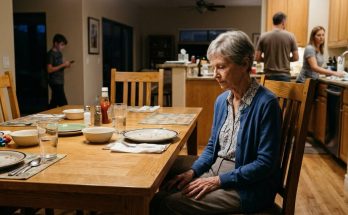
That evening, dinner was already on the table.
I had helped with the meal, as I often did.
The children sat in their usual places.
Daniel and Renee were there.
The room looked much like it had on any other evening.
Plates.
Glasses.
Serving dishes.
The ordinary objects of a family dinner.
I remember the roast chicken.
I remember reaching for a dish.
I remember the small sounds of everyone eating.
I remember thinking that the day had been uneventful.
Then Daniel moved his chair back.
The sound was brief, but I looked up.
He seemed to hesitate.
His eyes moved toward Renee before he addressed me.
“Mom, have you thought about when you might find a place of your own?”
He said it in a way that made it sound like a practical question.
A question that had been waiting for its turn.
I looked at him.
For a moment, I wasn't sure I had understood.
I had known the conversation was coming.
I had heard the hints.
I had noticed the changes.
Still, I had imagined that when the moment arrived, my son would find a way to speak to me with some care.
Instead, he had asked me about leaving while we sat around the dinner table.
I looked toward Renee.
She didn't appear surprised.
Then I looked at the children.
My granddaughter lowered her fork.
My grandson kept his eyes on his plate.
Neither of them said anything.
Their silence told me something I hadn't wanted to consider.
This was not the first time the subject had been discussed.
They had heard it before.
They knew it was coming.
I was the only person at that table who had not known when the question would be asked.
That hurt more than I expected.
I had spent so long trying to make myself useful that I had stopped asking whether anyone thought about how I felt.
Now I understood that they had been discussing my future without me.
I didn't know how many conversations there had been.
I didn't know exactly what Daniel and Renee had said to each other.
I only knew that they had reached a point where my leaving seemed like a decision they were entitled to raise whenever it suited them.
I looked down at my plate.
The food was still there.
Nobody had moved to clear the dishes.
I could hear the quiet sounds of the room, but I wasn't really listening to them anymore.
For years, I had believed that if I was patient enough, kind enough, and helpful enough, the people I loved would understand what I was trying to give them.
I had thought that my actions would speak for me.
I had assumed that my son knew me well enough to understand what it had cost me to leave my old home.
But I had been wrong about something important.
People could know what you had sacrificed and still treat the sacrifice as though it were nothing.
I folded my napkin.
I placed it beside my plate.
Then I stood up.
Daniel looked at me.
I didn't know whether he expected an argument or an explanation.
Perhaps he thought I would ask him why he was bringing it up.
Perhaps he expected me to become upset.
I had no desire to give him either.
“I'm going to step outside for a moment.”
That was all I said.
I left the table.
I walked through the house and out onto the patio.
The evening air was warm.
The ground smelled of dust and recently watered grass.
I could see the lights shining through the windows.
Inside, my family remained at the dinner table.
I sat down and let the quiet settle around me.
For a while, I did nothing.
I didn't cry.
I didn't rehearse the speech I might give Daniel.
I didn't try to decide who was right.
I simply sat there and allowed myself to feel what I had been avoiding.
I was hurt.
Not because I couldn't find another place to live.
Not because I had nowhere else to go.
I was hurt because I had spent months trying to prove that I deserved a place in my own son's home, and he had finally asked when I intended to leave.
I thought about Harold.
I thought about our old house.
I thought about the yellow kitchen and the rose bushes I had left behind.
I thought about the ticket I had kept hidden and the legal arrangements that were quietly taking shape.
I had options now.
More options than I had ever expected to have at my age.
But the money was not what made the moment clear.
It was the question Daniel had asked.
I took a small notebook from my room later that evening.
I opened it to a blank page.
Then I wrote down five short reminders.
Leave the house.
Keep my head clear.
Protect what is mine.
Find a home.
Do not forget how this felt.
I read the words again.
They weren't a plan in any detailed sense.
They were a beginning.
For the first time in a long while, I wasn't trying to figure out how to make everyone else comfortable.
I was thinking about what I needed to do for myself.
The next morning, I called my attorney.
Then I contacted a realtor.
I had made my decision.
I was going to find a home of my own, and I was going to do it on my terms.
Click here to continue reading: PART 5: I Had Spent Years Waiting for My Son to See My Worth, but the First Person to Take My Future Seriously Was My Attorney
I Thought Moving In With My Son Would Help Me Survive Losing My Husband, but I Never Asked What It Would Cost Me
Part 4 of 12