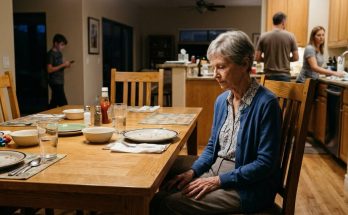
There was a time when I believed that growing older meant becoming more dependent on the people you loved.
I thought it was natural for children to take over some of the decisions their parents had once made for themselves.
I thought accepting help was part of aging.
And sometimes it is.
There is no shame in needing support.
There is no shame in asking for a place to stay when life becomes difficult.
The mistake I made was believing that accepting help meant I had to surrender my right to decide what happened next.
I had moved into Daniel's home because I was grieving.
I had needed companionship.
I had needed time to adjust to a world without Harold.
Daniel had offered me a place to stay, and I had accepted.
For that, I was grateful.
But gratitude had gradually become a reason to remain silent.
I had been afraid that if I complained, I would seem unappreciative.
I had been afraid that if I said no, I would become a burden.
I had been afraid that if I asked for more consideration, I would damage the relationship I was trying to preserve.
So I had made myself useful.
I had done the lunches and the laundry.
I had driven the children and prepared the meals.
I had tried to make my presence so convenient that nobody would regret inviting me.
And somewhere along the way, I had stopped asking whether I was happy.
The question at dinner forced me to look at that.
It was not the only thing that had gone wrong.
It was simply the moment when I could no longer pretend that the arrangement was working.
I had options.
I had the money.
I had the legal advice.
I had the ability to choose a different home.
But the most important decision was not about the property.
It was about whether I was willing to stop treating my own needs as less important than everyone else's.
I had spent months waiting for Daniel to recognize what I was giving.
I had hoped he would defend me when Renee complained.
I had hoped he would notice when I was tired.
I had hoped he would understand that I was not simply another person occupying a room in his house.
He might never fully understand those things in the way I wanted him to.
That was painful to accept.
But I could not spend the rest of my life waiting for him to become the person I needed him to be.
He was my son.
I loved him.
He was also an adult with his own responsibilities, weaknesses, and decisions to make.
I could not make those decisions for him.
I could only make my own.
The house on Willow Creek Lane gave me a place to begin.
I didn't think of it as a prize.
I didn't think of it as proof that I had won some contest with my son.
It was a home I had chosen because I wanted to live there.
The porch reminded me of Harold.
The trees gave the property a feeling of permanence.
The four bedrooms meant there was room for family to visit, if and when we could arrange that comfortably.
I liked the kitchen.
I liked the quiet.
I liked knowing that when I closed the front door at night, I was not occupying a space someone had reluctantly allowed me to use.
I belonged there because I had chosen it and made it my home.
That was enough.
I began to build a routine.
I woke at the time I wanted.
I made tea.
I spent time reading or tending to the small things around the house.
I went shopping when I needed groceries.
I cooked because I enjoyed cooking, not because a meal had to be ready when everyone else came home.
Some days, I made simple food.
Other days, I tried something that took longer.
There was no schedule to satisfy except my own.
I discovered that I still enjoyed having people around.
I had never wanted to become isolated.
I wanted companionship, conversation, and time with my grandchildren.
I wanted to share meals with people I loved.
What I no longer wanted was to confuse being loved with being constantly available.
There was a difference.
I could invite someone to dinner without taking responsibility for every part of their day.
I could help my grandchildren with something without assuming that every problem belonged to me.
I could listen to Daniel talk about work without feeling obliged to solve whatever had gone wrong.
I could be part of the family without living inside its routines.
That was the kind of relationship I wanted to build.
I also learned to be more careful with my money.
Eighty-nine million dollars was a sum I had never imagined having.
I knew it could make many things possible.
I also knew that money could complicate relationships if it became the center of every conversation.
I wanted to preserve my privacy.
I wanted to understand the arrangements my attorneys had made.
I wanted to make thoughtful decisions rather than responding to every new idea simply because I could afford it.
The company structure remained part of how I managed my affairs.
It had been established long before the lottery win, and it served a practical purpose.
The property purchase had been handled through that arrangement.
Daniel had seen the company name over the years without paying much attention to it.
I had not used it to create a false story about myself.
I had simply kept my financial matters private while I worked through an unexpected change in circumstances.
I didn't know what Daniel would think if he eventually understood the full picture.
I didn't know whether he would be surprised, embarrassed, or angry that I had not told him.
I had thought about those possibilities.
Then I stopped making them the center of my life.
The house was not a secret I needed to guard for the rest of my days.
It was a home.
The money was not a weapon.
It was a resource I needed to manage responsibly.
My decision to leave Daniel's house was not a punishment.
It was a boundary.
I could explain that if the time came.
I did not need to rehearse the explanation every morning.
One afternoon, I sat on the porch with Harold's photograph inside the house behind me.
I had been thinking about our old home again.
I remembered the yellow kitchen.
I remembered the rose bushes.
I remembered the front porch where Harold had sat with his tea before work.
I could still picture the way the morning light reached the front of the house.
For a while, I regretted selling it.
I wondered whether I had given up too much in my effort to make life easier after his death.
Perhaps I had.
But regret could not return the property to me.
It could only teach me something about the decisions I made when I was frightened and lonely.
I had believed that leaving the house meant leaving the life I had shared with Harold.
Now I understood that the memories had never belonged to the building.
They belonged to me.
I could remember Harold in the new kitchen.
I could think of him while sitting on the new porch.
I could keep his photograph on the shelf and tell stories about him when my grandchildren visited.
The old house had mattered.
It would always matter.
But I did not have to live there to keep loving the man who had shared it with me.
That realization brought me a kind of peace.
I was no longer trying to recreate the past.
I was learning to live in the present.
As for Daniel, I did not stop loving him because he had hurt me.
I did not decide that one painful question erased every good thing he had done.
He had offered me shelter when I was struggling.
That kindness had been real.
So had the disappointment that followed.
Both things could exist together.
I could remember his invitation with gratitude and still remember the dinner with pain.
I could hope our relationship would improve without pretending that nothing needed to change.
I could forgive him without moving back into his home.
And I could leave the door open to a better relationship without abandoning the boundaries I had finally established.
That was what I wanted.
Not revenge.
Not an apology delivered because someone had been frightened into giving one.
Not a family forced to admit that I had been right about everything.
I wanted honesty.
I wanted consideration.
I wanted the chance to be Margaret again, rather than the person who was always expected to have dinner ready or be available for a school pickup.
I wanted to enjoy my family without feeling that my place among them depended on what I could do.
At seventy-one, I had been given more money than I could reasonably have imagined.
But the most valuable thing I gained was not the ability to buy a house.
It was the ability to stop asking whether I deserved one.
I had spent years believing that my worth could be measured by how much I gave to the people around me.
I thought a good mother kept helping.
A good grandmother kept showing up.
A good widow learned to accept whatever arrangement made life easiest for her family.
Those beliefs had made me generous.
They had also made it easy for me to ignore my own needs.
I was still generous.
I still wanted to show up for the people I loved.
But I no longer believed that generosity required me to disappear.
I could be kind and still say no.
I could be grateful and still expect respect.
I could love my son and still choose a life that did not depend on his approval.
The morning after I finished unpacking, I made tea and carried it to the porch.
The trees shaded the front of the house.
The street was quiet.
I sat down and watched the day begin.
I thought about the woman I had been when Daniel first asked me to move in.
She had been lonely.
She had been grieving.
She had wanted to believe that accepting help would make the next part of her life easier.
I wished I could have told her that needing help did not make her weak.
I wished I could have told her that she did not have to earn her place in the world by being useful.
Most of all, I wished I could have told her that even after losing Harold, even after selling the house, even after being hurt by her own son, she would still have choices.
She would still have a future.
And she would still be herself.
I took a sip of tea.
It was still warm.
For once, I didn't hurry to finish it.
There were no lunches waiting to be packed.
No laundry waiting to be folded.
No one waiting for me to make myself useful.
There was only the morning, the house, and the life I was beginning to understand belonged to me.
I had won eighty-nine million dollars at seventy-one.
I had kept the news private while I protected my affairs.
I had bought the house my son's family once wanted.
I had left his home without an argument.
Those were the facts.
But they were not the part I wanted to remember most.
I wanted to remember the moment I realized I could leave a place where I felt unwanted and build a life somewhere else.
I wanted to remember that my value had not changed when my bank balance changed.
It had been there when I was packing lunches.
It had been there when I was folding laundry.
It had been there when I stood in the hallway listening to my son agree that I lived in his home without contributing.
And it had been there when I sat at the dinner table, folded my napkin, and stood up.
The money had given me choices.
The house had given me somewhere to begin.
But I was the one who had finally chosen myself.
I finished my tea and went inside.
I placed the cup in the sink.
Then I opened the curtains in the living room so the light could reach Harold's photograph.
I stood there for a moment, looking at the familiar face.
I missed him.
I always would.
Then I turned toward the kitchen and began my day.
Not because somebody needed me.
Not because I had something to prove.
Because it was my life.
And I was finally living it.
The End
Read more original stories on Feel Every Story.
I Thought Moving In With My Son Would Help Me Survive Losing My Husband, but I Never Asked What It Would Cost Me
Part 12 of 12