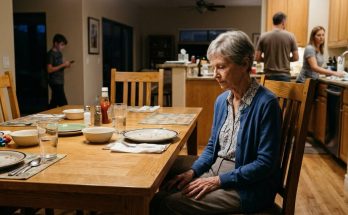
I learned the household's routine faster than I expected.
The children needed breakfast before school.
Their lunches had to be packed.
Someone had to remember which day meant soccer practice and which afternoon required a different pickup time.
Daniel and Renee had their jobs, their meetings, and their plans.
I had a fairly open schedule.
At least, that was how I described it to myself.
So I helped.
I learned what each grandchild liked in a lunchbox and what would come home untouched.
I learned where Renee kept the extra containers and which cupboard held the plastic bags.
I learned that one child liked his sandwiches cut into triangles while the other didn't care as long as there were no tomatoes.
These were small things.
They made me feel useful.
There was comfort in knowing exactly what to do.
After months of waking up in a house where every task reminded me of Harold, I liked having a reason to move through the day.
I could prepare breakfast.
I could make a list.
I could take someone somewhere and bring them home again.
The hours passed more quickly when somebody needed me.
I told myself I was fortunate.
Other women my age spent their days alone.
I had a family.
I had grandchildren who still came looking for me when they couldn't find something.
I had a son who had opened his home to me.
I tried not to think too much about the fact that I had sold my own home to make this arrangement possible.
I had made that decision willingly.
Nobody had held a pen in my hand.
That was the argument I used whenever a small doubt came creeping in.
In the beginning, Renee asked before handing me a task.
She would stand near the kitchen counter and look at the clock.
“Would you be able to get the children after school today?”
I almost always said yes.
If I already had something planned, I would change it.
I rarely had anything important enough to justify saying no.
Then the questions became shorter.
“Can you pick them up?”
“Can you start dinner?”
“Can you keep an eye on them Saturday?”
The words weren't unkind.
That was part of the problem.
There was no obvious cruelty to object to.
Renee was busy.
Daniel was busy.
The children had their activities.
The household had to keep moving, and I was available.
Before long, the questions stopped sounding like questions.
“I need you to get them today.”
Renee said that while checking something on her phone.
I was standing at the counter with a dish towel in my hand.
I remember looking at her for a second.
Then I nodded.
“All right.”
She thanked me without looking up.
I went back to drying the dishes.
At the time, I barely noticed the exchange.
Or perhaps I noticed and decided it didn't matter.
I had spent most of my life finding ways to make things easier for the people I loved.
When Harold worked long hours, I kept the house running.
When Daniel was growing up, I arranged my days around his needs.
There was always something to do for someone.
I had never considered that habit a weakness.
I still don't think helping people is a weakness.
But there is a difference between giving because you want to and giving because everyone has quietly decided that your time belongs to them.
I didn't understand that difference until I was already living inside it.
Daniel changed in a different way.
He didn't begin ordering me around.
He simply stopped asking.
If the children were ready for school, he assumed I had helped.
If dinner was waiting, he sat down.
If the laundry was folded, he put his clothes away.
The little acknowledgments disappeared.
At first, I told myself that this was what families did.
People who lived together couldn't be expected to thank one another for every ordinary task.
I didn't want to become the sort of mother who counted favors.
I didn't want my grandchildren to think that helping them came with a bill.
So I said nothing.
And the more I said nothing, the easier it became for everyone to believe I had nothing to complain about.
Some evenings, I sat at the kitchen table after the children had gone to bed.
The house would finally settle.
A light would remain on over the stove.
There might be a cup in the sink or a few crumbs beside the cutting board.
I would clean up, even when I was tired.
Then I would carry my tea to my room and close the door.
I had a small notebook where I wrote down things I needed to remember.
Appointments.
Shopping items.
Occasional thoughts I didn't want to lose.
I didn't write much about my feelings.
It seemed self-indulgent to spend time describing sadness when there were people around me who needed practical help.
Still, I sometimes wrote Harold's name.
Just his name.
I couldn't have explained why.
Perhaps I wanted to see something familiar on the page.
Perhaps I wanted to remind myself that before I became the extra pair of hands in Daniel's house, I had been a person with a home and a life of my own.
I didn't like admitting how much I missed that life.
The children were not the problem.
I want to be clear about that.
They had never asked me to sell my house.
They hadn't promised me anything.
They were children living in a home where adults made the rules, and they learned those rules as children do.
They came to me when they needed help.
They showed me schoolwork.
They asked me to find missing things.
Sometimes one of them would sit beside me on the couch, leaning against my shoulder while watching television.
Those moments mattered.
They reminded me why I had agreed to move.
But affection didn't change the arrangement I had fallen into.
I was still their grandmother.
I was also becoming the person who made sure their parents could carry on as though an extra adult had appeared in the house without needing anything in return.
Nobody had said that out loud.
Nobody needed to.
The understanding had formed through repetition.
I was there, so I helped.
I helped, so they relied on me.
They relied on me, so asking became unnecessary.
And because I rarely objected, I gave them no reason to question the pattern.
One afternoon, I discovered how little Daniel thought about it.
I had been walking down the hallway when I heard voices from his bedroom.
The door wasn't fully closed.
I wasn't trying to listen.
I was on my way past when I heard Renee mention me.
I stopped.
It was only a second, but I stopped.
“She doesn't pay anything to live here,” Renee said.
Her voice wasn't loud.
She sounded frustrated, as if she were discussing a problem that had been bothering her for some time.
I stood with one hand resting against the wall.
I could have continued walking.
I should probably have continued walking.
Instead, I waited.
Renee began talking about the expenses of the house.
The mortgage.
The utilities.
The groceries.
The ordinary costs that arrived whether a family was happy or unhappy, organized or disorganized.
She made it sound as though my presence was one more expense they had taken on without receiving anything in return.
I felt my face grow warm.
I thought about the lunches I had packed that morning.
I thought about the times I had driven the children across Scottsdale so Daniel and Renee could finish work.
I remembered dinners I had prepared while everyone else was occupied.
I remembered the laundry.
The school pickups.
The weekends when I had stayed home with the children so their parents could go away together.
I wasn't keeping a ledger.
But standing there, I suddenly remembered every task.
I waited for Daniel to answer.
He knew what I did around the house.
He knew I spent much of my day looking after his children.
He knew that the help I gave them was not limited to the occasional favor.
Surely he would explain that to Renee.
Surely he would tell her I had given up my own home and was doing everything I could to make their lives easier.
I didn't expect him to argue with his wife.
I didn't want a fight.
I only wanted him to acknowledge the other side of the arrangement.
Instead, I heard him let out a tired breath.
“I understand.”
Two words.
That was all.
There was no explanation after them.
No reminder of what I contributed.
No suggestion that the situation might be more complicated than Renee had made it sound.
I stood in the hallway until the conversation moved on.
Then I walked back toward my room.
My steps sounded normal.
That surprised me.
I had expected to feel angry enough to confront them.
I had expected to turn around, open the door, and say something I had been holding inside for months.
But I didn't.
I went into my room and sat on the edge of the bed.
My hands rested in my lap.
I looked at them for a long time.
I thought about how many years those hands had worked.
They had cooked meals for Harold.
They had raised Daniel.
They had cared for my grandchildren.
They had packed boxes when I left my old house.
Now, apparently, they belonged to someone who lived for free.
I felt ashamed of myself for being hurt.
That was the strangest part.
I had been the one who chose to help.
I had been the one who agreed to move in.
I had been the one who kept saying yes.
So I wondered whether I had any right to feel wounded when my family treated my help as ordinary.
Looking back, I can see how unfair that question was.
At the time, I believed it.
I told myself not to make a fuss.
I told myself Renee was under pressure.
I told myself Daniel had a lot on his mind.
I told myself that the children were happy and that I should be grateful for that.
Every explanation gave me another reason to remain silent.
And silence was something I had become very good at.
That evening, I made dinner.
Renee came into the kitchen and asked whether I needed anything.
I said no.
Daniel sat at the table and talked about work.
The children told us about their day.
I passed the dishes.
I listened.
Nobody mentioned the conversation I had overheard.
Nobody knew I had heard it.
I watched my son reach for a serving spoon, and I wondered when he had stopped seeing me as his mother and started seeing me as part of the household machinery.
The thought was painful.
I pushed it away.
There were still dishes to wash.
Still lunches to prepare for the next morning.
Still things I could do to make the lives of the people I loved a little easier.
So I did them.
But something had changed.
I could no longer tell myself that everyone understood what I was giving.
They might appreciate it.
They might even love me.
Those were different things.
And for the first time since I had moved to Scottsdale, I began to wonder whether being needed was the same as belonging.
I didn't know the answer.
I only knew that I was tired of pretending the question didn't matter.
Click here to continue reading: PART 3: While I Was Making Their Lives Easier, My Son and His Wife Found a House They Believed Would Finally Make Them Happy
I Thought Moving In With My Son Would Help Me Survive Losing My Husband, but I Never Asked What It Would Cost Me
Part 2 of 12