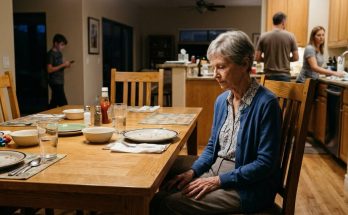
The first time Daniel mentioned the house, he brought it up during an ordinary evening at home.
I was clearing the dinner dishes.
Renee was sitting at the table with her phone, and Daniel had settled into his chair after work.
He started talking about a property they had seen.
It was an older craftsman-style house on Willow Creek Lane.
I didn't know the street particularly well, but I listened while he described it.
Four bedrooms.
A broad front porch.
Large trees that shaded the yard.
It sounded like the sort of house that had been standing long enough to become part of its neighborhood.
Renee looked up from her phone.
She had apparently been thinking about the property all day.
She began explaining what she liked about it.
There was room for the children to grow.
There was enough space for the family to spread out.
The layout had possibilities.
She talked about the porch and the trees as if she could already picture herself sitting there.
Daniel nodded along.
He seemed excited in a way I hadn't seen for a while.
I was glad for him.
A home can represent more than walls and a roof.
It can represent the belief that your life is moving in the right direction.
I understood that feeling.
I had once looked at a house and imagined years of happiness inside it.
I knew how quickly ordinary rooms could become important.
So when Daniel and Renee talked about the place, I listened.
I asked a few questions.
They answered them eagerly.
The children joined in.
They wanted to know which bedroom would be theirs.
They started imagining where their things would go.
Renee told them not to get ahead of themselves.
But she was smiling when she said it.
They went to see the house again.
Then they went a third time.
Each visit seemed to make them more attached to the idea of living there.
The conversations became more detailed.
Renee began working through the numbers.
She made spreadsheets and compared costs.
Daniel looked at mortgage figures and discussed what they could afford.
They talked about the price, the payments, and the financial decisions they would have to make.
Sometimes I heard them talking while I prepared dinner.
Other times, the subject came up at the table.
The house had become part of their daily conversation.
I learned the details without trying.
I knew it had four bedrooms.
I knew the porch was one of Renee's favorite features.
I knew Daniel thought the property would be a good long-term choice for the family.
I knew the children had begun assigning rooms to themselves.
I also knew how badly they wanted it.
There was something almost touching about watching them imagine a future together.
I didn't begrudge them that.
I wanted Daniel to be happy.
I wanted Renee to have the home she had been picturing.
I wanted my grandchildren to have a place where they could grow up with good memories.
I had spent years wanting those things for my son.
That part of motherhood never seemed to end.
But there was another feeling beneath my happiness for them.
I noticed it when they talked about the extra space.
I noticed it when Renee described how much easier family life would be with a different layout.
I noticed it when Daniel mentioned the children's growing needs.
Each time, I wondered where I would fit into that picture.
I didn't ask.
I knew better than to turn their excitement into a discussion about me.
Besides, they had not yet bought the house.
There was no reason to create a problem before one existed.
So I kept my thoughts to myself.
I made the lunches.
I drove the children to their activities.
I folded the clothes and put away the dishes.
Their plans continued around me.
Then, one evening, Daniel came home with disappointing news.
The house had been sold.
A buyer had made an offer in cash, and the transaction had moved ahead before Daniel and Renee could secure the property.
I heard about it while I was in the kitchen.
Renee was upset.
Daniel sounded frustrated.
They went over the details again, trying to understand how they had lost their chance.
They had visited the house three times.
They had run the numbers.
They had spent hours imagining how it would work for them.
And now somebody else owned it.
I didn't have anything useful to say.
I told them I was sorry.
Renee shook her head.
Daniel went quiet.
The children seemed disappointed too, although I don't know whether they fully understood what had happened.
For the next several weeks, the house kept coming up.
Someone would mention the porch.
Someone else would wonder what the new owners planned to do with the place.
Renee talked about the layout.
Daniel returned to the financial calculations, as though there might still be a way to make the loss feel less final.
They had wanted that house.
They had pictured their lives inside it.
And then, in a matter of days, it had become somebody else's future.
I watched them deal with the disappointment.
I didn't realize how important that detail would become.
At the time, it was simply something that had happened to my family.
Their dream had slipped away.
My own life continued much as before.
I had routines now.
I knew which days were busiest and when I would have a little time to myself.
I knew where to sit in the living room without being in anybody's way.
I knew how to move around the kitchen while someone else was trying to get ready for work.
I had learned the household so well that I rarely needed to ask where anything belonged.
There was comfort in that knowledge.
There was also something sad about it.
I had once known every corner of my own home because I had helped make it a home.
Now I knew every corner of Daniel's house because I had learned how to function inside somebody else's life.
I didn't say that to anyone.
I didn't want to sound ungrateful.
And I still loved my son.
That was what made the situation difficult.
People sometimes imagine that disappointment comes with a clear moment of understanding.
They think you see something terrible and suddenly know what to do.
My experience was different.
I could see the small things that hurt me.
I could hear the way Renee spoke when she was stressed.
I could notice Daniel's silence.
I could feel myself becoming less comfortable in a place where I had once felt welcome.
But those moments did not erase the years of love that had come before them.
Daniel was still the boy I had raised.
I could still remember his childhood voice.
I could still picture him sitting at our old kitchen table, telling Harold about something that had happened at school.
I could still remember the first time he had needed help with something he was afraid to admit he couldn't do.
Those memories did not disappear because he had disappointed me.
They made it harder to know how to respond.
So I carried on.
I told myself that families went through difficult periods.
I told myself that I was an adult and could manage my own feelings.
I told myself that I shouldn't expect to be the center of everybody's attention.
There was truth in all of those thoughts.
But there was also a convenient lie.
I used them to avoid asking whether my place in the family had changed in ways I could no longer ignore.
Then something happened that had nothing to do with the house on Willow Creek Lane.
At least, not at first.
Three months before the dinner that would change everything, I went to a routine doctor's appointment.
There was nothing unusual about the visit.
I had an appointment to keep, so I kept it.
Afterward, I stopped at a gas station.
I can't remember why I chose that particular station.
I may have needed something from the shop.
I may simply have been driving past and decided to stop.
It wasn't an important day.
I had no reason to believe I would remember it years later.
I bought a lottery ticket.
It was an ordinary purchase, made without much thought.
I wasn't a person who spent a great deal of time imagining what I would do with a fortune.
I had lived long enough to know that most things I wanted couldn't be purchased.
Harold couldn't be brought back.
The years we had spent together couldn't be extended.
The house we had shared couldn't be made into the same home simply by finding another property.
Still, I bought the ticket.
Then I went back to my usual routine.
I returned to Daniel's house.
I helped with the children.
I made dinner.
I went to bed.
The ticket stayed with me.
For two days, it meant nothing more than a small piece of paper I hadn't checked.
Then I looked at the numbers.
I was at the kitchen counter when I did it.
I remember that much clearly.
There were ordinary things around me.
The sort of things that belonged in a kitchen where people lived and ate and hurried through their days.
I checked the ticket.
Then I checked it again.
I read the numbers slowly.
I looked away and started over.
For a moment, I wondered whether I had misunderstood what I was seeing.
I checked again.
The numbers matched.
I had won eighty-nine million dollars.
I didn't scream.
I didn't laugh.
I didn't call Daniel into the kitchen.
I stood there with the ticket in my hand, staring at it as if the paper might change if I looked away.
The house around me continued as it had before.
Nothing had moved.
Nobody had noticed.
I was still the same woman who had been making lunches and folding laundry.
Except I wasn't.
Not anymore.
I put the ticket down carefully.
Then I picked it up again.
Eighty-nine million dollars.
I had never seen a number like that attached to my own life.
I thought of Harold.
I wished he had been there.
I wished I could have told him and watched the expression on his face.
I could almost imagine the questions he would have asked.
He would have wanted to know whether I was certain.
He would have checked the numbers himself.
Then, once he believed it, he probably would have sat down and told me not to do anything foolish.
I smiled at that thought.
The smile didn't last.
Because Harold was gone, and I was standing alone in a kitchen that wasn't mine.
I looked toward the hallway.
I could hear movement elsewhere in the house.
The ordinary sounds of my family's day continued around me.
I folded the ticket and put it somewhere safe.
Then I stood very still.
I had been given a choice I had never imagined.
And before I could decide what it meant, I knew one thing.
I could not tell my family.
Not yet.
Click here to continue reading: PART 4: I Kept Packing Lunches After Winning Eighty-Nine Million Dollars, but the Dinner Table Finally Showed Me What I Needed to Know
I Thought Moving In With My Son Would Help Me Survive Losing My Husband, but I Never Asked What It Would Cost Me
Part 3 of 12