Opal didn't answer Nate's question right away.
She reached into her purse and took out a small envelope.
The paper had yellowed with age, and its edges were soft from years of being handled.
She opened it carefully.
Inside was a photograph.
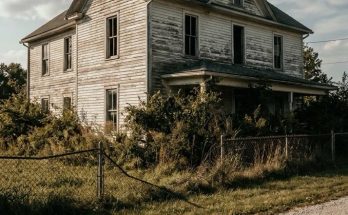
The picture showed Opal as a young woman standing beside Walter in front of the farmhouse.
He wore overalls, and she stood close enough to him that their shoulders nearly touched.
The porch behind them was straight and well maintained.
The shutters were green.
Between them stood a little boy holding a wooden toy tractor.
Nate leaned closer.
“That's Dad.”
Opal nodded.
“He was eleven years old.”
I studied the photograph again.
The child in the picture looked nothing like the man I knew as my father-in-law, at least not in the way I expected.
It was strange to see Ron standing in front of this house, smiling as though the place belonged to a happy childhood he had never shared with his own children.
I had known Ron for years.
He could talk at length about responsibility, work, and the importance of making sensible choices.
He was particularly fond of explaining why people shouldn't expect others to solve their problems.
Yet he had never mentioned that his family once owned nearly sixty acres of land.
He had never told Nate that his grandfather had grown up here.
He had never told us that this farmhouse had been part of their history.
I looked at Opal.
“Why did the property leave the family?”
Her mouth tightened.
“Because Ronald convinced Walter to sign papers he shouldn't have signed.”
Nate sat down.
“What papers?”
Opal rested the photograph on her lap.
“Your grandfather was recovering from a stroke. He wasn't thinking as clearly as he had before, and he depended on other people to help him manage his affairs.”
She paused, rubbing her thumb against the edge of the envelope.
“Ronald told him that the documents would protect the property from creditors.”
I felt a knot form in my stomach.
“And they didn't?”
“They did something very different.”
Opal looked toward the cabinet.
“The papers transferred ownership of the land to a company Ronald controlled.”
For several seconds, I couldn't think of anything to say.
Nate's face had gone blank.
His father had persuaded his own recovering father to sign away control of the family property.
And he had done it under the explanation that he was protecting it.
“Are you saying Dad took Grandpa's land?” Nate asked.
Opal lowered her eyes.
“I'm saying Walter believed he was signing papers to save what he had spent his life building. He later discovered that he had given up control of it.”
Nate leaned back in his chair.
I could see him trying to fit this information into everything he knew about his father.
It wasn't fitting.
“What happened to the company?” I asked.
“Eventually, the property was sold to Harold Miller.”
I glanced toward the window.
The Miller name had appeared on the paperwork connected with our purchase.
Until that moment, I had thought of it as nothing more than the name of the people who had owned the farmhouse before us.
Now it meant something else.
Ron had told the family that the land was lost because of unpaid debts.
According to Opal, that explanation had concealed the truth.
“After Walter died, I found out enough to know that the story wasn't right,” she said.
“Then why didn't you tell anyone?”
The question came out more sharply than I intended.
Opal looked down at her hands.
I immediately regretted my tone.
She was an old woman sitting in a house she had once known as part of her husband's life, explaining a betrayal she had carried for decades.
I had no idea what it had cost her to remain silent.
“I was afraid,” she said.
Her voice was quiet.
“Ronald was my son. I kept thinking that if I pushed too hard, I would lose him.”
She paused.
“Then the years passed, and the longer I stayed quiet, the harder it became to speak.”
I understood the fear, even if I couldn't imagine living with it for forty years.
Still, it was difficult not to think about what that silence had done.
Walter had lost his property.
Opal had kept the truth to herself.
Ron had continued living as though the family's history belonged to him alone to tell.
And Nate had grown up without knowing that his grandfather's home had ever existed.
“Did Grandpa know what Dad had done?” Nate asked.
Opal nodded.
“He found out after the papers were signed.”
“Did he confront him?”
“I know they had a terrible disagreement. Walter never trusted Ronald with his financial affairs again.”
She looked at Nate.
“But by then, the damage had been done. The ownership had changed, the money had disappeared, and your father refused to discuss it.”
Nate rubbed his hands together.
He wasn't angry in the way I expected him to be.
He looked hurt.
That was worse.
His father had spent years presenting himself as the person who understood responsibility, yet his own grandfather had apparently trusted him and suffered because of it.
I thought about the twenty-thousand-dollar checks Ron and Judy had given their other children.
I remembered the card we had received.
At the time, I had told myself that perhaps they thought we were more independent.
Perhaps they assumed we didn't need the same help.
Perhaps there was some explanation that had nothing to do with favoritism.
Now I wondered whether our exclusion had been part of something else.
Had they known we were saving for a home?
Had they known which house we were considering?
Had they recognized the property and hoped we would never look closely at it?
I didn't have answers.
I only had questions, and each one made the room feel smaller.
Opal reached into her purse again.
This time, she took out a small brass key.
A faded red ribbon was attached to it.
She placed it in Nate's open hand.
“I kept this after Walter passed away.”
Nate examined the key.
“What does it belong to?”
“The cabinet your grandfather made.”
He looked toward the built-in shelves.
“You mean this one?”
“Yes.”
Nate stood and crossed the room.
He ran his fingers along the cabinet's lower edge, searching for the lock.
I watched him work.
The key looked so ordinary in his palm that I couldn't understand why Opal had held on to it for so many years.
Then Nate found a small keyhole beneath the lower shelf.
He inserted the key.
It turned.
A soft click came from inside the wood.
He opened the cabinet doors.
There were three narrow drawers behind them.
The first held old receipts and several faded photographs.
The second contained a leather-bound notebook.
The third would not move when he pulled on it.
Nate tried again, using a little more force.
“Something's caught.”
Opal shook her head.
“Look underneath.”
He crouched and felt along the bottom of the cabinet.
His fingers found a small metal lever.
He pressed it.
The drawer slid forward.
Inside lay a brown envelope sealed against the dust of the years.
Three words had been written across the front in faded blue ink.
FOR MY FAMILY.
Nate stared at the handwriting.
Then he turned toward his grandmother.
“Did Walter write this?”
Opal's eyes filled with tears.
“Yes.”
He lifted the envelope carefully.
Whatever his grandfather had left inside that drawer, it had waited longer than Nate had been alive to be found.
And as he began opening it, I had the uneasy feeling that the house we had purchased for $41,500 was about to change everything we thought we knew about his family.
Source: dailytruthhub.com
Click here to continue reading: PART 3: The Letter Hidden Behind the Cabinet Drawer Named Someone We Never Expected, and the Old Survey Pointed Toward Something Beneath the Barn
We Spent Two Years Saving for a House Nobody Wanted, Never Knowing Why My Husband’s Grandmother Was Afraid of What We Had Bought
Part 2 of 8