I used to think that if you worked hard enough, eventually people had to respect you.
I was wrong about that.
Sometimes, the people who watched you struggle were the same ones who preferred you that way.
My husband, Nate, and I learned that lesson slowly, over two years of saving money, turning down invitations, and telling ourselves that we didn't need anyone else's help.
His parents had made their position clear long before we bought our house.
They had three other children, and each of them received twenty thousand dollars from Ron and Judy to help purchase a home.
We received a card.
I remember holding it in my hands, waiting for something else to come out of the envelope.
A check, perhaps.
A note explaining that our help would come later.
Anything that might make the difference between us and the other children feel less deliberate.
There was nothing.
Nate read the card, smiled politely, and thanked his parents.
I stood beside him, trying not to let my face show what I felt.
Later, when we were alone, I asked him why he thought they had done it.
He shrugged.
“They probably think we can manage on our own.”
I wanted to believe him.
It was easier than admitting that his parents had looked at their four children and decided we were the ones who could be left out.
So we managed.
We put money aside whenever we could.
We stopped buying things we didn't need and learned to live with things that were falling apart.
There were weekends when our friends went away and we stayed home because the cost of a trip would have taken another week out of our savings.
We kept going anyway.
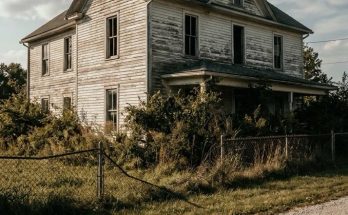
By the time we found the abandoned farmhouse, we had spent nearly every spare dollar preparing for the possibility of owning a place of our own.
The price was $41,500.
Even now, that number stays with me.
Forty-one thousand five hundred dollars for a property most people would have driven past without slowing down.
The house needed work.
The floors were worn, the plaster was damaged, and the plumbing was bad enough that Nate warned me not to get too excited before he had examined it properly.
The barn stood behind the house, partly swallowed by weeds and climbing vines.
Nothing about the place suggested an easy life.
But it was ours.
We had bought it without asking Ron or Judy for a cent.
For the first time in years, I felt that our future belonged to us.
I didn't know then that the house had once belonged to Nate's grandfather, Walter.
I didn't know that the property had been taken out of his family's hands under circumstances that had divided them for decades.
And I certainly didn't know that our purchase would bring an old secret back into the light.
At first, we concentrated on making the house usable.
Nate worked on the electrical panel in the kitchen.
I dealt with the rooms that needed cleaning and sorting, moving old objects aside so we could see what needed repairing.
The house made noises as we worked.
The floorboards creaked under our feet, and the wind slipped through places where the windows no longer fitted properly.
It was tiring, but the work felt worthwhile.
Then Opal arrived.
She was Nate's grandmother, an elderly woman who had lived long enough to recognize things the rest of us overlooked.
She stood on the porch and looked at the house as if she had been waiting years to see it again.
When I took her hand, she held mine more tightly than I expected.
“I'm glad you bought this place,” she told me.
I smiled.
“We're glad we found it.”
Her expression changed.
She looked past me toward the barn.
Then she turned back and spoke in a voice that made me stop smiling.
“You need to be careful about who finds out what you've bought.”
I didn't understand.
“Who would be upset about us buying an old farmhouse?”
Opal didn't answer immediately.
She studied my face, then glanced toward the road.
“Your father-in-law.”
I almost laughed because the idea seemed so strange.
Ron had never shown the slightest interest in our plans.
He hadn't offered to help us buy a house, and he had certainly never mentioned this property.
“Why would Ron care about this place?”
Opal's fingers tightened around mine.
“Because there's a reason he never wanted this house discussed.”
I waited for her to explain.
She didn't.
Instead, she asked me to help her inside.
I took her arm and guided her over the uneven walkway, watching her feet as she made her way toward the door.
Nate was still in the kitchen, crouched beside the open electrical panel.
He looked up when we entered.
“Grandma? I wasn't expecting you.”
Opal smiled at him.
“You've surprised me, too.”
Nate laughed.
“Hopefully in a good way.”
“I'll decide that after I see what you've done to the place.”
He wiped his hands on a rag and stood.
“You should know that the plumbing isn't going to impress you.”
“I didn't come here to inspect your plumbing.”
Something in her voice made him stop smiling.
She moved slowly through the room, taking in the walls and the old staircase.
Then she looked toward the dining room.
Her eyes settled on a wooden cabinet built into the wall.
I had noticed it before, but I had assumed it was simply part of the house.
The cabinet had decorative molding around its doors, and its dark wood looked older than most of the furniture we had found.
Opal approached it carefully.
Her fingertips moved along the edge.
“Walter built this himself,” she said.
Nate frowned.
“Grandpa built it?”
“Long before you were born.”
She continued looking at the cabinet.
“Long before your father married your mother, too.”
I looked from her to Nate.
“Why would your grandfather have built something here?”
Opal turned toward us.
“Because this was his home.”
The words settled over the room.
Nate stared at her.
“What do you mean?”
She lowered herself into one of our folding chairs.
“Walter grew up here. His parents owned this land, and it was once much larger than what you see today.”
“How much larger?” I asked.
“Nearly sixty acres. The farmhouse, the barn, the orchard, and the creek were all part of it.”
Nate looked toward the window.
He had spent the previous day walking around the property, measuring what needed to be repaired and deciding where to begin.
He had never imagined that the boundaries we knew represented only a fraction of what had once belonged to his family.
“Dad never told me any of this,” he said.
Opal looked at him for a long moment.
“No. He made sure you never heard it.”
That was when I understood that we weren't having an ordinary conversation about an old house.
Opal had not come to admire our purchase.
She had come because she knew something about it, and whatever that knowledge was, she had carried it for a very long time.
Nate pulled a chair toward her.
“Grandma, what happened here?”
She folded her hands over the handle of her cane.
“Your grandfather died believing this land would one day come back to the family.”
She paused.
“He trusted your father to make that happen.”
I felt Nate go still beside me.
“Then why didn't it?”
Opal looked at her grandson.
And for the first time since she had entered the house, she looked frightened.
Source: dailytruthhub.com
Click here to continue reading: PART 2: An Old Photograph Revealed the Home My Husband’s Father Had Hidden From Us, Along With a Betrayal That Began After a Stroke
We Spent Two Years Saving for a House Nobody Wanted, Never Knowing Why My Husband’s Grandmother Was Afraid of What We Had Bought
Part 1 of 8