Ron and Judy did not leave immediately.
They stayed in the kitchen while Nate arranged the documents on the table.
The letter went beside the notebook.
The survey lay beneath both.
The broken chain rested near the edge, its metal links dark with age.
It was an odd collection of things to find in a house we had owned for less than a day.
Ron kept looking at the letter.
Judy kept looking at Opal.
Nobody seemed willing to be the first person to speak.
Finally, Nate broke the silence.
“I'm going to keep copies of all this.”
Ron nodded stiffly.
“You can do what you want.”
“I intend to.”
Nate looked at him.
“But I want you to understand something. I'm not going to pretend I never saw that letter just because it makes you uncomfortable.”
Ron rubbed his jaw.
“You have no idea how complicated this was.”
“Then tell me.”
His father looked toward the window.
“I can't explain everything in one conversation.”
“I'm not asking you to.”
Nate tapped the notebook.
“Start with what you know.”
Ron said nothing.
Judy shifted in her chair.
“We need to think about what happens next.”
I looked at her.
“We've been thinking about it all afternoon.”
She flinched.
I hadn't meant to sound so sharp, but I was tired of the careful language.
Everyone kept talking about what might happen if we asked questions.
Nobody seemed concerned about what had already happened to Walter.
Opal sat quietly near the dining room doorway.
She looked older than she had when she arrived.
I wondered whether telling the truth had relieved her or simply made her feel the weight of all those years more clearly.
Nate turned to his grandmother.
“Do you remember anything else Grandpa said about the property?”
She thought for a long time.
“He believed the land was worth more than the money people saw in it.”
Nate looked at the survey.
“What did he mean?”
“I don't know. He loved that place. He knew every fence line, every tree, and every patch of ground that flooded after heavy rain.”
She smiled faintly.
“He could tell you which part of the orchard produced the sweetest apples.”
I looked through the window toward the overgrown trees near the yard.
The orchard was still there, though it had been neglected.
A few branches leaned over the old fence.
I had walked past them that morning without giving them much thought.
Now I wondered how many years Walter had spent tending those trees.
How much of his life had been tied to the property.
How difficult it must have been to learn that the land he trusted his son to protect had been transferred away from him.
Opal looked at Nate.
“He wanted you to have a chance to know where you came from.”
Nate lowered his eyes.
“I wish he'd told me himself.”
“So do I.”
For a while, we returned to the records.
The notebook contained more than a list of expenses.
It included descriptions of the property's boundaries and notes about the land beyond the creek.
Some entries were difficult to read because the ink had faded.
Others were clear enough to show how carefully Walter had kept track of what belonged to him.
Nate compared the survey with the paperwork from our purchase.
The difference was striking.
The house and its eight acres were only a small section of the original property.
The rest had been divided over time.
We didn't know who owned all of it, and the documents in front of us didn't answer that question.
Still, the survey showed that Walter had been careful to record the land as he understood it.
Nate photographed each page.
I checked the pictures afterward to make sure the writing was visible.
We weren't trying to prove anything that afternoon.
We were preserving what we had found.
There was a difference.
Ron watched us from the other side of the table.
At one point, he reached toward the survey.
Nate moved it out of his reach.
“Please don't.”
Ron pulled his hand back.
“You're making this more difficult than it needs to be.”
Nate looked at him.
“It's already difficult.”
His father had no response.
Judy rose and walked toward the window.
She stood looking at the barn.
I joined her.
“Why did you warn us not to dig there?”
She didn't turn around.
“Because I knew your grandfather had kept something out there.”
“What did you think it was?”
“I didn't know.”
“Did you know what he was trying to protect it from?”
She pressed her fingers against the windowsill.
“Your father was determined to find whatever Walter had left behind.”
I turned toward her.
“When?”
Judy finally faced me.
“After Walter died.”
The answer made my stomach tighten.
“You knew he was looking?”
She nodded.
“I knew he wanted to find something. I never knew whether he succeeded.”
“Then why didn't you tell us?”
She looked down.
“Because I hoped the whole matter would stay in the past.”
I thought of the warning on my phone.
She hadn't wanted us to dig because she was afraid we might disturb something.
She had wanted us to stop because she knew the barn was connected to a secret that had never been resolved.
I couldn't tell whether she was protecting Ron, protecting herself, or trying to prevent us from repeating an old mistake.
Perhaps she didn't know herself.
I went back to Nate.
He had finished photographing the notebook.
He placed it beside the letter and looked toward Opal.
“Grandma, do you think Grandpa left something valuable beneath the barn?”
Opal considered the question.
“I think he left something he believed was important.”
“That isn't quite the same thing.”
“No,” she said. “It isn't.”
Ron stood abruptly.
“We're leaving.”
Judy turned from the window.
“Ronald—”
“We've said enough.”
He picked up his keys.
Nate didn't try to stop him.
But before Ron reached the door, he spoke.
“If you find anything out there, don't assume you understand what it means.”
Nate looked at him.
“Then you should explain it now.”
Ron shook his head.
“I can't.”
“Or you won't?”
His father stopped.
For a moment, I thought he might finally tell us something.
Instead, he opened the door.
Judy lingered behind him.
She looked at Opal, then at Nate.
“I never wanted this to happen.”
Opal's expression remained firm.
“But it did.”
Judy nodded.
She left without saying anything else.
The SUV rolled down the gravel driveway and disappeared along the road.
Nate stood at the window until we could no longer hear it.
Then he turned back to the table.
I went to him.
“What do you want to do?”
He looked at the survey.
“Find out what Grandpa was protecting.”
I thought about the broken chain, the open doors, and the fresh tire tracks.
“We can't assume whoever went in there has already found it.”
“No.”
“And we can't assume it's still there.”
He nodded.
“We need to understand the property before we do anything else.”
For the rest of the afternoon, we organized the photographs and put the original papers away.
We didn't go back into the barn.
We didn't dig.
We didn't pretend that an old drawing was enough to explain what Walter had hidden.
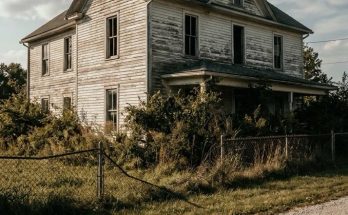
But we stopped treating the farmhouse as nothing more than a cheap house that needed repairs.
It had become a place where the past had left evidence.
And we had a responsibility to understand it before someone else decided what we were allowed to know.
Source: dailytruthhub.com
Click here to continue reading: PART 8: The House We Bought for Ourselves Forced the Family to Face What Had Been Hidden, and I Finally Understood Why the Card Had Hurt So Much
We Spent Two Years Saving for a House Nobody Wanted, Never Knowing Why My Husband’s Grandmother Was Afraid of What We Had Bought
Part 7 of 8

One Comment on “PART 7 – We Stopped Treating the Farmhouse as a Lucky Purchase and Began Looking at the Records Walter Had Left for His Family”