The first thing I noticed about the orchard after the hearing was how quiet it seemed.
I had spent weeks looking at the empty branches and thinking about what had been taken. Now, with the legal matter settled, I was finally able to look at the trees themselves.
They were still alive.
The trunks stood firm, and the roots had years of growth beneath them. Daniel had chosen hardy varieties and taken care to establish them properly.
He had always said that a good orchard required patience.
You couldn't force a tree to produce before it was ready.
You couldn't neglect it for months and expect it to reward you simply because you wanted fruit.
I had heard those words many times without thinking much about them.
Now I found myself repeating them as I walked between the rows.
The season was changing.
The days grew shorter, and the air smelled of damp soil and fallen leaves. The few apples that had escaped Monica's hands were gone, and I had cleared the damaged fruit from beneath the trees.
There wasn't much to do until spring.
Still, I checked the branches every few days.
I wanted to see signs of new growth, though I knew the trees wouldn't show me much yet.
Daniel's notebook became part of my routine.
I kept it on the kitchen table and opened it whenever I had a question about a tree. Sometimes I found an answer. Sometimes I found another small note in the margin that reminded me of something Daniel had said.
The handwriting made me feel close to him.
It also reminded me that he had planned for a future he wouldn't see.
I wasn't ready to put the notebook away.
At work, I tried to return to my ordinary responsibilities. I had been away for Daniel's funeral and the days afterward, and there were tasks waiting for me.
People asked how I was doing.
I learned to answer without making them uncomfortable.
"I'm getting through it."
Most accepted that.
A few stayed long enough to listen when I said more.
I appreciated them, though I rarely knew what to say in return.
At home, Ben and I settled into a routine that didn't feel like ours yet. We made dinner, checked homework, and set out clothes for the next morning.
Sometimes he mentioned his father without warning.
A tool Daniel had left in the shed.
A joke he'd told at breakfast.
A plan they'd made for the next season.
I let him talk.
I didn't try to turn every memory into something uplifting. Sometimes we laughed. Sometimes neither of us could finish what we were saying.
The orchard stayed in our conversations.
One evening, Ben asked whether we would give apples away again if the trees produced enough next year.
I looked up from the dishes.
"Do you want to?"
He shrugged.
"Dad always did."
"Yes, he did."
"Then I think we should."
I dried my hands on a towel.
"We'll see how much work it is. I can't do everything your dad did by myself."
Ben nodded.
"I can help."
I believed him, though I knew there were limits to what a child could manage.
Still, his answer gave me something to think about.
Daniel's tradition had never been about the amount of fruit one person could carry.
It had been about sharing what the trees gave us.
Maybe that part could continue, even if the work looked different.
A few days later, I found myself standing beside the side gate again.
The marks Monica's ladder had left were no longer as clear. Rain had softened the soil, and the flattened grass had begun to rise.
I ran my hand along the fence.
I didn't feel the same rush of anger I'd felt when I first discovered the theft.
The memory was still there, but it no longer filled every inch of my attention.
I could think about Monica without seeing her only as the woman in the photographs.
I knew she had a job to find, a fine to pay, and a house she was trying to keep. I didn't know how those things would work out.
I didn't ask Rachel for updates.
That wasn't because I didn't care.
I simply understood that Monica's problems belonged to her, and I couldn't take them on as if they were another part of my own grief.
If she needed help, she would have to learn to ask.
I had said that to her.
Now I needed to let the words stand.
One afternoon, I called the county extension office.
It was a place I'd known about for years, and Daniel had occasionally spoken to people there about caring for the trees.
I explained that my husband had died and that I was trying to maintain an orchard on my own.
I asked what programs might be available to help a homeowner who was struggling with the upkeep of fruit trees.
The person I spoke to was patient.
She asked questions about the size of the orchard, the varieties we grew, and the kind of help I needed.
I answered as best I could.
She explained that there were local resources and people who might be able to offer advice.
We talked through what would need to happen before spring.
I wrote the details in Daniel's notebook.
It felt strange to add my own handwriting to his pages, but I left a little space beneath his last entry and made a careful list.
I could almost hear him telling me not to write so close to the edge.
That evening, I sat on the porch with a cup of tea.
The wooden chair Daniel had used was beside me. I had cleaned it and moved it back to its usual place, facing the street.
For years, he had sat there after finishing his work, watching neighbors pass and stopping to talk whenever someone slowed down.
I used to think he simply enjoyed knowing everyone's business.
Now I understood that he had been making himself available.
He had left room for people to approach him.
There was a difference between that and waiting for someone to prove they deserved kindness.
I looked toward Monica's house.
Her curtains were drawn, and I couldn't see whether she was home.
I wondered whether she was still embarrassed to walk outside.
I wondered whether the neighbors had stopped talking about the incident.
I hoped they had.
I didn't want her to be publicly punished forever. The court had dealt with the theft, and I had made my own decision about repayment.
That was enough.
It didn't mean the photographs had been a mistake in every respect.
They had shown the truth, and the truth had mattered.
But I no longer wanted the display to be the thing people remembered about that season.
I wanted them to remember Daniel.
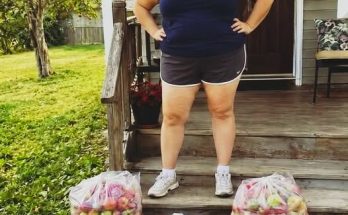
The bags of apples.
The wheelbarrow.
The way he knocked on every door and never made anyone feel small for accepting what he offered.
I sat there until the tea went cold.
Then I carried the cup inside and set it beside the sink.
The next morning, I returned to the orchard.
I checked the trees one by one, following the map Daniel had drawn. I looked for damaged branches and made notes about the work that would be needed when the weather warmed.
I couldn't do everything alone.
That fact was no longer something I felt ashamed to admit.
I would need advice. I would need help with the heavier work. I would need to ask questions rather than pretend I knew everything.
Daniel had left me the trees, but he had also left me a neighborhood full of people who knew what they meant.
I wasn't ready to ask everyone for help.
Not yet.
But I was beginning to understand that accepting it didn't diminish what I'd lost.
It gave me a way to keep going.
Source: gostoryusa.com
Click here to continue reading: PART 8: When the Trees Began to Blossom Again, I Learned That Keeping Daniel’s Tradition Meant Opening My Door and Letting Other People In
Twelve Days After I Buried My Husband, I Walked Into His Orchard and Realized Someone Had Taken Everything He Left Behind
Part 7 of 12