The next morning, I woke before the alarm.
The house was quiet, and the kitchen still smelled faintly of apples. I made coffee and stood by the window, looking toward the orchard.
The trees were almost bare.
A few leaves remained, clinging to the branches, and the grass beneath them was scattered with fallen ones.
The harvest was over.
I should have felt relieved.
Instead, I felt the familiar ache of missing Daniel, sharpened by the knowledge that another season had passed without him.
I carried my coffee to the table and opened his notebook.
The pages were full of dates, sketches, and small reminders. My own notes had begun to fill the spaces he had left blank.
I ran my finger over the map of the orchard.
Every tree had a place.
Every variety had a season.
Daniel had planned for years of harvests, even though he could never have known how many he would live to see.
I thought about the bags Monica had carried the previous afternoon.
I thought about Mr. Patterson recognizing Daniel's tradition in the apples she held out.
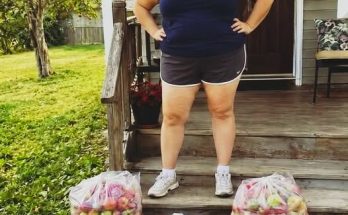
And I thought about the two bags left on the final porch.
I had watched Monica place them there.
She hadn't known whether anyone would answer the door, but she'd left the fruit anyway.
That was something Daniel would have understood.
He had done the same thing for twenty years.
He had left bags for people who never came outside, including Monica herself. He hadn't demanded a conversation or waited for a thank-you.
He had simply made sure the apples were there.
I closed the notebook.
Then I looked toward the porch.
Daniel's old chair stood beside the door, where I had moved it after the weather turned cold. I carried my coffee over and sat down.
From there, I could see the orchard and the street beyond it.
The neighborhood was beginning its day.
A car pulled away from a driveway. Someone opened a garage door. A dog barked twice and went quiet.
Ordinary sounds.
I had once believed that losing Daniel meant losing the ordinary life we'd built together.
I had thought the orchard would become another responsibility I couldn't manage, another place where his absence would make every task harder.
In some ways, that was true.
I still had to do the work.
I still had to make decisions he would once have made without thinking.
I still had to answer Ben's questions when I didn't have answers of my own.
But the harvest had shown me something I hadn't understood before.
Daniel's tradition wasn't held together by his hands alone.
It lived in the people who remembered him.
Mr. Patterson remembered the bags of apples he'd received every October. Mrs. Alvarez remembered Daniel teaching her grandchildren to pick fruit. Ben remembered how his father had shown him to turn an apple gently instead of pulling it from the branch.
And now Monica had carried those memories into another season.
She had made a mistake that hurt us.
She had lied about it, and she had faced the consequences.
None of that had disappeared.
But she had also chosen to return to the orchard, do the work, and share what she had once taken.
I couldn't say what Daniel would have thought about all of it.
I could only remember how he had lived.
He had never treated kindness as a reward for good behavior.
He had never believed that people had to be perfect before they deserved help.
He had simply offered what he could.
I took a sip of coffee.
It had gone cold.
I went inside to warm it, then checked my phone.
There was a message from Rachel.
She thanked me for allowing Monica to help with the harvest. She said her mother had come home tired but seemed lighter than she had in months.
I read the message twice.
Then I replied that Monica had done good work and that I was glad she had come.
I didn't write anything about forgiveness.
I didn't need to.
Rachel sent a simple thank-you.
I set the phone down.
A little later, Ben came into the kitchen and asked whether we had any apples left.
I told him there were plenty.
He opened the bowl on the counter and chose one with a small mark near the stem.
"Can I have this one?"
"Of course."
He took a bite and sat at the table.
I watched him for a moment.
"Do you remember what Dad used to say about the harvest?"
Ben chewed thoughtfully.
"That we couldn't eat all of them ourselves."
I smiled.
"That's right."
He looked at the bowl.
"Are we going to do it again next year?"
I looked out toward the orchard.
The trees would need pruning, and the soil would need attention. There would be work to do before the next season arrived, and I would have to ask for help again.
I wouldn't always know what I was doing.
Some days would be harder than others.
But I knew the answer.
"Yes," I said. "We'll do it again."
Ben nodded and returned to his apple.
After breakfast, I went outside to check the shed.
The ladders were stored safely against the wall. The baskets were clean and stacked in their usual place. Daniel's tools sat in the drawer where he'd kept them.
I checked the latch and made sure the door closed properly.
Then I walked to the first tree.
I rested my hand against the trunk.
The bark was rough beneath my palm.
"I think we managed," I said.
I didn't expect an answer.
I stood there for another minute, then returned to the house.
That afternoon, I passed Monica's place while taking out the rubbish.
She was in her front yard, gathering a few fallen branches into a small pile. When she saw me, she straightened.
"Good morning," she said.
"Morning."
She hesitated.
"Rachel told me she messaged you."
"She did."
Monica looked toward the street.
"I wanted to say that I appreciate you letting me help. I know I don't have any right to expect things to be normal between us."
I considered her words.
"You don't have to keep apologizing every time we speak."
She looked at me, surprised.
"I still mean it."
"I know."
I shifted the rubbish bin beside the garage.
"But if you want to make things right, keep doing what you did this weekend."
She nodded slowly.
"Help when you can?"
"And ask when you need help."
She looked down.
"That's the harder part."
"I know."
We stood in the quiet for a moment.
Then she said, "I'm trying."
I believed her.
That didn't mean I trusted her with everything. It didn't mean I had forgotten the empty orchard or the photographs on my lawn.
Trust would have to grow slowly, if it grew at all.
But I no longer needed to keep her at a distance simply to prove that what she had done was wrong.
The court had addressed the theft.
I had made my decision about the fruit.
The rest belonged to the days ahead.
I nodded toward the branches she had gathered.
"Those look heavy."
"They are."
"Do you need a hand?"
She seemed caught off guard.
For a moment, I saw the old instinct rise in her face. The quick refusal. The desire to insist that she could manage alone.
Then she looked at the pile again.
"Actually," she said, "yes. If you have a minute."
I went to her yard.
We worked together, carrying the branches to the side of her house. There wasn't much to it, and we finished quickly.
When we were done, she thanked me.
I told her it was nothing.
But it wasn't nothing.
It was a small thing, the kind of thing neighbors did without keeping track of who owed whom.
I went home afterward and put the kettle on.
As I stood in the kitchen, I remembered the two bags Monica had left on that quiet porch.
I had wondered why she left two instead of one.
Now I thought I understood.
She had finally begun to see that the point wasn't to make sure every person received exactly the same amount or to measure whether someone deserved what was offered.
The point was to leave something good behind, even when no one was there to thank you.
That was what Daniel had done for years.
He had left apples for people who opened their doors and people who didn't. He had shared with the neighbors who thanked him and with the one who never did.
He hadn't been foolish.
He had been generous.
I had mistaken the difference before, too.
Not in the same way Monica had, but in smaller ways. I had sometimes worried about whether people appreciated what Daniel did. I had wondered why he kept giving to those who never acknowledged it.
He never seemed troubled by those questions.
He simply kept going.
Now I understood that his generosity had never depended on being recognized.
It had been a way of living.
That evening, I opened the notebook one last time before putting it away for the night.
I looked at the map, the dates, and the notes about next year's work.
Then I turned to the page where I had written my own reminder.
Ask for help before you need it.
I left the notebook open on the table.
There would be more work in the spring. There would be more decisions, more difficult days, and more moments when I wished Daniel were standing beside me.
I couldn't change any of that.
But I could keep the orchard alive.
I could teach Ben what his father had taught him.
I could share what we had enough of.
And when someone needed help, I could leave the door open long enough for them to ask.
I turned off the kitchen light and went upstairs.
Outside, the orchard stood quiet beneath the night sky.
The trees had given us what they could.
The rest was up to us.
Source: gostoryusa.com
The End
Read more original stories on Feel Every Story.
Twelve Days After I Buried My Husband, I Walked Into His Orchard and Realized Someone Had Taken Everything He Left Behind
Part 12 of 12