I heard the knock a little after lunch.
I had been standing at the kitchen counter, turning Daniel's orchard notebook over in my hands, trying to decide where it belonged.
The desk in his office seemed too far away.
The kitchen table seemed too crowded.
So I had carried it from one place to another without putting it down for good.
Then came the knock.
I looked toward the front door.
For a moment, I thought it might be Rachel again. She had left the previous morning with the foreclosure papers tucked under her arm and a look on her face I couldn't forget.
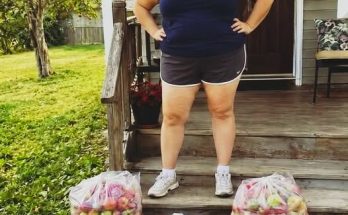
But when I opened the door, Monica stood on the porch.
She had no bags with her.
No ladder.
Nothing to hide behind.
Her hands hung at her sides, and she kept her eyes on the wooden boards beneath her shoes.
"Claire," she said.
Her voice was quieter than I'd ever heard it.
I waited.
"I'm sorry."
The words came out in a rush, then she stopped as if she'd used up everything she had prepared to say.
I could have made her explain herself right there.
I could have asked whether she was sorry for taking the apples or for being caught. I could have asked why she had lied to Rachel, why she had climbed over my fence, or why she'd decided that Daniel's death made his property available to anyone who wanted it.
Instead, I stepped back.
"Come inside."
She hesitated before crossing the threshold.
I closed the door behind her.
The house was quiet. Ben was at school, and the washing machine had finished its cycle a few minutes earlier. The only sound was the clock above the refrigerator.
Monica stood near the kitchen doorway.
"Would you like some coffee?" I asked.
She looked surprised.
"Yes, please."
I took two cups from the cupboard.
Daniel's favorite mug was still on the counter, the one with the chipped blue rim. I had washed it several times without using it, and now I moved it carefully to the side before pouring the coffee.
Monica watched me.
"I shouldn't have come here expecting you to make me comfortable," she said.
"I didn't ask you to be comfortable."
She nodded.
I set her cup on the table.
Then I brought Daniel's notebook from the counter and placed it between us.
Monica looked down at the worn cover.
"What's that?"
"His records of the orchard."
I opened it to the first page.
The handwriting was unmistakably Daniel's. His letters leaned slightly to the right, and he always drew a firm line beneath dates he considered important.
I showed Monica the planting records.
The first trees had gone into the ground the year Ben was born. Daniel had written down the varieties, the spacing between each tree, and the dates he expected them to begin producing fruit.
"He kept track of everything," I said.
Monica turned a page.
There was the map he had drawn of the orchard, with each tree marked in its place.
She ran one finger along the edge of the paper without touching the writing.
"He really did this every year?"
"Every year."
I showed her the notes about pruning and the small reminders he'd added beside the trees that needed extra attention.
Then I turned to the last page.
Daniel had marked the expected picking dates for this season. Beside one variety, he'd written that the apples looked especially good.
Monica stared at the note.
For a long time, she didn't speak.
I watched her face, trying to understand what she was thinking.
She had seen the fruit hanging from those branches. She had seen a way to make money.
She hadn't seen all the work that had come before it.
Or perhaps she had seen it and decided it didn't matter.
I couldn't know.
I turned the notebook toward her.
"There was something else I wanted you to see."
She looked up.
"For twenty years, Daniel left a bag of apples on your porch."
Her mouth tightened.
"I know."
"Every October."
"I know, Claire."
"He never said anything bad about you for not answering the door."
Monica lowered her eyes.
"He always thought you might be busy. Or that you didn't hear him knock."
I paused.
"Sometimes I thought he was making excuses for you."
A faint, painful smile crossed her face.
"He probably was."
She wrapped both hands around her coffee cup.
"I remember those bags," she said.
I waited for her to continue.
"I saw them when I came home. Sometimes I'd bring them inside, and sometimes I'd leave them on the porch until I couldn't pretend I hadn't seen them anymore."
"Why didn't you thank him?"
She looked toward the window.
"Because I thought accepting something for free meant I owed someone something."
I didn't interrupt.
"My husband left years ago," she continued. "After that, I decided I wasn't going to depend on anybody again. I told myself I could manage everything on my own."
Her fingers tightened around the cup.
"If someone offered me help, I found a reason to refuse it. If someone gave me something, I worried about what they'd expect in return."
She looked down at Daniel's notebook.
"I thought I was protecting myself."
I had spent years thinking Monica was simply unfriendly.
I had seen the closed door, the sharp replies, the way she rarely stopped to talk when we met outside.
I had never wondered what might be behind any of it.
That didn't make what she'd done acceptable.
But it made the woman sitting across from me harder to dismiss as someone who had always been cruel.
"Why didn't you ask for help when you lost your job?" I asked.
She gave a small, humorless laugh.
"Because then I'd have to admit I couldn't do everything myself."
"And taking the apples didn't require you to admit anything?"
She flinched.
"No."
The answer came quickly.
Then she looked at me.
"It was easier to tell myself they would go to waste. I knew you were grieving. I knew you had other things to think about."
Her voice grew thinner.
"I told myself you wouldn't miss them."
I felt anger rise again, sharp and familiar.
"They were Daniel's last harvest."
"I know that now."
"You knew he was gone."
She nodded.
"I knew."
The room fell silent.
I could have told her that those two facts should have been enough. I could have said that grief didn't make me blind, and it certainly didn't make my property hers.
But she already knew the words I might have used.
Her face had changed since she came in. The defensiveness I'd seen in the yard was gone, replaced by something I couldn't quite name.
She looked exhausted.
"I was wrong," she said.
It wasn't an excuse.
It wasn't a request to withdraw the police report.
For once, she wasn't telling me what I should do about her mistake.
She was admitting it.
I sat back in my chair.
"Monica, sharing something isn't the same as giving it to someone who takes it."
"I know."
"Daniel gave those apples away because he wanted to."
She nodded.
"He never wanted anyone to feel indebted to him."
I glanced at the notebook.
"He just liked knowing people had enough to eat."
Monica began to cry.
She tried to stop herself, wiping her face with the heel of her hand. That only made her look more upset.
I didn't reach across the table to comfort her.
Not yet.
She had come here to apologize, and I needed her to understand that I wasn't going to make the conversation easier by pretending the theft hadn't happened.
After a while, she took a breath.
"I'm losing the house," she said.
"I know."
"Rachel told you."
"She showed me the notices."
Monica stared at her coffee.
"I didn't want her to know how bad it was."
"She loves you."
"I know that, too."
She looked toward the front door.
"I kept thinking I could fix it before anybody found out. I sold things. I stopped buying things I didn't need. I told myself another month would be enough to catch up."
She shook her head.
"Then I lost the job, and there wasn't another month."
I thought about the three months of missed payments on the papers Rachel had brought.
I thought about how many decisions a person could make while telling herself there was still time.
Then I thought about the ladder against my fence.
"You could have come here," I said.
Monica nodded.
"I should have."
"I would have given you apples."
She pressed her lips together.
"I know."
"I could have paid you to help pick them. There was more work than I could do alone, especially this year."
She looked at me then.
For the first time, she seemed to understand what she had passed up.
Not just the fruit.
A chance to ask.
A chance to be helped without having to steal something first.
"I don't know how to do that," she whispered.
"Do what?"
"Ask."
I looked at her for a moment.
"Then you need to learn."
She wiped her cheeks.
"I don't know if I can."
"You're here, aren't you?"
She glanced at the door, then back at me.
A small nod.
I wasn't ready to tell her everything would be fine.
I wasn't sure it would be.
Her house was still at risk. The police report was still active. The apples were gone, and Daniel wasn't coming back to plant another season.
But she had walked through my front door without pretending she owned what was inside.
That mattered.
We sat for a while longer.
I showed her a few more pages in the notebook, including the dates Daniel had marked for the varieties that ripened early.
She asked questions about the trees.
I answered them.
For a little while, we spoke about something other than the theft.
When Monica finally stood to leave, she paused beside the kitchen table.
"I don't expect you to forgive me today," she said.
"Good."
She looked startled, then seemed to understand that I wasn't trying to hurt her.
"I can't promise you anything about what happens next," I added. "The report is still there, and you'll have to answer for what you did."
"I understand."
"But I'm not going to ask for the value of the fruit."
She nodded.
"Thank you."
"Don't thank me yet."
She looked at me.
"If you want things to change, you have to stop waiting until you're desperate to tell someone the truth."
Monica swallowed.
"I'll try."
She walked to the front door.
I followed her to the porch and watched her go down the steps.
She didn't look back at the orchard.
She didn't look toward the empty stretch of fence where the ladder had stood.
She simply walked home.
When I closed the door, I returned to the kitchen and sat beside Daniel's notebook.
I had expected her apology to settle something inside me.
It didn't.
But it changed the shape of my anger.
I could see the person who had made the choice, not just the choice itself.
And I knew that whatever happened next, I would have to live with my own decisions, too.
Source: gostoryusa.com
Click here to continue reading: PART 6: The Judge Had to Hear What Monica Did, but I Refused to Let the Worst Day of Her Life Become the Only Thing About Her
Twelve Days After I Buried My Husband, I Walked Into His Orchard and Realized Someone Had Taken Everything He Left Behind
Part 5 of 12