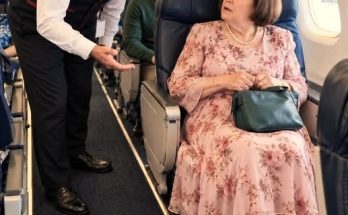
I thought my grandmother was being difficult.
That was the truth, and I have spent a long time wishing I had understood her better before that afternoon.
I had paid for her first-class seat myself. It was supposed to be part of her birthday present, something comfortable after years of her insisting that other people deserved the better things in life more than she did.
She had thanked me when I bought the ticket.
Then, at the airport, she had quietly traded it away.
By the time I found her in row 34A, the seat I had chosen for her was empty, and my eighty-year-old grandmother was sitting in economy with her worn brown purse on her knees.
I remember looking at her and feeling annoyed.
Not furious. Not even particularly upset.
Just annoyed in the way people get when someone refuses a gift they have spent time and money choosing.
I had no idea that she was carrying something that had been waiting twenty-seven years to be understood.
And I certainly had no idea that a man in a pilot's uniform would soon look at her as if the past had walked onto his airplane.
The flight had already begun boarding when I noticed her seat.
I stood in the aisle with my carry-on hanging from one shoulder, checking the row numbers against my boarding pass.
First class was several rows ahead.
Grandma's name was on the reservation I had made, and I knew exactly where she should have been sitting.
Instead, I found her beside the window near the back of the plane.
She had placed her purse on her lap and folded her hands over it.
Her silver hair was pinned neatly behind her ears. She wore the same sensible shoes she always wore when traveling, and her blue cardigan was buttoned all the way to the top.
She looked perfectly content.
That bothered me more than it should have.
"Grandma, what are you doing back here?"
She looked up and smiled.
"There's room by the window."
I glanced at the seat beside her.
"Your seat is in first class."
"I know, sweetheart."
"You gave it up?"
She adjusted the strap of her purse.
"Someone needed to change seats."
I waited for more of an explanation.
None came.
I had spent extra money on that ticket because she had spent most of her life making do. When I was little, she would cut the crusts off my sandwiches and give me the larger half of anything we shared.
She never bought herself anything expensive.
Even when she could afford it, she seemed to think comfort was something she had to earn.
I had wanted her to have one afternoon when she didn't have to think that way.
Now she was sitting in a cramped seat, looking pleased with herself.
"At least you could have told me."
She reached for my hand.
"I'm sorry."
The apology should have settled it.
Instead, I pulled my hand away a little too quickly.
I saw her notice.
She didn't say anything.
I put my bag in the overhead compartment and sat beside her. For a few minutes, we watched other passengers shuffle past, lifting bags, checking seat numbers, apologizing when they bumped someone with an elbow.
The cabin smelled faintly of coffee and cleaning solution.
Somewhere near the front, a child was asking his father how long the flight would take.
Grandma stared out the window.
I tried to let the matter go.
I really did.
But every time I remembered the price of the ticket, the irritation returned.
"Was first class uncomfortable for you?" I asked.
"No."
"Then why switch?"
She rubbed her thumb along the edge of her purse.
"I wanted to sit here."
There was something in the way she said it that made me pause.
Not defiance.
Not embarrassment.
Something closer to a decision she had made long before I bought the ticket.
Before I could ask another question, a flight attendant approached us.
She carried a small tablet and wore the pleasant, practiced expression of someone who had answered the same questions all morning.
"Mrs. Walsh?"
Grandma looked up.
"Yes?"
"Would you mind coming with me for a moment? The captain would like to speak with you."
I thought I had misunderstood.
"The captain?"
The attendant nodded.
"He asked me to bring you forward when you're settled."
Grandma's fingers tightened around her purse.
For the first time since I had found her, she didn't look comfortable.
She looked frightened.
I turned toward her.
"Did something happen?"
"No."
Her answer came too quickly.
The flight attendant waited politely.
Grandma took a breath and stood, smoothing the front of her cardigan.
I rose with her.
"I'm coming too."
The attendant gave a small nod.
"Of course."
We followed her down the aisle.
Passengers glanced up as we passed. A man moved his knees aside to let Grandma through, and she thanked him quietly.
I stayed close enough to catch her elbow if she stumbled.
She didn't stumble.
But she kept one hand wrapped around the strap of her purse as though someone might try to take it from her.
When we reached the front of the cabin, a pilot stepped out from the cockpit.
He was tall, with silver beginning to show at his temples. His uniform was immaculate, but his face looked strained.
He held a boarding pass in one hand.
"Mrs. Walsh?"
Grandma stopped.
"Yes."
He looked at her for a long moment.
Then he looked down at the paper again.
"Would you tell me your full name, please?"
"Eleanor Walsh."
He repeated it under his breath.
"Eleanor Walsh."
His expression changed.
I watched the color leave his face.
He looked back at Grandma, then at the small silver wings attached to the zipper of her purse.
"May I ask about those?"
Grandma followed his gaze.
She touched the wings with two fingers.
"They belonged to someone I loved."
The pilot seemed to forget the question he had intended to ask.
His mouth opened slightly.
Then he swallowed.
"Was that man's name Thomas?"
I felt something cold move through me.
Thomas Walsh.
My grandfather.
I had known his name all my life, of course. His photograph stood on Grandma's bedside table, beside a little lamp with a cracked ceramic base.
In the picture, he wore a dark jacket and a tie that was slightly crooked. He had one hand resting on Grandma's shoulder, and his smile made him look like someone who was always about to tell a joke.
He had died when my mother was still young.
I had never known the details.
Whenever I asked Grandma about him, she would tell me that he had been a good husband and a kind father. If I pushed for more, she would find something else to do.
My mother was no different.
She remembered her father in fragments, but she rarely spoke about the day he died.
After a while, I stopped asking.
In our family, the silence around Thomas had become so ordinary that I hadn't realized how strange it was.
Now a pilot I had never met was standing in front of my grandmother, looking as though he had seen a dead man.
Grandma's eyes filled with tears.
"Yes," she said. "Thomas was my husband."
The pilot closed his eyes.
For several seconds, he didn't move.
Then he opened them and looked at her again.
"I thought you had died."
Grandma's lips trembled.
"I thought you had, too."
I stared at them.
I didn't understand what I was hearing.
The pilot lowered his head, and the other man standing behind him, also dressed in a pilot's uniform, quietly stepped aside.
Nobody in the nearby rows spoke.
Even the flight attendant seemed unsure whether she should remain.
I reached for Grandma's arm.
"What's going on?"
She turned toward me, and I saw that she was trying not to cry.
But she didn't answer.
Instead, she looked at the captain.
"Did anyone ever discover what happened to Flight 217?"
The question made no sense to me.
The captain's expression tightened.
"Some of it," he said. "Not all of it."
He glanced at the boarding pass he was holding.
Then he looked back at Grandma.
"I think you may have something we've been missing."
My heart began to pound.
Flight 217.
I had heard that number once, many years earlier.
I was about twelve, sitting cross-legged on Grandma's living room floor while she sorted through an old box of family photographs.
The box had smelled of dust and lavender sachets. It was full of pictures with curled edges, envelopes held together by rubber bands, and newspaper clippings she had folded into neat little squares.
One clipping showed an airplane in black and white.
I had picked it up because I liked airplanes and wanted to know whether Grandpa had ever traveled on one.
Before I could read much, Grandma had taken it from my hands.
She had been so quick that the paper tore slightly at one corner.
"That's nothing you need to worry about," she told me.
I remember staring at her.
She had never spoken to me like that before.
Later, I went into the kitchen to get a glass of water and found her standing beside the sink, crying with one hand pressed against her mouth.
She wiped her face when she saw me.
I pretended I hadn't noticed.
I never asked about the clipping again.
Now, standing near the cockpit, I remembered the photograph, the torn corner, and the way she had looked at the sink.
"Grandma," I whispered, "what was Flight 217?"
She looked at me as though she had been waiting for that question for years.
Then she took my hand.
"Something your grandfather never wanted you to be frightened of."
The captain pulled an empty seat away from the row and sat down.
He seemed unaware that other passengers were watching him. The flight attendant stood nearby, waiting for a signal to continue her duties.
The captain held the boarding pass carefully between his fingers.
"Mrs. Walsh, I need to ask you about something that happened many years ago."
Grandma nodded.
"My father was the first officer on Flight 217," he said. "He was supposed to fly with another captain, but a crew member became ill shortly before departure. The crew was changed at the last minute."
He paused.
"My father never returned home."
The words settled over us.
The captain looked down at the paper in his hands.
"For a long time, my family was told that the aircraft had suffered a mechanical failure. The official explanation described a series of circumstances that led to the accident. My father was remembered as a capable pilot who had died while doing his job."
His voice remained controlled, but I could see the effort it took him to speak.
"There were questions. My mother had questions. But we never received answers that satisfied her."
He looked at the silver wings on Grandma's purse.
"She believed my father had spoken to someone before the flight. Someone he trusted. Someone who knew he was worried about the aircraft."
Grandma squeezed my hand so tightly that I felt her fingernails against my skin.
The captain leaned forward.
"That person was Thomas Walsh."
I couldn't seem to draw a full breath.
My grandfather had worked for an airline, as far as I knew. Grandma had told me that much, but she had never explained his job.
I had imagined him behind a desk, perhaps working with schedules or paperwork.
The captain seemed to notice my confusion.
"Your grandfather was a flight operations engineer," he explained. "He worked with maintenance teams and flight crews. He understood the aircraft and the procedures that were supposed to keep them safe."
He turned back to Grandma.
"My father trusted him."
Grandma brushed a tear from her cheek.
"Your father was a decent man," she said. "He treated people kindly, even when they gave him very little reason to."
The captain looked at her with a mixture of grief and frustration.
"Then why did you disappear?"
His voice was sharper than before.
He seemed to regret it as soon as the words left his mouth, but Grandma didn't take offense.
She lowered her eyes to the boarding pass.
"Because I was afraid."
Those words changed everything.
Until then, I had thought we were dealing with a misunderstanding, or perhaps an old friendship that had been lost to time.
But my grandmother had not simply lost contact with someone.
She had spent decades afraid of something.
The captain waited for her to continue.
Grandma drew a shaky breath.
"Twenty-seven years ago, Thomas called me from the airport. He said he had found a problem in a maintenance report. It was serious enough that he believed the aircraft should not be allowed to fly until someone had examined it properly."
She stopped to steady herself.
"He told me he was going to speak to the people responsible. He said he would be home that night."
Her voice broke.
"He never came home."
I felt her hand trembling inside mine.
After the accident, she told us, people had come to the house to ask questions. Some were polite. Some were impatient.
They told her that the matter had been reviewed.
They said the explanation was complete.
They suggested that there was no reason to keep searching for something that would never bring her husband back.
"Did you believe them?" I asked.
"No."
She answered so firmly that the captain looked up.
"I knew Thomas. He would never knowingly allow a dangerous aircraft to leave the ground. And he would never walk away from his family without telling us why."
Grandma opened her purse.
Inside were the ordinary things I had seen her carry for years: a packet of tissues, a small wallet, a pen, a folded shopping list, and a little plastic container of mints.
She moved them aside and removed an old boarding pass.
The paper was faded and soft at the creases.
She held it with both hands.
"This was the last ticket Thomas ever gave me."
The captain leaned closer.
Grandma carefully unfolded the paper until it lay flat across her palm.
There was writing on the back in blue ink.
I moved nearer to read it.
The handwriting was thin and uneven, but the words were still visible.
Eleanor, if something happens to me, remember where we said goodbye. Trust the people who still remember.
Beneath the message was a date.
The date of Flight 217.
I stared at the writing.
The paper looked too ordinary to carry so much weight. It was just a ticket, worn by time and handled so often that the edges had begun to soften.
But Grandma held it as if it were the last solid thing connecting her to her husband.
"Where did he give this to you?" the captain asked.
"At the airport."
She looked at the faded ink.
"Thomas had planned to take me with him on the next part of his trip. I was going to travel with him later that evening."
She gave a small, painful smile.
"At the last minute, I changed my mind. Our daughter was still young, and I couldn't bear the thought of leaving her alone overnight."
She paused.
"I went home instead."
For years, she explained, she had replayed that decision in her mind.
She wondered whether being there might have helped her understand what had happened. She wondered whether she might have noticed something, heard something, or asked a question that would have changed the course of events.
Most of all, she wondered whether Thomas had been alone when he realized he might not come home.
"I kept thinking that if I had gone with him, I could have done something," she said.
The captain shook his head gently.
"You couldn't have known."
"I know that now."
Grandma looked at him.
"But knowing something and feeling it are two different things."
The captain's eyes filled with tears.
He reached into the inside pocket of his uniform and took out a small photograph.
It showed a young man in a pilot's uniform standing beside an airplane. One hand rested on the shoulder of a little boy who looked about six years old.
The boy was smiling at the camera.
The man had a gentle expression that reminded me of the photographs of my grandfather.
The captain turned the picture toward Grandma.
"This is my father. And that's me."
Grandma studied the photograph without speaking.
Then she reached out and touched its edge.
"You have his eyes," she whispered.
The captain gave a short, broken laugh.
"My mother always said that."
For a moment, neither of them seemed to remember that they were strangers standing in an airplane cabin.
They were simply two people who had spent years living with the same unanswered question.
I sat beside them, holding Grandma's hand, and felt the shape of my own understanding begin to change.
The seat she had chosen was no longer the thing I was thinking about.
Neither was the money I had spent.
My grandmother had returned to the place where something in her life had stopped making sense. She had carried a promise for twenty-seven years without knowing how to fulfill it.
And now, at last, someone connected to that promise was sitting in front of her.
But the captain had another question.
He looked at the boarding pass, then at Grandma.
"Mrs. Walsh, did Thomas ever mention a second envelope?"
Grandma went completely still.
Her fingers stopped moving against mine.
"What envelope?" she asked.
The captain's face lost what little color had returned to it.
"My father told my mother that Thomas had removed something from the operations office. He believed it was evidence that someone had ignored a warning before the flight."
He paused.
"My father said Thomas intended to get it to the investigators."
The cabin seemed to grow quieter around us.
"The report was never recovered," the captain continued. "Neither was the envelope."
Grandma slowly lifted her eyes to his face.
For several seconds, she looked as though she had been carried somewhere far away from the airplane, the passengers, and the present day.
Then she placed one hand over her brown purse.
"I know where it is," she said.
The captain stood so quickly that the seat belt sign caught my attention above us.
"Where?"
Grandma looked toward the window.
Clouds stretched beneath the wing, white and unbroken.
She held the purse against her body.
"Not here," she whispered. "Not until I've told my granddaughter what really happened to her grandfather."
I looked at her.
For the first time, I understood that whatever we had uncovered was not only a mystery about a pilot who had died decades earlier.
It was part of my own family's history.
And my grandmother had been carrying the missing piece all along.
Source: camdope.site
Click here to continue reading: PART 2: The Little Brass Key Had Been Hidden for Decades, and Grandma Was Afraid of What Her Husband Had Left Behind
I Thought My Grandmother Was Throwing Away a Gift Until the Captain Recognized the Name on Her Boarding Pass
Part 1 of 4