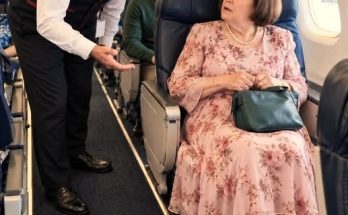
The captain introduced himself before he returned to the cockpit.
"My name is David Mercer," he told Grandma. "My father was Captain James Mercer."
Grandma nodded as though she had known that name for years.
"If there's anything left to learn about that night," David said, "I want to know it."
"You deserve to know," she answered.
He gave her his contact information and arranged for us to speak after landing. He also promised that if the papers she mentioned contained evidence connected to the accident, he would help us find the appropriate people to examine them.
He did not promise that the documents would solve anything.
I appreciated that.
At the time, I wanted answers so badly that I might have accepted almost any explanation offered to me.
David seemed to understand how dangerous that hunger could be.
Before he left, Grandma reached for the silver wings attached to her purse.
She unfastened them slowly.
The little pin had a dull shine, and the edges were worn from years of handling. I had seen it countless times without ever wondering where it came from.
She held it out to David.
"Your father gave these to my husband," she explained. "They were a gift after the two of them worked together on a difficult flight."
David stared at the wings.
"My father had another set," he said. "He kept them for himself. The second set was meant for someone who had helped him when he was still young."
"He said Thomas had a kind of courage that didn't need anyone to notice it."
David accepted the wings carefully.
Then he placed them back in Grandma's hand.
"I think you should keep them until we know more."
She closed her fingers around the pin.
"Thank you."
He hesitated before saying goodbye.
"My father used to tell me that the most important thing a pilot carried wasn't something you could see in the cockpit."
I looked at him.
"What did he mean?"
David glanced toward the rows of passengers.
"The lives of the people who trusted him to get them home."
Then he returned to the front of the aircraft.
Grandma watched him go.
"He has his father's kindness," she murmured.
I slipped my arm through hers.
"Let's get home."
She looked surprised.
"But we came all this way for your birthday."
"And we can still celebrate it."
A small laugh escaped her.
It was fragile, but it was real.
I was ashamed of how I had treated her earlier that day.
I had been so concerned with the seat I bought that I hadn't noticed the fear behind her decision. I had mistaken an old woman's determination for stubbornness because that was easier than asking why she needed to be there.
I apologized while we waited for our luggage.
Grandma squeezed my hand.
"You don't have to apologize for wanting me to be comfortable."
"I was rude."
"You were disappointed."
"That's not an excuse."
She looked at me for a moment.
Then she nodded.
"No, I suppose it isn't."
She never made me feel worse than I already did.
That somehow made the guilt harder to carry.
We drove home that evening beneath a sky streaked with pale orange light. Grandma sat beside me with her purse resting on her lap.
She barely spoke during the drive.
Every so often, I caught her touching the place where the silver wings had been attached.
I wanted to ask about the envelope.
I wanted to ask about the airport, the accident, and the people who had come to our house after Thomas died.
But I had the feeling that if I asked too much too soon, she might retreat into the same silence that had protected her for so many years.
So I kept driving.
For once, I let her decide when she was ready to speak.
Three days later, she called me.
"Could you come over this afternoon?"
"Of course."
"I've made tea."
She said it in her ordinary voice, the one she used when she wanted company but didn't want to admit she needed it.
I arrived shortly after lunch.
Her house looked exactly as it always had. The curtains were drawn halfway across the kitchen window, a dish towel hung over the oven handle, and a bowl of apples sat beside the telephone.
On the counter were two cups.
Beside them lay a small brass key.
I stopped when I saw it.
Grandma stood near the table, holding a wooden box against her waist.
It was dark oak, about the size of a shoebox, with worn corners and a simple brass lock. A faint crescent-shaped scratch marked the lid.
I had never seen it before.
"Is that it?"
She nodded.
"Where have you kept it all this time?"
"In a place where I wouldn't have to look at it every day."
She set the box on the table.
I pulled out a chair.
Neither of us sat down immediately.
The key was small enough to fit between two fingers. A piece of faded red thread had been tied through its loop, and the metal had darkened with age.
Grandma touched it.
"Thomas gave me this the morning he died."
I looked at her.
"He knew he might not come home?"
"He knew something was wrong. I don't think he knew exactly what would happen."
She pulled out the chair opposite mine.
"He told me to keep the key safe. If he couldn't explain things himself, I was to hold on to it until I found someone I could trust."
I thought about the twenty-seven years she had carried it.
The birthdays.
The holidays.
The quiet afternoons when she sat alone in this kitchen, making tea for one person and putting away the extra cup.
All that time, the key had been somewhere in the house.
"Why didn't you open the box sooner?"
She sat down.
For a moment, she stared at the lock.
"Because he asked me not to open it unless I was ready to learn the truth, even if I ended up angry with him."
I frowned.
"Why would you be angry with Grandpa?"
"I don't know."
She said it without trying to soften the answer.
"That frightened me. I knew he had done something he thought was right. But I didn't know what it was, and I couldn't bear the thought that the man I loved might have kept something important from me."
She rested both hands on the table.
"After he died, I was afraid of everything that reminded me of that night. The telephone ringing late. Someone knocking on the door. A letter arriving with an official name on the envelope."
She looked up.
"I told myself I would open the box when I was stronger."
"When did you think you would be strong enough?"
Her eyes moved to the window.
"I kept moving the day farther away."
I didn't know what to say.
I had always thought of Grandma as the strongest person in our family. She had raised my mother alone after Thomas died, worked when she needed to, and somehow made our house feel safe even when money was short.
She had never told us how much effort it took.
"Did anyone threaten you?" I asked.
She shook her head.
"Not in the way you're thinking."
She explained that nobody had stood on her doorstep and directly threatened to harm her. Instead, people had spoken to her as though her grief made her incapable of understanding what she was seeing.
They told her that the investigation was finished.
They said she was hurting her daughter by refusing to accept the explanation.
Some suggested that she had misunderstood Thomas's work or confused ordinary maintenance disagreements with something more serious.
"They were very patient with me at first," she said. "They made it sound as though they were helping."
"And later?"
"Later, I started to feel foolish whenever I asked another question."
She rubbed her thumb across the table.
"I began to wonder whether I was making things worse for everyone by refusing to let the matter rest."
My anger returned.
"They shouldn't have treated you that way."
"Perhaps they believed they were being kind."
"That doesn't make it right."
"No," she said. "It doesn't."
She looked at the box again.
"I had a little girl to raise. I couldn't spend every day fighting people who told me I was imagining things."
I thought about my mother growing up without her father.
I remembered the few photographs she kept of him, and the way she sometimes studied them when she believed no one was watching.
Grandma had been trying to protect her daughter.
She had also been trying to survive her own grief.
Neither fact made the silence harmless.
But I understood it differently now.
"What's in there?" I asked.
"Something Thomas wanted the investigators to see. He believed it might stop another family from going through what we did."
She took the key.
Her hand trembled slightly as she guided it into the lock.
Then she stopped.
I waited.
"Are you ready?" I asked.
"No."
She gave a short, nervous laugh.
"But I'm tired of being frightened."
She turned the key.
The lock opened with a small click.
Grandma lifted the lid.
Inside were three objects arranged neatly beside one another.
A thick envelope sealed with yellowed tape.
A black notebook.
And a photograph.
I reached for the photograph first.
It showed Thomas standing beside a younger James Mercer in front of an airplane. Thomas wore a plain shirt and tie, while James was dressed in his pilot's uniform.
They were smiling at the camera.
One of James's hands rested on Thomas's shoulder.
I turned the photograph over.
Someone had written a message on the back.
For the two men who refused to look away.
I read it twice.
"Who wrote this?"
"I don't know," Grandma said. "Thomas never told me."
I placed the photograph beside the box.
The notebook was next.
Its black cover was worn at the edges, and the pages smelled faintly of old paper. The first entries looked ordinary enough: dates, names, aircraft identification numbers, and notes about maintenance work.
Thomas's handwriting was neat and controlled.
I recognized it from the birthday cards he had sent me when I was little, though I had never realized how familiar those letters would feel now.
For several pages, the entries were technical and difficult for me to understand.
Then the tone changed.
Thomas had written about a maintenance concern that remained unresolved. He had recorded conversations with members of the operations team and noted repeated requests for a formal inspection.
There were names beside some entries.
Times beside others.
A few sentences had been underlined.
I could not make sense of every detail, but I could see that he had been worried.
He had not simply heard a rumor and forgotten it.
He had documented his concerns.
He had returned to them.
He had tried to get someone to act.
Grandma watched me turn the pages.
"That was how he worked," she said. "If he thought something mattered, he wrote it down."
Near the back of the notebook, I found a page dated the day before Flight 217.
One sentence had been marked twice.
If the report is changed, the original record must survive somewhere it cannot quietly disappear.
I felt the skin on my arms tighten.
"Grandma."
She leaned forward.
I showed her the line.
She read it slowly, then sat back.
For years, she had carried the key without knowing what the box contained. Now the words were in front of us, written in the hand she had known for decades.
I understood why she had been afraid to open it.
Once we read the pages, we couldn't return to not knowing.
I reached for the envelope.
It was sealed with old tape, and the paper had yellowed around the edges. I opened it carefully and removed several folded documents.
There were copies of maintenance records, correspondence, and a handwritten letter addressed to Eleanor.
Grandma made a small sound when she saw the handwriting.
"That's his."
I knew it too.
I unfolded the letter.
The first line was simple.
My dearest Eleanor,
I stopped breathing for a moment.
Thomas had been dead for most of my life. I knew him through photographs, old stories, and the careful way my grandmother kept his belongings.
But here he was, speaking to her in his own words.
The letter explained that he had been trying for weeks to convince people that an unresolved maintenance concern needed proper attention.
He wrote that some people seemed more frightened of admitting a mistake than of allowing others to suffer because of it.
James Mercer had agreed with him.
Both men knew that raising the issue could cost them their careers. Both believed that remaining silent could put lives at risk.
I read the words twice before continuing.
Thomas admitted that he was frightened.
He didn't pretend to be fearless or certain that everything would turn out well.
He was afraid of what might happen if people who knew about the problem chose to keep quiet.
But he was more afraid of what might happen to the people who would board the aircraft without knowing there was anything to worry about.
I had to stop reading.
Grandma covered her mouth with one hand.
I reached across the table and held her fingers.
For a while, we sat without speaking.
Then she whispered, "There's more."
I looked down at the letter.
The final lines were written in smaller letters, as if Thomas had been trying to fit everything he needed to say onto the remaining space.
He explained that the person who could clarify why the original report had disappeared was not the person most people suspected.
It was someone who had spent years being praised for protecting the airline.
Then came a warning.
People could make terrible decisions out of fear, he wrote, and even decent people could help a false account survive.
He asked Eleanor to forgive him for leaving her with questions.
He reminded her that he loved her.
Then he signed his name.
Thomas.
I lowered the letter onto the table.
Grandma was crying silently.
I wanted to tell her that everything would be all right, but I knew that would be a promise I had no right to make.
The letter did not explain exactly what had happened to Flight 217.
It did not tell us who had changed the report or why the envelope had never reached the investigators.
It only showed that Thomas had been trying to make someone listen.
And that he had been afraid.
There was one more document beneath the notebook.
Grandma drew it out and unfolded it.
It was a photocopy of an internal memo.
The writing was faint, but a signature remained visible at the bottom.
I recognized the name.
It belonged to a senior airline official whose name had appeared in newspaper articles about the accident. The articles described him as the person who led the review that concluded the tragedy could not have been prevented.
Over the years, he had become known for his work on airline safety.
He had given interviews.
He had attended conferences.
He had received awards for his contributions.
He had also died several years before I was born.
I stared at the signature.
"Does this mean he was responsible?"
Grandma took the memo from me.
"No."
Her answer was firm.
"It means Thomas believed he knew something important. We can't decide what happened because a name appears on a page."
I looked at the documents spread across the table.
For the first time, I understood that finding a secret and proving the truth were different things.
The box could tell us what Thomas had feared.
It could show us what he had recorded.
But it could not, by itself, tell us everything that had happened after he left the airport.
Grandma gathered the pages carefully.
"We need someone to examine these."
"David?"
She nodded.
"He knows what questions to ask. And he has a reason to care."
I looked at the photograph of Thomas and James.
Two men stood beside an airplane, smiling as though they believed they had plenty of time left.
I thought about the families who had waited for Flight 217 to arrive.
I thought about James Mercer's son growing up with questions, just as my mother had.
And I thought about Grandma, who had kept a key hidden in her own house because she was afraid of what opening a box might do to the memory of the man she loved.
The tea on the table had gone cold.
Neither of us noticed.
That evening, I helped her place the documents back in the box. We left the lid open, and the brass key rested beside it.
For the first time, Grandma did not ask me to put everything away.
She sat with the photograph in her hands.
"I used to think that if I opened this box, I would lose him all over again," she said.
I pulled my chair closer.
"Do you still think that?"
She studied Thomas's face.
"I don't know."
Then she touched the edge of the photograph.
"But I think I'm ready to find out."
The next morning, we called David Mercer.
And this time, Grandma did not hesitate when he answered.
Source: camdope.site
Click here to continue reading: PART 3: We Wanted Someone to Blame, but the Records Gave Us Something Harder to Accept Than a Simple Answer
I Thought My Grandmother Was Throwing Away a Gift Until the Captain Recognized the Name on Her Boarding Pass
Part 2 of 4