I used to think the worst thing a family could do was fight over money.
I was wrong.
The worst thing was sitting at a table with people you loved and realizing they had already divided up the life of someone who was still sitting among them.
That was what happened at my grandfather’s house that December evening.
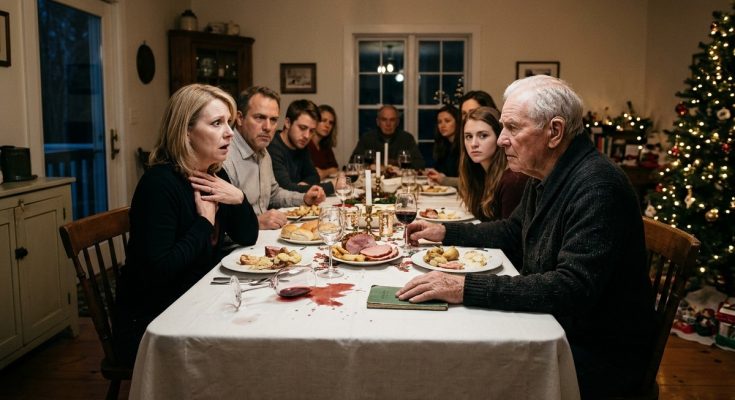
The roast was getting cold.
Grandma’s chair was empty.
And my aunt Linda had just finished explaining how Grandpa’s death would finally let her pay off her mortgage.
She said it as if she were talking about an insurance payment.
Then Grandpa stopped eating.
He set his fork beside his plate, wiped his mouth with a folded napkin, and looked straight at her.
“Linda, how much do you still owe on that house?”
She blinked.
“What?”
“Your mortgage. How much is left?”
Linda glanced at her husband, Gary, before answering.
“I don’t see why that matters.”
“It matters to you, apparently.”
Nobody moved.
I was sitting two chairs away from Grandpa, close enough to see the small tremor in his fingers as he reached for his glass of water.
He was eighty-two years old.
His hands had grown stiff over the past few years, and he sometimes needed an extra moment to hear what someone said. None of that had stopped him from working on the farm, though.
He still checked the weather before breakfast.
He still walked out to the barn every morning.
And he still knew exactly where every tool belonged.
My family often treated those habits like evidence that he was too old to understand what was happening around him.
That evening, they were about to learn how wrong they were.
Linda gave a short, nervous laugh.
“Dad, we’re having dinner. Can we please not do this now?”
Grandpa glanced at the plate in front of her.
“You were the one talking about my death.”
Her face tightened.
“I didn’t say it like that.”
“You said the farm would be sold, and your share would take care of your mortgage.”
“I said that if something happened to you, we’d have to make decisions.”
“Something has already happened to me.”
He paused.
“Your mother died.”
The room went still.
That was the first time anyone had mentioned Grandma directly since we sat down to eat.
She had been gone for eight months.
Her blue mug was still on the kitchen shelf, and her chair beside the living room window remained exactly where she had left it. Grandpa had refused to let anyone move it.
I had watched him look toward that chair every morning when I visited.
He never said much about missing her.
He didn’t need to.
Linda lowered her eyes and picked at a piece of potato with her fork.
“I miss Mom, too.”
“I know you do,” Grandpa said.
His voice wasn’t loud.
That made it worse.
“But missing her doesn’t explain why you’ve spent so much time discussing what you’ll get when I’m gone.”
Gary leaned forward.
“Henry, I think there’s been a misunderstanding.”
Grandpa turned toward him.
“A misunderstanding?”
Then he reached beside his plate and picked up a small green notebook.
I’d seen that notebook before.
It usually sat near the telephone in the kitchen, tucked beneath a stack of envelopes and an old pair of reading glasses. I had assumed it contained grocery lists, planting dates, or reminders about the farm.
Grandpa opened it carefully.
“November twenty-sixth, 2020. Thanksgiving dinner.”
Gary’s shoulders stiffened.
Grandpa ran a finger down the page.
“You spent a good part of the evening telling Linda that my combine could sell for sixty thousand dollars or more. You said you wanted the keys before I died so you could handle the auction without having to argue with the rest of the family.”
Gary’s face changed.
“That was just talk.”
Grandpa didn’t look up.
“That’s what you called it afterward, too.”
He turned a page.
“Christmas Eve, 2021. Brett asked whether I’d notice if he took the old tractor from the barn. You told him I probably wouldn’t care if he hauled off the whole building.”
My cousin Brett sat up so quickly that his knee struck the underside of the table.
“I was kidding, Grandpa.”
“Then tell me what was funny about it.”
Brett stared at him.
His mouth opened, but he couldn’t find an answer.
I had seen these people argue for most of my life.
They fought about broken equipment, unpaid loans, fence repairs, and who had failed to show up for Sunday dinner. Every disagreement came with a list of old complaints.
Someone was always the victim.
Someone else was always to blame.
But I had never seen them look so uncomfortable around Grandpa.
They had spent years talking over him, making decisions for him, and treating his quietness as permission.
Now he was reading their own words back to them.
Grandpa closed the notebook.
“I didn’t ask everyone here because I wanted to spoil Christmas.”
His eyes moved around the table.
“Your grandmother isn’t here to tell you what she thinks anymore, and I’m tired of pretending I don’t hear the things you say when you believe I’m not listening.”
He stopped.
For a moment, the anger left his face.
What remained was grief.
“I lost the woman I spent sixty-two years married to. I come downstairs every morning and see the chair where she used to sit. I still catch myself saving things to tell her.”
He looked toward the living room.
“And while I’ve been trying to figure out how to live without her, some of you have been working out how to divide everything she and I built.”
Nobody spoke.
I wanted to say something.
I wanted to tell Grandpa that I was sorry.
But I had sat through enough of those conversations without objecting that I wasn’t sure I had earned the right to comfort him.
That was something I would have to live with.
Grandpa drew a slow breath.
“Your grandmother believed family was worth more than money. She taught me that. But she also knew that loving people doesn’t mean letting them use you until there’s nothing left.”
Then he looked at me.
“Katie, would you bring Mr. Dawson inside?”
I pushed my chair back.
The legs scraped loudly against the wooden floor.
“Yes, Grandpa.”
Nobody tried to stop me.
I crossed the kitchen and opened the front door.
The December air struck my face, and I pulled my sweater closer around myself.
Mr. Dawson was waiting in his parked car at the edge of the driveway. The light from his dashboard fell across the papers in his hands.
He had been Grandpa and Grandma’s attorney for almost thirty years.
He was a quiet man with silver hair, a careful way of speaking, and the sort of patience that made people forget he was paying attention to every word.
When I tapped on his window, he looked up.
“Is Henry ready?”
“He wants you inside.”
Mr. Dawson gathered the documents on his lap.
“Then let’s go.”
We walked back toward the house together.
Snow had collected along the fence posts, and the barn stood dark beyond the yard. The windows of the farmhouse glowed against the winter evening.
I had grown up coming here.
I learned to ride my bicycle on the driveway, collected eggs with Grandma, and followed Grandpa around the fields until he finally gave me a job I could manage.
When I was little, he used to lift me onto his shoulders at the county fair so I could see over the crowd.
I remembered the smell of the barn after rain.
I remembered Grandma’s apple pies cooling beside the kitchen window.
I remembered Grandpa showing me how to plant corn, explaining that there was no point rushing something that needed time to grow.
Back then, the farm had never seemed like an asset.
It was simply the place where my family belonged.
Somewhere along the way, that changed.
The land became a price.
The combine became an auction estimate.
The barn became something that could be sold for parts.
And Grandpa became a problem everyone expected to solve eventually.
I followed Mr. Dawson through the front door and into the dining room.
Every face turned toward us.
Grandpa gestured to the empty chair beside him.
“Thank you for coming, James.”
Mr. Dawson nodded.
“Of course, Henry.”
Linda stood immediately.
“James, I’m glad you’re here. Maybe you can help us understand what’s going on. Dad seems to think we’ve been plotting against him.”
Mr. Dawson removed his coat and placed it over the back of his chair.
“Henry asked me to attend because there are several matters he wants to discuss. I suggest everyone sit down and let him finish.”
“Several matters?” Gary asked.
“Yes.”
“Are they about the farm?”
Grandpa looked at his son.
“They’re about my life, Gary. The farm is part of that life, but it isn’t the whole thing.”
Gary sat down again.
I noticed he kept glancing at the green notebook.
Linda folded her arms.
“Dad, if you’ve changed your will because you’re upset about a few things people said, I hope you’ll think carefully before doing anything.”
Grandpa looked at her.
“Why would I change it because of a few things people said?”
“Because we’re your children. We should know what you’re planning.”
“Should you?”
Linda’s expression shifted.
“We’re family.”
“Yes,” he replied. “We are.”
She waited for him to say more.
He didn’t.
Finally, she leaned forward.
“You need to trust us.”
Grandpa watched her for several seconds.
“Linda, do you remember what you said to me at the hospital last February?”
She stopped moving.
“What does that have to do with anything?”
“Your mother was still awake. She couldn’t speak very well by then, but she could hear us. You came into the room and asked whether the will had been updated.”
Linda looked down.
“I was trying to make sure everything was taken care of.”
“You asked whether the farm would be sold as soon as she died.”
“Dad, I was worried about you.”
“You said I shouldn’t keep trying to run the place alone. You said I belonged in a care home, and the land should be sold before the next planting season.”
Her fingers tightened around the edge of the table.
“I didn’t mean it the way you’re making it sound.”
Grandpa’s expression remained unchanged.
“Your mother cried after you left.”
Linda looked up.
“What?”
“She started crying when the room was empty.”
He paused.
“She was too weak to get out of bed, but she was still worried about you. She asked me whether you’d eaten that day. She wanted me to send leftovers home with you the next time you visited.”
Linda’s lips trembled.
“I didn’t know she cried.”
“No,” Grandpa said. “You were already gone.”
The old clock above the fireplace ticked through the silence.
I remembered Grandma’s final months.
She had asked about everyone’s birthdays, their jobs, their children, and the little things happening in their lives. Even when she was tired, she wanted to know who would come to dinner on Sunday.
She kept a list of family birthdays beside her bed.
She worried when Linda worked late.
She worried when Gary had trouble with money.
She worried when Brett went too long without calling.
She had spent her life making room for people who rarely considered how much room they took.
I had watched her do it.
I had benefited from it, too.
Looking back, I knew I had mistaken her endless patience for something that would always be there.
Mr. Dawson cleared his throat.
“Henry, shall we go through the documents?”
Grandpa nodded.
“Yes.”
The attorney opened his briefcase and removed a thick folder.
“Before we discuss the estate, I want to make one thing clear. Henry has been evaluated as mentally competent, understands his property and finances, and has received independent legal advice. These decisions were made voluntarily.”
Gary frowned.
“Who said he wasn’t competent?”
Mr. Dawson looked at him.
“Three weeks ago, someone contacted my office with concerns about Henry’s hearing. The caller wanted to know whether his difficulty hearing certain conversations could affect his ability to understand legal documents.”
Nobody moved.
Grandpa slowly turned toward Gary.
“Would you like to tell everyone who called?”
Gary’s face reddened.
“I was concerned about you.”
“Were you concerned that I couldn’t understand my own affairs, or that I might make a decision you didn’t like?”
Gary pushed his chair backward.
“This is absurd. I’m not sitting here listening to this.”
“Then you can leave,” Grandpa said.
Gary stopped.
For the first time that evening, I saw uncertainty cross his face.
Grandpa didn’t raise his voice or threaten him.
He simply continued.
“James has copies of every document I’ve signed. Nobody is going to tell the court that I didn’t understand my own wishes.”
Gary looked toward Linda.
She said nothing.
He looked toward Brett.
My cousin stared at his plate.
Gary slowly pulled his chair back under the table and sat down.
Mr. Dawson placed a document in front of him.
“This is Henry’s current estate plan. It replaces the earlier version prepared several years ago.”
Brett swallowed.
“Who gets the farm?”
Grandpa looked at him.
“Is that all you want to know?”
“No, Grandpa.”
“Then listen first. You can ask questions when I’m finished.”
Brett nodded, his ears turning red.
Mr. Dawson began explaining the plan.
The farmhouse was addressed.
So were the agricultural fields, the barns, the equipment, and the south parcel beyond the red barn. The documents included provisions for maintaining the property and keeping the farm’s operations organized.
Linda gripped the table.
“But who owns it after you die?”
Grandpa rested his hands beside his plate.
“I own it now, Linda. I’m sitting in front of you.”
“I know that. I’m asking what happens later.”
“And that’s exactly what I’ve been trying to make you understand.”
He looked from one relative to the next.
“For years, I’ve listened to you talk about what my land is worth. I’ve heard you estimate the price of my equipment while I was still using it. I’ve watched you turn family gatherings into discussions about what you’ll receive when I die.”
He paused to let the words settle.
“You’ve planned your lives around property you don’t own, and you’ve done it while I’m still here to hear you.”
Linda shook her head.
“We were only trying to prepare.”
“Prepare for what?”
“For the future.”
“Whose future?”
She didn’t answer.
Grandpa reached for the green notebook again.
“There are entries in here that James hasn’t seen.”
Mr. Dawson looked surprised.
“Henry, I thought we’d review the legal documents before getting into the notebook.”
“We will. But I want them to understand why we’re having this conversation.”
Grandpa opened to a page marked with a narrow red ribbon.
“March fourteenth, 2023. I heard Linda tell Gary that if I found out they’d been talking to a realtor, they could simply claim I was confused.”
Linda rose from her chair.
“Stop it, Dad.”
He continued reading.
“October ninth, 2024. Gary told Brett that they should get me to sign a power of attorney while I was still healthy enough to understand it.”
Gary shook his head.
“You’re leaving out the context.”
“Then explain the context.”
“I was talking about making things easier for you. You can’t do everything forever.”
Grandpa closed the notebook halfway.
“You never asked what I needed help with. You wanted to know whether you could make decisions for me.”
Gary’s jaw tightened.
Mr. Dawson lifted one hand.
“Henry, I understand why these entries matter, but I think we should keep the discussion focused on the documents.”
Grandpa gave a small nod.
“Fair enough.”
He set the notebook down.
“I’ve spent my whole life working this farm. I’ve fixed fences in freezing weather. I’ve worked through summers when the tractor seat was too hot to touch without a rag. I’ve borrowed money for equipment, and I’ve paid every debt I owed.”
He looked at his hands.
“Your grandmother worked just as hard. When we couldn’t afford help, she came out into the fields with me. She packed my lunch before sunrise and waited up when I came home after dark.”
His voice faltered slightly.
“When the crops failed, she stood beside me. When we had a good year, she celebrated with me. We built this place together, one season at a time.”
He looked toward the empty chair by the window.
“She never thought of this farm as a pile of money waiting for somebody to collect.”
Nobody spoke.
“This is the life we made,” he continued. “And I’m not going to let it be pulled apart because the people around this table think they’re entitled to it.”
Linda wiped her cheek.
I couldn’t tell whether she was ashamed or frightened.
Perhaps she felt both.
Mr. Dawson turned to another section of the folder.
“There’s one more matter Henry wants to address before we go through the inheritance provisions.”
He took several photographs from the folder and laid them across the table.
The first showed the south parcel.
I knew that stretch of land better than any other part of the farm. It ran beyond the old red barn toward the creek, where Grandpa sometimes took me early in the morning to watch the sun come up over the fields.
The second photograph showed a boundary marker.
The third was a survey map with lines drawn across the property.
Gary leaned forward.
“What are we looking at?”
“An independent survey,” Mr. Dawson said. “Henry wanted the boundaries and ownership records for the entire property checked.”
Linda frowned.
“Why would you need that done?”
Grandpa answered before the attorney could.
“Because someone approached a commercial realtor about buying part of my land without asking me.”
Gary’s eyes moved to the photographs.
Then they moved away.
Grandpa folded his hands.
“I wanted to know whether the conversation was just another thing you thought I wouldn’t hear about, or whether someone had started trying to make it happen.”
Mr. Dawson opened a second folder.
“The realtor confirmed that someone had contacted him about the south parcel. No sale was completed, and Henry never gave permission for one.”
I stared at the map.
The south parcel had been part of the farm for longer than I had been alive. Grandpa had told me that his father once planted oats there, before the family switched to corn. The creek flooded every few years, and Grandpa knew which parts of the field drained first after heavy rain.
To him, it was ground he had worked with his own hands.
To someone else, it was a number on a survey.
I looked at Linda.
She was staring at the photographs as if she wanted to make them disappear.
Gary sat rigidly in his chair.
Brett had stopped pretending to study his plate.
For the first time, I understood that Grandpa hadn’t called us together to argue about something he had overheard.
He had come prepared.
The notebook.
The attorney.
The survey.
Every detail had been gathered before that dinner began.
And I had spent years believing his silence meant he didn’t know what was happening.
Mr. Dawson placed the photographs in a neat stack and turned back to the estate documents.
Grandpa reached for his water glass, took a small sip, and set it down.
“Now,” he said, “we can talk about what I’ve decided to do.”
I held my breath.
So did everyone else.
But Grandpa didn’t rush.
He looked once more at Grandma’s empty chair, then at the people sitting around his table.
“I’ve had enough time to think about this,” he said. “I’m not making these decisions because I’m angry tonight. I’ve been thinking about them for a long time.”
Linda sat down fully.
Gary folded his arms.
Brett looked toward the attorney.
I watched Grandpa’s fingers settle on the cover of the green notebook.
He had spent years listening to people explain what they believed would happen after he died.
Now he was finally going to tell them what would happen while he was still alive.
Mr. Dawson opened the estate plan to the first page.
Grandpa nodded for him to continue.
And nobody at that table asked about the value of the farm again.
The End
Read more original stories on Feel Every Story.