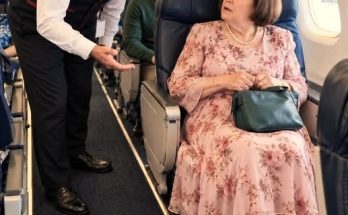
By the time Grandma turned eighty-one, the review had reached its conclusion.
We had spent months speaking with people, preserving documents, and trying to understand what Thomas had recorded.
Some questions remained unanswered.
The evidence supported the fact that he had raised concerns about a maintenance issue before Flight 217. The surviving records showed that those concerns had been discussed, but they did not establish every decision made afterward.
Nobody could prove from the documents alone that one person had caused the accident or that the missing report would have prevented it.
I had to learn to live with that.
So did Grandma.
There were days when she still became quiet after reading one of Thomas's letters. Sometimes she would stop in the middle of telling me a story and stare at the photograph beside her lamp.
But she no longer hid the papers away.
The wooden box stayed in her house, and the brass key rested in a small dish on the kitchen table.
She had stopped treating the past like something that would hurt everyone who touched it.
My mother learned about the box, too.
Grandma told her what we had found, carefully separating the facts from the questions we still couldn't answer.
My mother listened without interrupting.
When Grandma finished, she asked to see the photograph of Thomas and James.
She held it for a long time.
"I wish I'd known more about him," she said.
Grandma's face crumpled.
"So do I."
My mother reached across the table and took her hand.
For years, both of them had believed they were protecting each other by saying very little.
Now they began sharing what they remembered.
My mother told stories about the father she had lost as a child. Grandma filled in the details she could remember, including the small habits and ordinary moments that had once seemed too insignificant to mention.
They did not recover the years they had spent in silence.
But they found a way to speak about Thomas without treating every memory as a wound that needed to be covered.
That mattered.
David stayed in contact with us.
He spoke with his mother regularly and kept us informed when he learned anything relevant to the old investigation. Sometimes he called simply to ask how Grandma was doing.
She liked that.
She had spent so long believing that people only wanted to discuss Thomas when they needed something from her. It was a relief to discover that someone could remember him without making the conversation feel like an interrogation.
One afternoon, David visited with his mother on a video call.
The two women spoke about their husbands, comparing memories of the men they had loved before either of them became part of a tragedy.
They laughed about their habits.
They remembered their stubbornness.
They talked about the way both men had believed that doing a job properly mattered, even when nobody was watching.
At one point, David's mother asked Grandma whether she still kept the silver wings.
Grandma reached for the framed photograph on the sideboard.
The wings were displayed beside it, resting in a small frame alongside the picture of Thomas and James.
"I couldn't put them away," Grandma said.
David's mother smiled.
"Neither could I."
For a moment, the years between the two families seemed less heavy.
They still had questions.
They still had losses that could not be repaired.
But neither woman had to carry her memories entirely alone anymore.
As Grandma's birthday approached, I decided to buy her another first-class ticket.
I wanted to give her something comfortable.
That was still part of it.
But this time, I also wanted to make a different kind of memory with her, one that wasn't centered on the accident or the years she had spent afraid to talk about it.
I didn't tell her where she would be sitting.
When I handed her the boarding pass, she examined it with suspicion.
"You're up to something."
"I'm giving you a birthday present."
"You said that last time."
"And I meant it last time."
She narrowed her eyes at me.
"That's what makes you dangerous."
I laughed.
She did too.
It was an ordinary exchange, the sort of thing we might have said before any of this happened.
But I noticed how easily she laughed now.
Not every day was easy for her. Some memories still caught her off guard, and there were evenings when she missed Thomas so much that she preferred not to talk.
The difference was that she no longer felt she had to pretend those feelings didn't exist.
On the morning of the flight, I picked her up early.
She was waiting by the door with her worn brown purse over one arm.
The silver wings were no longer attached to the zipper.
They had a place of their own now, beside the photograph at home.
She looked at my car, then at me.
"Are you sure we need to go this early?"
"I thought you liked being early."
"I like being early when there's a reason."
"There is a reason."
"What is it?"
"So we don't have to rush."
She considered that.
"That's a reasonable answer."
I took her bag, and we left.
At the airport, she walked beside me at her own pace. We stopped for coffee, and she complained that mine was too expensive before asking to taste it.
I gave her the cup.
She took a sip and made a face.
"You're right," she said. "That's terrible."
I laughed so hard that I nearly spilled it.
For the first time in a long while, the airport felt like an ordinary place.
There were people checking luggage, children dragging small suitcases, and travelers looking up at the departure screens.
Nobody was waiting for a lost report.
Nobody was asking us to explain a tragedy.
We were simply two people going on a trip.
When we reached the gate, Grandma took out her boarding pass.
She held it between her fingers for a long moment.
Then she looked at me.
"Would you mind if I sat in economy again?"
The question took me back to the previous year.
I remembered finding her in row 34A, the irritation that had risen in me, and the way I had made her explain herself before I had even considered that she might have a reason I didn't understand.
For a second, that old feeling stirred.
Then it passed.
"Is there somewhere in economy you'd like to sit?"
She smiled.
"Not today."
I looked at her carefully.
"Are you sure?"
"Quite sure."
"Then we'll sit wherever you want."
She slipped the boarding pass back into her purse.
"Thank you, sweetheart."
We boarded together.
This time, she took the window seat beside me.
I settled into the seat next to hers and put our bags away. She adjusted her cardigan, buckled her seat belt, and looked out at the airport workers moving between the aircraft.
Nothing dramatic happened.
No captain appeared with a familiar name.
Nobody asked about an old boarding pass.
There was only the low hum of the cabin and the sound of people settling into their seats.
I found myself grateful for the quiet.
When the plane began to taxi, Grandma turned toward me.
"Do you remember the first time you asked me about your grandfather?"
I thought about it.
"I remember the newspaper clipping."
She nodded.
"You were so young."
"You took it away before I could read it."
"I know."
"Why?"
She looked down at her hands.
"Because I didn't know how to explain it. I was afraid you would ask questions I couldn't answer."
I waited.
She continued.
"I thought I was protecting you from something painful. I didn't understand that I was also keeping you from knowing him."
I looked toward the window.
The aircraft was moving slowly past the terminal.
"I wish you'd told me sooner," I said.
"So do I."
She didn't defend herself.
She didn't tell me that I wouldn't have understood or that the past was too complicated for a child.
She simply admitted that she wished things had been different.
That made it easier for me to forgive her.
"I can't imagine how lonely it must have been," I said.
Grandma's eyes filled with tears.
"It was."
She looked down at her lap.
"But I wasn't lonely every minute. I had your mother. I had you. There were good years, too."
She smiled faintly.
"I don't want you to remember me as a woman who spent twenty-seven years being afraid."
"I don't."
"What do you remember?"
I thought about the kitchen where she had taught me to make tea. The bowl of apples beside the telephone. The birthday cards she kept in a drawer. The way she always made enough food for one more person than she expected to feed.
I remembered her sitting beside me when I was sick, even when she had work to do.
I remembered her laughing at jokes that weren't funny because she knew I wanted her to laugh.
And I remembered the afternoon we opened the wooden box.
"I remember that you kept going," I said.
She studied my face.
"Even when I was frightened?"
"Especially then."
She turned back to the window.
For a while, neither of us spoke.
Then she began telling me about Thomas.
Not about the accident.
Not about the missing report.
She told me how he used to dance with her in the kitchen when their favorite song came on the radio. How he would tap his fingers against the table when he was trying to remember something.
She told me about the time he drove forty miles in the rain because she had mentioned wanting apple pie.
She remembered that he sang lullabies to my mother, even though he couldn't carry a tune.
"He always sang the wrong words," she said.
"Did you correct him?"
"Of course."
"Did he listen?"
"Never."
She laughed.
I could picture it.
I imagined Thomas standing in their old kitchen, singing loudly while Grandma shook her head at him. I imagined my mother as a little girl, listening to her father's voice before she understood how brief their time together would be.
For years, I had known Thomas primarily as the man who died on Flight 217.
Now I was beginning to know him as a husband, a father, a friend, and an ordinary man with habits that had once made the people around him smile.
That was what Grandma had wanted to give us.
Not a perfect explanation.
Not a story in which every question had a satisfying answer.
A chance to remember him as a whole person.
When the aircraft began its ascent, Grandma reached into her purse and took out a folded piece of paper.
It wasn't the old boarding pass.
This one was new, and the handwriting was hers.
She passed it to me.
I unfolded it carefully.
Some places keep our memories.
Some memories hurt us for years.
And sometimes we have to return before we can move forward.
I read it twice.
"Did you write this?"
She nodded.
"Last night."
"It's beautiful."
She looked embarrassed.
"It's only a few words."
"They're good words."
She smiled and turned toward the window.
"I spent twenty-seven years believing that going back to that seat would help me understand why Thomas never came home."
I held the note in my lap.
"I thought that if I could return to the place where we said goodbye, I might finally find an answer that made sense of everything."
She paused.
"But I was wrong about one thing."
I waited.
"I didn't need that seat to bring him back. I needed to stop being afraid of remembering him."
I took her hand.
Outside, the clouds stretched into the distance beneath the afternoon sun.
The light moved across her face as the plane climbed higher.
For a while, she rested her head against my shoulder.
Then she spoke again.
"I was frightened when David came looking for me."
"I know."
"No," she said gently. "I was frightened because I thought someone was finally going to ask me a question I'd spent half my life avoiding."
I leaned my cheek against her hair.
"And now?"
She looked out at the clouds.
"Now I think I can remember Thomas without being afraid of what I might discover."
I squeezed her hand.
For the first time, I felt no irritation about the seat she had chosen the year before.
I was grateful that she had lived long enough to tell me why.
The old boarding pass had never really been about an airplane.
It was about a promise made by a man who believed that safety mattered more than convenience, and that speaking up was necessary even when the consequences frightened him.
It was about a woman who had carried that promise through decades of grief and uncertainty, unsure whether she had the courage to do anything with it.
And it was about a granddaughter who had mistaken an act of determination for an unnecessary sacrifice.
Grandma had given up first class because she needed to return to the place where her story had been left unfinished.
She hadn't been looking for a particular seat.
Not really.
She had been trying to find the courage to open a door she had kept closed for most of her life.
When she finally opened it, she discovered that the truth could not bring the dead home.
It could not return the years she had spent missing her husband.
It could not erase the birthdays, anniversaries, and quiet evenings that had passed without him.
It could not answer every question about Flight 217.
But it could give Thomas something that grief and silence had slowly taken away.
His voice.
His intentions.
His chance to be understood.
As the plane crossed the clouds, Grandma closed her eyes.
I watched the sunlight fall across her face and thought about the brown purse resting beside her.
For years, I had assumed it held nothing more than old receipts, tissues, faded photographs, and the ordinary things she carried because she had carried them for so long.
I had never imagined that a small key inside her home could connect two families, reopen an old investigation, and change the way we remembered a man who had died before I was old enough to know him.
Sometimes the smallest objects hold the largest parts of a person's life.
And sometimes the journey that matters most is not the one that takes us somewhere new.
It is the one that finally allows us to return to something we have been afraid to face.
I thought about the wooden box on Grandma's kitchen table.
The black notebook.
The yellowed envelope.
The photograph of two young men standing beside an airplane, smiling as though they had no reason to believe their lives would be remembered for anything other than the work they did.
We had not solved every mystery.
We had not found a simple explanation for the accident.
We had not proved that any one person was responsible for what happened.
But we had learned that Thomas had raised concerns, that James had trusted him, and that their efforts deserved to be remembered honestly.
We had also learned that Grandma's silence had never meant she had stopped caring.
She had been afraid.
She had been grieving.
She had been trying to raise a daughter while carrying questions she didn't know how to answer.
For years, I had judged her decision to keep those questions to herself.
Now I understood that courage didn't always look like standing in front of a room and speaking without hesitation.
Sometimes it looked like opening a box after twenty-seven years.
Sometimes it meant admitting that you had been wrong.
And sometimes it meant telling your granddaughter a painful story because you finally trusted her to hear it.
The plane began its descent later that afternoon.
Grandma opened her eyes and looked at me.
"Thank you for bringing me back, sweetheart."
I smiled.
"Anytime."
She rested her hand over mine.
Then she added something I have carried with me ever since.
"Remember this, darling. Sometimes the people who appear to be giving something up are trying to find something they've been missing for years."
I looked at her.
And at last, I understood.
She hadn't traded first class for economy.
She had taken a step toward the truth.
The seat had been a small part of it.
The real journey had begun long before I bought her that ticket, and it had taken her twenty-seven years to reach the point where she could finish what her husband had started.
When we landed, Grandma gathered her purse and stood beside me in the aisle.
She moved slowly, waiting for the passengers ahead of us to collect their bags.
There was no urgency in her face.
No fear that someone might ask her a question she couldn't answer.
She looked like an old woman returning home after a birthday trip.
Just that.
And I thought it was a beautiful thing.
Not because the past had been repaired.
It hadn't.
Not because the mystery had been completely solved.
It hadn't been.
But because Grandma could finally speak about the man she loved without feeling that remembering him meant reopening a wound she had to hide from everyone else.
We walked toward the terminal together.
Her hand rested lightly on my arm.
For once, I didn't try to hurry her along.
I let her set the pace.
Source: camdope.site
The End
Read more original stories on Feel Every Story.
I Thought My Grandmother Was Throwing Away a Gift Until the Captain Recognized the Name on Her Boarding Pass
Part 4 of 4