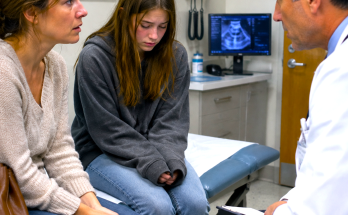
Daniel was sentenced in winter.
Rachel did not attend every hearing that followed the verdict.
That decision surprised people.
Some assumed she would want to see every consequence.
She did not.
For years too much of her life had revolved around Daniel’s moods, decisions, punishments, apologies, and explanations.
She refused to build recovery around watching what happened to him.
Mara called after sentencing.
She told Rachel the result.
Prison.
Mandatory programs.
A long protective order.
Financial restitution that Rachel privately doubted would ever mean much in practical terms.
Rachel listened from Emily’s couch with a blanket across her legs.
Outside the apartment windows, snow had begun falling.
“Do you want the details?”
Mara asked.
Rachel thought about it.
“No.”
“Okay.”
“Just tell me one thing.”
“What?”
“Did the judge say it was an accident?”
Mara paused.
“No.”
Rachel closed her eyes.
“That’s enough.”
She ended the call.
Emily looked over from the kitchen.
“Well?”
“It’s done.”
Emily did not ask whether Rachel was happy.
She made tea.
That was better.
Recovery continued without a dramatic finish.
Rachel’s back improved.
Then plateaued.
Then improved again.
Some mornings she woke almost normal.
Other days, cold weather sent pain through her spine before she got out of bed.
Her doctors stopped predicting exact outcomes.
Rachel stopped asking for them.
Uncertainty had once frightened her because Daniel treated uncertainty as failure.
Now she learned to live beside it.
Would she always have pain?
Maybe.
Would she have another pregnancy someday?
She did not know.
Would she want one?
She did not know that either.
Answers could come later.
Or not.
Rachel returned to work part-time in January.
The first day exhausted her more than she admitted.
She sat in the parking lot afterward with both hands on the steering wheel and cried.
Not because work had gone badly.
Because she had driven herself.
The car was Emily’s old sedan.
Rachel had bought it cheaply after the insurance settlement began.
The driver’s seat was adjusted exactly where she wanted it.
No one commented on how fast she drove.
No one checked the mileage.
No one asked why she stopped for coffee.
Rachel sat there for ten minutes simply enjoying ownership of small decisions.
She called Emily.
“I’m in the parking lot.”
“You okay?”
“Yes.”
“You sound like you’re crying.”
“I drove here.”
There was a pause.
Emily understood.
“Want me to come get you anyway?”
Rachel laughed.
“No.”
“Good.”
“I’m driving home.”
“Text me when you’re parked.”
Rachel smiled.
“That sounds controlling.”
Emily gasped theatrically.
“Fine. Disappear forever.”
Rachel laughed harder.
It hurt her back.
She did not care.
The divorce moved separately from the criminal case.
Daniel contested parts of it at first.
Property.
Accounts.
The house.
Then legal costs and incarceration narrowed his ability to fight.
Rachel did not want the house.
People seemed surprised by that too.
It had equity.
It was partly hers.
It contained years of furniture and appliances she had paid for.
But the utility room existed inside it.
So did the kitchen where Daniel tore the names.
The bedroom where Rachel hid her phone.
The stairs where she had learned to recognize his footsteps.
Rachel wanted her financial share.
She did not want the walls.
The house was eventually sold.
Before closing, Rachel had one final opportunity to collect personal belongings.
Emily offered to go alone.
Rachel considered it.
Then said, “I want to go.”
They arrived on a bright March morning.
The house looked smaller.
That offended Rachel slightly.
For years it had felt like an entire world.
Now it was beige siding, two narrow front windows, and a porch Daniel had never finished staining.
Rachel stood beside Emily’s car.
“You sure?”
Emily asked.
“No.”
“Good enough.”
Rachel walked to the front door.
The lock had been changed.
The realtor opened it.
She knew only that this was a difficult divorce and that Rachel was collecting property.
Rachel appreciated the ignorance.
She did not want sympathy filling every room.
The living room was nearly empty.
Indentations marked where furniture had stood.
The wedding portrait was gone.
Rachel had no idea who removed it.
She was grateful.
She walked through the kitchen.
The refrigerator remained.
She looked at the floor beneath it.
Months earlier Emily had found the torn names there.
Rachel touched the wooden box inside her bag.
She had brought it without knowing why.
The utility-room door stood closed.
Rachel stopped.
Emily moved beside her.
“You don’t have to.”
“I know.”
“You can leave.”
“I know.”
Rachel placed one hand on the knob.
Her palm began sweating.
For a second she could hear Daniel again.
You wouldn’t listen.
Stop fighting.
You’re making this worse.
Rachel opened the door.
The room was empty.
The rope was gone.
The washer had been removed.
Only the hook remained in the ceiling beam because investigators had photographed and measured it before releasing the house.
Rachel stared upward.
Her body reacted before thought.
Dizziness.
Heat.
Pain around her ankles that was no longer physically there.
Emily stepped beside her.
“Look at me.”
Rachel did.
The phrase returned from the hospital.
You’re standing.
Rachel looked down.
Her shoes rested firmly on concrete.
She took one breath.
Then another.
“I thought it would feel bigger.”
“The room?”
“Yes.”
Emily looked around.
“It’s tiny.”
Rachel nodded.
They stood there for less than a minute.
Then Rachel stepped backward and closed the door.
That was all.
No speech.
No collapse.
No symbolic destruction.
The room did not deserve ceremony.
Upstairs, Rachel found the green dress she wore on her first anniversary.
She left it.
She found a photo album from college.
She took that.
A ceramic bowl their mother had made.
Take.
Daniel’s collection of travel mugs.
Leave.
A stack of old tax documents.
Take.
The blue nursery stopped her.
The room had never held a crib.
Daniel had painted before they bought one.
The walls remained pale blue.
A small shelf held the unopened baseball glove.
Rachel stared.
Emily waited in the hallway.
“You want me to get it?”
“No.”
Rachel stepped inside.
Dust coated the shelf.
She picked up the glove.
It was absurdly small.
Not newborn-sized.
Something for a toddler.
A child Daniel had already imagined so specifically that there had been no room for the actual baby to arrive unknown.
Rachel turned it over in her hands.
For a long time she hated the glove.
Then she realized the object itself was innocent.
It represented a future that had never belonged exclusively to Daniel.
Rachel placed it inside her bag.
Emily raised an eyebrow.
“I don’t know why.”
“You don’t have to.”
They left the house before noon.
Rachel did not look back.
Several weeks later she moved into a small apartment of her own.
It was one floor above ground level with an elevator that sometimes smelled like someone’s cooking.
The kitchen was narrow.
The bathroom tile was ugly.
The bedroom windows faced a maple tree.
Rachel loved it.
Emily helped assemble shelves.
Rachel insisted on choosing their height herself.
“Higher?”
Emily asked.
“A little.”
“You sure you can reach?”
Rachel looked at her.
Emily laughed.
“Right. Your apartment.”
“Exactly.”
They mounted the shelf.
Rachel placed the wooden box there.
Inside remained the letter to the baby and the torn girl names.
She added the tiny baseball glove.
Emily noticed.
“You kept it.”
“Yes.”
“Does that feel okay?”
Rachel thought.
“Yes.”
The glove did not mean Daniel had been right to demand a son.
It meant the baby had existed beyond Daniel’s obsession.
A child Rachel had loved before knowing anything definitive.
A child who had happened to be male.
The chromosomes did not change the meaning of that love.
They only exposed the emptiness of Daniel’s claim that control had been necessary.
Rachel began therapy.
At first she hated it.
The therapist asked questions that seemed obvious.
What happens in your body when you hear a raised male voice?
What do you believe will happen if someone is disappointed in you?
When did you first learn that love required managing another person’s anger?
Rachel sometimes left irritated.
Then she noticed changes.
A coworker asked Rachel to cover a shift.
Rachel said no.
Nothing catastrophic happened.
Emily disagreed with her about buying a sofa.
Rachel bought the one she liked.
Emily still came over for dinner.
A stranger in a parking garage shouted into his phone.
Rachel froze.
Then she recovered in minutes instead of hours.
Progress remained small enough to miss if measured only by dramatic moments.
Rachel learned to measure differently.
She slept through one entire night.
She stopped checking the apartment door twice.
She deleted a folder containing screenshots of Daniel’s relatives’ messages.
She went three days without thinking about court.
Then five.
On the first anniversary of the pregnancy loss, Rachel requested the day off.
Emily offered to spend it with her.
Rachel said yes.
They drove to a lakeside trail where the path was level enough for Rachel’s back.
Trees stood bare against a pale sky.
The water looked metallic.
They walked slowly.
Rachel carried the wooden box in a canvas bag.
At the edge of the lake they found a bench.
Rachel sat.
Emily sat beside her.
For a while they watched two ducks move through reeds.
Rachel opened the box.
She removed the letter.
The torn paper.
The glove.
She held the two pieces containing the girl names.
“I used to feel stupid about these.”
Emily looked over.
“Why?”
“Because the baby wasn’t a girl.”
“So?”
Rachel smiled faintly.
“That’s what I finally figured out.”
She looked at the names.
“They weren’t a prediction. They were possibilities.”
She folded them again.
The uncertainty Daniel had hated now felt precious.
Before the scans.
Before the loss.
Before anyone knew.
The baby had been allowed to be simply a baby in Rachel’s mind.
Daniel had demanded certainty because certainty could be turned into possession.
Rachel no longer needed it.
She took the letter from the box.
“Do you want me to move?”
Emily asked.
“No.”
Rachel unfolded it.
She read silently.
The words were the same ones she had written months earlier.
You were wanted before anyone knew who you would become.
You did not fail anyone.
Neither did I.
Rachel’s eyes blurred.
She reached the end.
For the first time she did not imagine Daniel when thinking about the baby.
That realization arrived quietly.
She looked out over the water.
“I think I’m going to keep this.”
“The letter?”
“All of it.”
Emily nodded.
Rachel returned everything to the box.
She had once imagined grief required letting go.
Now she thought that phrase was too simple.
Some things were not released.
They were carried differently.
Rachel stood.
Her back protested.
She waited until the pain settled.
Then she began walking again.
Later that spring, Dr. Patel discharged her from regular specialist follow-up.
“You’ll still need periodic monitoring,” she said.
Rachel smiled.
“But?”
“But you’re no longer in the phase where I need to see you every few weeks.”
Rachel looked around the examination room.
The first time she had seen Dr. Patel clearly, she was lying beneath fluorescent lights asking someone to check for a heartbeat that was already gone.
Now she stood beside the chair in ordinary clothes holding her own car keys.
“Thank you.”
Dr. Patel smiled.
“You did the hard part.”
Rachel shook her head.
“A lot of people did parts of it.”
“That’s also true.”
At the door, Dr. Patel asked their familiar question.
“Are you safe?”
Rachel stopped.
A year earlier she had answered, I’m becoming safe.
She thought about Emily.
The apartment.
The locked door she controlled.
The trial.
Therapy.
Her job.
The cane stored in her closet for difficult days.
The baby’s box on the shelf.
The fact that fear still visited occasionally but no longer made decisions for her.
“Yes.”
The answer did not mean nothing bad could ever happen again.
It meant her life was no longer organized around preventing Daniel’s anger.
“Yes,” Rachel repeated.
“I’m safe.”
Outside, sunlight reflected from car windshields.
Rachel walked across the parking lot without assistance.
She got into her car.
Before starting the engine, she pulled a small notebook from the glove compartment.
She had begun keeping it there months earlier.
Shopping reminders.
Appointment times.
Fragments of thoughts.
Names.
Rachel turned to a blank page.
For several seconds she held the pen above it.
Then she wrote two names.
Not for a future pregnancy.
Not as a plan.
Just names she liked.
One was the same name Daniel had torn from the paper the morning everything changed.
Rachel looked at it.
The sight no longer frightened her.
She closed the notebook.
Started the car.
And drove home without asking anyone’s permission.
The End
Read more original stories on Feel Every Story.
The Morning Daniel Found Two Girl Names Beside the Refrigerator, Something in His Face Told Rachel She Needed to Run
Part 8 of 8