Emily went to the house the next morning with a police escort.
Rachel remained at the hospital.
She did not ask for photographs.
She did not want to know whether Daniel’s coffee cup still sat in the sink or whether the rope had been removed from the utility room.
She asked for only three things.
Her identification.
The green sweater.
Any mail with her name on it that looked important.
Emily returned two hours later carrying a small duffel bag.
She set it on the chair.
“I found your insurance folder too.”
Rachel nodded.
“Thank you.”
Emily hesitated.
“What?”
“There was something under the refrigerator.”
Rachel’s stomach tightened.
Emily opened the front pocket of the duffel.
Two torn pieces of paper lay inside a clear sandwich bag.
Rachel recognized the handwriting immediately.
The girl names.
Emily had found only two pieces, enough to show most of both names.
Rachel reached toward them.
Her fingers stopped.
“You didn’t have to bring those.”
“I know.”
“Why did you?”
Emily sat down.
“Because they seemed like yours.”
Rachel looked at her.
Not evidence.
Not property of the investigation.
Not proof of anything Daniel had done.
Hers.
She took the bag and placed it beside the bed.
The next day, doctors fitted the brace she would wear outside bed.
Standing for the first time took three people.
A therapist positioned the walker.
A nurse steadied one side.
Emily waited behind them.
Rachel pushed herself upward.
Pain traveled through her back.
Her knees shook.
The floor seemed too far away.
For one terrifying second the room inverted.
She saw concrete above her.
The beam below.
Rope biting into her ankles.
“No.”
The therapist stopped.
“You’re safe.”
“No.”
Rachel grabbed the walker so tightly that her knuckles whitened.
“I’m upside down.”
Emily stepped into her line of sight.
“You’re standing.”
Rachel looked at her.
“Look at me.”
Rachel did.
“You’re standing beside the bed.”
Slowly the hospital room returned.
The tile beneath her feet.
The walker.
Emily.
Rachel lasted four seconds before her knees gave way.
The therapist helped lower her onto the mattress.
Rachel turned her face away.
“I can’t do it.”
“You just did.”
“For four seconds.”
“Yesterday you couldn’t do it at all.”
Rachel wanted to throw something.
Instead she cried.
Progress, she discovered, was insulting at first.
The accomplishments were microscopic.
Sit upright.
Move one foot.
Press a heel down.
Stand.
Breathe.
Ask for help before falling.
Before Daniel, Rachel had carried grocery bags up two flights of stairs in college.
She had danced barefoot at Emily’s wedding.
She had driven six hours alone to visit their mother after surgery.
Now a therapist praised her for shifting weight from her left foot to her right.
She hated the praise.
Then she hated herself for hating it.
Emily refused to participate in either judgment.
When Rachel said, “This is pathetic,” Emily replied, “It’s physical therapy.”
When Rachel said, “I should be stronger,” Emily asked, “According to whom?”
When Rachel apologized for needing help in the bathroom, Emily said, “You can apologize if you flood it. Existing in it doesn’t require an apology.”
Rachel began recognizing how often Daniel still spoke through her own thoughts.
She had left him.
His voice had not left with him.
Discharge day arrived almost a week after the assault.
A hospital employee wheeled Rachel toward Emily’s car.
The air outside smelled wet and cold.
Rachel had not expected weather to affect her.
She began crying before they reached the curb.
Emily crouched.
“Pain?”
Rachel shook her head.
“What?”
“I’m outside.”
Emily looked around as if confirming the obvious.
“You are.”
“He isn’t here.”
“No.”
Rachel inhaled.
The cold air hurt her lungs in a clean way.
For years Daniel had insisted she could leave whenever she wanted.
He used the phrase whenever Emily questioned his control.
Nobody is stopping her.
Technically, the door had often been unlocked.
Rachel now understood that freedom was not measured by whether a door contained a bolt.
Daniel had controlled money.
Transportation.
Passwords.
Friendships.
Fear.
He had made every path outward feel dangerous.
The hospital door opened automatically behind them.
For the first time, Rachel was leaving without needing Daniel to agree that she had the right.
Emily’s apartment smelled like coffee and fresh paint.
The building manager had installed the portable ramp.
A borrowed shower chair waited in the bathroom.
The rug in the hallway had been removed.
A small table stood beside the guest bed with water, medication, tissues, and Rachel’s phone charger.
“You moved everything.”
“Mostly things you could trip over.”
Rachel stared toward the kitchen.
The coffee maker had been shifted from a high shelf to the counter.
“Why?”
“You can reach it without stretching when you’re able to stand longer.”
Rachel looked at her sister.
Care had always sounded grand when Daniel described it.
A husband protects.
A husband provides.
A husband leads.
Emily did none of those speeches.
She moved a coffee maker six inches so Rachel would not hurt herself reaching for it.
The difference nearly broke her.
The first week was worse than Rachel expected.
At the hospital, needing help belonged to illness.
At Emily’s apartment, it followed her into ordinary life.
She needed help getting out of bed in the morning.
She needed help washing her hair.
Once she dropped a spoon because medication made her fingers clumsy.
The spoon hit the floor.
Rachel stared at it.
Then she began crying.
Emily looked up from the table.
“Pain?”
“No.”
“What happened?”
“I dropped a spoon.”
Emily waited.
Rachel laughed through tears.
“I’m crying because I dropped a spoon.”
Emily walked into the kitchen, picked it up, rinsed it, and put another beside Rachel’s bowl.
She did not tell Rachel to stop crying.
She did not tell her how lucky she was.
She did not turn the moment into a lesson.
That mercy mattered.
At night the trauma became stranger.
Rachel woke believing the bed was above her.
Her calves cramped.
The skin around her ankles burned where the rope had compressed it.
A ceiling fan in the guest room rotated slowly.
One night Rachel stared at it until she became nauseated.
Emily found her sweating.
“What’s wrong?”
“The fan.”
Emily looked upward.
“I know it’s stupid.”
Emily stood on the mattress the next morning and removed it.
She replaced it with a plain ceiling light.
Rachel watched from the doorway with her walker.
“You didn’t have to do that.”
“I know.”
“You could’ve just switched it off.”
“I could have.”
Emily tightened the fixture.
“But does this help?”
Rachel looked at the motionless ceiling.
“Yes.”
“Then good.”
A temporary protective order prevented Daniel from contacting Rachel directly.
That did not stop other people.
His aunt texted Emily.
Then a cousin.
Then one of Daniel’s friends.
The messages differed in wording but not purpose.
Daniel had been under pressure.
Daniel had wanted a family more than anything.
Daniel had made a terrible mistake.
Daniel was devastated by the baby’s death too.
Rachel read one message and gave the phone back.
“Block them.”
Emily did.
Another relative called.
Emily answered because she thought it might concern property at the house.
The woman spoke long enough for Rachel to hear Daniel’s name repeatedly.
Finally Emily said, “Wanting a son does not explain injuring your wife.”
A pause.
“No, I’m not debating it.”
She ended the call.
Rachel watched her.
“What did she say?”
“That he’s always dreamed of having a boy.”
Rachel looked down at her hands.
As if a dream were a mitigating circumstance.
As if Daniel’s desire had become so large that Rachel and the baby were expected to survive inside it.
The legal case progressed slowly.
Forms arrived.
Phone calls had to be returned.
Rachel gave consent for medical records to be shared.
An investigator asked follow-up questions.
The hospital documentation became crucial because the sequence did not depend only on memory.
Daniel had offered his accidental-fall explanation before Rachel could describe the assault.
The scans contradicted it.
Staff had recorded his statements about needing a son.
The physical injuries matched prolonged suspension and force.
Rachel’s account fit the medical evidence.
For once, Daniel’s confidence worked against him.
He had spoken because he believed explanation could control reality.
He had not understood that other people could write his explanations down.
Money became another problem.
Rachel could not return to work.
Her sick leave was limited.
Insurance paperwork moved more slowly than bills.
Emily quietly accepted extra shifts.
Rachel noticed the dark crescents under her eyes.
One evening she said, “Tell me what I can do.”
Emily looked up from her laptop.
“Recover.”
“That isn’t what I mean.”
“I know.”
“I can do something.”
Rachel could not carry laundry.
She could not drive.
She could barely stand long enough to brush her teeth.
But her mind still worked.
She began paying household bills online.
She made grocery orders.
She spent forty minutes arguing with an insurance representative until a delayed therapy authorization was corrected.
When Emily returned from work, Rachel pointed toward the laptop.
“They approved the next eight sessions.”
Emily dropped her keys onto the table.
“Seriously?”
“Yes.”
“You’re terrifying.”
Rachel smiled.
It felt unfamiliar.
“I used to be good at this.”
“At what?”
“Things.”
Emily stared at her.
“You still are.”
Rachel looked away quickly.
Two weeks later physical therapy moved from the bedroom to the living room.
The goal was twelve steps.
Rachel gripped the walker.
Emily stood several feet away.
The therapist counted.
One.
Two.
Rachel moved carefully.
Three.
Four.
At six, pain flared.
She stopped.
“I can’t.”
The chair behind her was close.
The kitchen counter ahead was farther.
Rachel stared at it.
Emily spoke quietly.
“You can sit down.”
Rachel looked at her.
“Or?”
“Or you can try another step.”
Rachel waited.
Emily shrugged.
“Either choice is yours.”
Something inside Rachel shifted.
Daniel had turned choices into loyalty tests.
If you loved me, you would.
If you trusted me, you would.
If you cared about this family, you would.
Emily offered two options and attached no punishment to either.
Rachel looked toward the chair.
Then toward the kitchen.
She took one more step.
Seven.
The therapist did not cheer.
Rachel was grateful.
Weeks passed.
Her bruises faded before the deeper pain did.
The marks around her ankles became pale bands.
She graduated from the walker for very short distances and began working with a cane under supervision.
The first time she walked outside, Emily took her to a small park with a level paved path and benches every few hundred feet.
They carried coffee in paper cups.
Rachel made it to the first bench.
She sat.
Her back hurt badly enough that tears came.
Emily sat beside her.
Neither spoke.
Ten minutes later Rachel stood again.
They walked to the second bench.
Rachel sat.
Then she began crying harder.
Emily looked concerned.
“Too much?”
Rachel shook her head.
“I made it.”
Emily’s mouth trembled.
“Yes.”
The baby remained present in ways Rachel could not explain to people who wanted grief arranged neatly.
Some talked as though the assault and pregnancy loss were separate tragedies.
Rachel could not separate them.
Yet she also hated when legal documents reduced the baby to clinical terms.
Evidence.
Fetal loss.
Consequences of trauma.
Necessary words.
Insufficient words.
One evening Rachel took the torn paper from her bedside drawer.
The two girl names remained incomplete.
She placed them on the table.
Emily sat across from her.
“I don’t know whether the baby was a girl.”
“I know.”
“I don’t know whether either of these names would’ve fit.”
“You don’t have to know.”
Rachel opened a notebook.
She began writing.
Not a statement for investigators.
Not an insurance form.
A letter.
She wrote that the baby had been wanted before Daniel transformed wanting into ownership.
She wrote that the child had existed beyond the role Daniel demanded.
She wrote that uncertainty had once contained possibility rather than fear.
When she finished, she folded the page.
Emily found a small wooden box in a closet.
Rachel placed the letter inside with the torn names.
She did not put the wedding ring there.
The ring remained at the house.
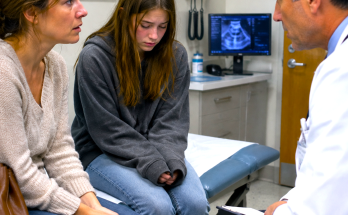
Months after the assault, Rachel returned to Dr. Patel for follow-up imaging.
She walked into the examination room using a cane.
The doctor smiled when she saw her.
“Look at you.”
Rachel sat carefully.
“Slowly.”
“Slowly counts.”
After reviewing the scans, Dr. Patel asked a question she asked at every visit.
“Are you safe?”
Rachel almost answered automatically.
Yes.
Daniel could not contact her.
She lived with Emily.
The doors locked.
Her phone was private.
Then Rachel thought about waking at night.
Checking ceilings.
Freezing when unknown numbers appeared.
Hearing Daniel’s voice inside every guilty thought.
“I’m becoming safe,” she said.
Dr. Patel nodded as though that were a perfectly valid medical answer.
On the drive home Rachel repeated the sentence silently.
Becoming safe.
Not arriving.
Not erasing.
Becoming.
That evening another envelope connected to Daniel’s criminal case arrived.
Emily brought it from the mailbox and placed it on the table.
Rachel recognized the return address.
Her stomach clenched.
“You want me to open it?” Emily asked.
Rachel nearly said yes.
Then she reached for it herself.
Inside was notice that the case was moving forward.
The prosecution intended to rely heavily on the medical findings, hospital witnesses, and Rachel’s statement.
Daniel’s attorney had begun suggesting that the incident occurred during some sort of emotional or psychological crisis.
Rachel read that paragraph twice.
The old reflex surfaced.
Maybe he really had lost control.
Maybe Daniel was sick.
Maybe naming him cruel was unfair if something was wrong with him.
Then Rachel remembered the prepared rope.
The folded towel.
Her keys on top of the refrigerator.
The delay before he called for help.
The story he wanted them to tell the hospital.
Those were not the scattered actions of one accidental second.
Daniel had made choices.
Rachel folded the letter.
“What is it?” Emily asked.
“They’re moving ahead.”
“How do you feel?”
Rachel looked toward the kitchen.
Toward the lowered coffee maker.
Toward the hallway she could now cross with a cane.
“I don’t know.”
Emily nodded.
That answer was allowed too.
Rachel placed the legal notice beside the wooden box containing the letter to her baby.
One represented what Daniel had done.
The other represented what Daniel could never define.
For months Rachel had believed recovery meant eventually becoming the woman she had been before the utility room.
Now she understood that woman had spent years making herself smaller to keep Daniel calm.
Rachel did not want to return to her.
She wanted to find out who she could become when every ordinary decision—where to live, whom to call, what name to write on a scrap of paper, whether to sit down or take another step—belonged to her.
The court proceedings still waited ahead.
Daniel would still try to explain.
Rachel was certain of that.
But this time his explanation would enter a room where scans, witnesses, records, and Rachel’s own signed words were waiting for him.
And for the first time since the morning he found those two names beside the refrigerator, Rachel was no longer afraid that his version would be the only one anyone heard.
Click Here to continue read next: PART5: When Daniel Finally Faced the Evidence, His Explanation Changed Again, and Rachel Realized the Trial Would Test More Than Her Memory
The Morning Daniel Found Two Girl Names Beside the Refrigerator, Something in His Face Told Rachel She Needed to Run
Part 4 of 8