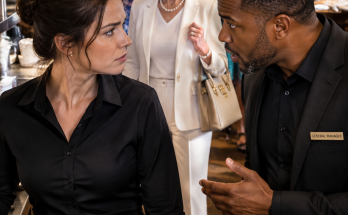
The question from the little boy stayed with Sarah longer than she expected.
Did you build it?
At the time, she had answered simply.
I helped build it.
But later, after the lunch rush had faded and the restaurant settled into its afternoon quiet, she found herself thinking about the difference between building something and merely possessing it.
She had once believed the distinction was obvious.
It wasn't.
David had possessed the ability to borrow money, negotiate contracts, persuade people, and make plans. He had looked at Oak & Vine and seen an opportunity. On paper, he could describe its value in numbers precise enough to satisfy a lender.
But he had never understood the mornings.
The deliveries that arrived before sunrise.
The refrigerator that failed during the busiest weekend of the year.
The employee who cried in the office because her father had been hospitalized.
The customer who complained about a table and then returned three days later to apologize.
The wedding party that stayed until closing because the bride could not stop dancing.
The years when there was barely enough money to replace a broken piece of equipment.
Those things never appeared in the valuation.
Sarah sat alone at table seven and looked around.
She understood now that the restaurant had survived not because it had been protected from difficulty, but because difficulty had never been allowed to become its identity.
That afternoon, Jessica entered carrying a cardboard box.
“I found this in storage.”
Sarah looked up.
“What is it?”
“Old photographs.”
Jessica set the box on the table.
Sarah opened it.
There were pictures from the first year.
The original dining room looked almost unfamiliar.
The walls had been a different color.
The chairs were mismatched.
The lighting was too bright.
Sarah laughed when she saw herself in one photograph wearing an apron two sizes too large.
Marcus appeared in another, younger and thinner, holding a tray with a ridiculous expression of exhaustion.
“Oh, no,” he said from behind her.
Sarah looked up.
“You've aged.”
“So have you.”
“I'm the owner.”
“Exactly. Stress.”
Jessica smiled.
They spread the photographs across the table.
There was one of Sarah and David standing outside the restaurant on opening night.
They were smiling.
Sarah stopped.
For a moment, she simply looked.
There had been happiness there.
Real happiness.
She refused to erase that just because the marriage had ended badly.
Marcus noticed her expression.
“You okay?”
“Yes.”
“You sure?”
Sarah nodded.
“I think I'm finally able to look at this without wanting to change it.”
Marcus sat down.
“That sounds like progress.”
Sarah touched the photograph.
“I used to think if the marriage ended, then every good memory had to become evidence against him.”
“And now?”
“Now I think a good memory can just be a good memory.”
Marcus nodded.
“That seems fair.”
Sarah put the photograph aside.
She did not throw it away.
She did not display it.
She placed it back in the box.
Some memories belonged to the past without needing to be punished for staying there.
A week later, Sarah received an unexpected letter.
The envelope came from the lender's office.
Her first reaction was physical.
Her shoulders tightened.
Her hand stopped halfway through opening it.
For a second, the old fear returned.
Then she looked at the return address again.
It was not a demand.
It was a formal notice confirming that all matters relating to David's proposed financing had been closed from the lender's side.
The document stated that Oak & Vine had no ownership obligation connected to David's financing.
Sarah read it twice.
Then she put it down.
There was something almost absurd about how ordinary the final confirmation looked.
Months of fear.
Months of meetings.
Months of documents.
And eventually, one page.
Closed.
She forwarded it to Jessica.
Then she sent a copy to the attorney who had helped her through the settlement.
The attorney replied with two words.
Keep it.
Sarah smiled.
She filed it.
That evening, Eleanor called.
Sarah almost let it go to voicemail.
Instead, she answered.
“Hello?”
“It's me.”
“I know.”
There was a pause.
“I received something from David.”
Sarah looked out the office window.
“What?”
“A message.”
“What did he say?”
Eleanor hesitated.
“He said he finally understands that he cannot rewrite what happened.”
Sarah closed her eyes.
“That sounds like progress.”
“I think so.”
“Did he ask you to contact me?”
“No.”
“Good.”
Eleanor laughed softly.
“I thought you'd say that.”
Sarah smiled.
They spoke for another few minutes.
Not about David.
Not about the divorce.
Eleanor told her about a garden she had started at home.
Sarah told her about the restaurant's new spring menu.
It was strange.
Months earlier, Sarah could not have imagined speaking to Eleanor about ordinary things.
Now she could.
Not because everything was forgotten.
Because it no longer needed to dominate every conversation.
When the call ended, Sarah remained in the office.
She looked at the gray box.
Then at the new notice from the lender.
Then at the drawer where she kept David's letter.
She understood something she had not understood when the conflict began.
Closure was not one moment.
It was a series of ordinary confirmations.
A repayment cleared.
A document filed.
A difficult conversation ended.
A morning passed without fear.
A question no longer hurt.
A memory stopped demanding an answer.
That was closure.
Not forgetting.
Not pretending.
Just no longer being controlled by what had happened.
The next morning, Sarah arrived early.
She opened the front door.
A delivery truck was already waiting.
The driver waved.
“Morning!”
“Morning.”
The kitchen staff began unloading produce.
Marcus appeared carrying a clipboard.
“We have a problem.”
Sarah looked at him.
“What now?”
“We're short six cases of tomatoes.”
She stared at him.
“That's your emergency?”
“It's a serious emergency.”
Sarah laughed.
“Handle it.”
Marcus smiled.
“That's the spirit.”
She walked into the kitchen.
The restaurant was alive again.
No courtroom.
No lawyers.
No ownership dispute.
Just tomatoes.
Orders.
Coffee.
People.
Work.
Sarah realized she preferred this kind of problem.
She preferred problems that could be solved before lunch.
Click here to continue reading: PART 18: The Things That Could Not Be Taken
Thirty-Eight Women Arrived Expecting a Free Feast, but My Mother-in-Law’s Casual Announcement Made Me Realize This Lunch Was Never Really About Food
Part 17 of 20