Ernest's birthday arrived in early spring.
He would have been seventy-three.
I woke before sunrise and lay quietly beneath the blanket, listening to the house settle.
For a moment, I reached across the bed without thinking.
My hand met cold sheets.
Then I remembered.
The grief came softly.
It no longer knocked me flat.
It simply entered the room and sat beside me.
By eight, I was in the kitchen making coffee.
At nine, Austin called.
“Happy birthday to Dad,” he said.
I smiled.
“Happy birthday to him.”
“We're coming over.”
“We?”
“Everyone.”
“How many people is everyone?”
“Don't worry.”
“That answer always means I should worry.”
He laughed.
“Mom, we'll bring food.”
“All right.”
“And Chloe has something for you.”
“For me?”
“Yes.”
“Why?”
“I don't know.”
“You're becoming mysterious.”
“I learned from you.”
I hung up smiling.
By noon, the cottage was full.
Lily brought flowers from the garden.
Ethan carried a cardboard box that he refused to explain.
Chloe arrived with food.
Austin brought a small folding table because he claimed my kitchen table wasn't large enough.
“You've been here five minutes,” I told him, “and you've already rearranged my furniture.”
“You're welcome.”
“I didn't thank you.”
“You will.”
He was right.
The garden filled with voices.
There was no ceremony.
No speech.
No one stood in the center and announced that our family had healed.
We simply ate.
That was better.
After lunch, Ethan disappeared toward the porch.
A few minutes later, he came running back.
“Grandma!”
“What?”
“You have to see this.”
He pulled me outside.
Near the rosebush sat a small wooden box.
I looked at Austin.
He shook his head.
“Not me.”
Chloe smiled.
Lily stood behind Ethan with her hands clasped.
“It's from all of us,” she said.
I crouched beside the box.
“May I open it?”
“Yes.”
Inside was a small brass plaque.
It wasn't elaborate.
Just a few engraved words.
For Grandma Theresa, who taught us that home is where you can be yourself.
I couldn't speak for a moment.
I looked at Austin.
His eyes were wet.
Chloe reached for his hand.
Lily looked uncomfortable with the silence.
“Is it okay?” she asked.
I touched the plaque.
“It is perfect.”
Ethan pointed at it.
“I helped choose the words.”
“I can tell.”
“What does it mean?”
I smiled.
“It means you're all getting very sentimental.”
He laughed.
We attached the plaque to the garden post that afternoon.
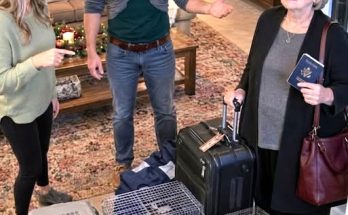
As I watched Austin tighten the final screw, I remembered the cages.
Three cages in my living room.
A rabbit.
Two parakeets.
A cat.
Austin had once dropped them there as if my grief were an empty room waiting to be filled with someone else's responsibilities.
I had thought that moment was the beginning of everything changing.
But perhaps it had only been the moment when I finally stopped pretending nothing needed to change.
The real transformation had happened slowly.
One refusal.
One apology.
One difficult conversation.
One unpaid bill.
One repaired fence.
One honest phone call.
One decision after another.
That evening, everyone stayed until the sky turned violet.
After the children went inside, Austin and I remained on the porch.
“Mom?”
“Yes?”
“Do you ever regret leaving?”
I looked toward the water.
“No.”
He nodded.
“Even though it hurt us?”
“It needed to hurt before we understood.”
He was quiet.
“I wish I'd understood sooner.”
“So do I.”
He smiled.
“But I don't think we can live our lives wishing the lesson had arrived earlier.”
“No.”
He looked at the garden.
“You're happy here.”
“Yes.”
“I can tell.”
“Are you?”
He thought about it.
“Not every day.”
I smiled.
“Good answer.”
“But yes.”
He leaned back in the chair.
“I used to think happiness meant not having problems.”
“What do you think now?”
“Having problems you know how to face.”
I looked at him.
That sounded like something Ernest might have said.
Maybe that was the real inheritance.
Not the trust.
Not the house.
Not the money.
Not even the letter.
A way of thinking.
A way of standing upright when life stopped cooperating.
Later, after everyone left, I carried the plaque inside for safekeeping before deciding where it should hang permanently.
I placed it beside Ernest's photograph.
For a while, I stood there.
“You would have liked today,” I said.
Then I smiled.
“You would have complained about the amount of food.”
The room was silent.
But the silence no longer felt empty.
I opened the drawer beneath the photograph and found the old cruise ticket.
The paper had faded.
I ran my thumb over the printed date.
That ticket had once represented escape.
Now it represented something else.
Proof.
Proof that I had been capable of choosing myself.
Proof that I could leave.
Proof that I could return.
Proof that my family could survive without me carrying every burden.
And perhaps most importantly, proof that I could love them without surrendering the life I had fought to recover.
I put the ticket back.
Then I took Ernest's letter from the folder.
I read the first few lines again.
He had been right about many things.
But there was one thing he couldn't have known.
He couldn't have known what our son would eventually become.
He couldn't have known how Chloe would change.
He couldn't have known that Lily would stand beside a research boat wearing a yellow raincoat and talking about the ocean.
He couldn't have known that I would one day sit on this porch and hear laughter coming from the garden without feeling responsible for keeping it alive.
That part belonged to us.
I folded the letter carefully.
Then I turned off the kitchen light.
Outside, the rosebush moved gently in the night wind.
The plaque caught a little moonlight.
For years, I had believed Ernest's final gift was the freedom to leave everything behind.
I finally understood that it was something more difficult.
He had given me the courage to decide what was worth carrying.
I carried his photograph.
I carried the lessons.
I carried the love.
I carried the memory of the woman I had been.
But I no longer carried everyone's problems simply because I was capable of lifting them.
That was the difference.
And when I closed the porch door that night, I did not feel as though I were closing myself away from the world.
I felt as though I were opening a home I had finally learned how to own.
Click here to continue reading: PART 17: When a Letter From the Trustee Raised One Last Question About Ernest’s Money, I Refused to Let Fear Turn My Family Back Into What It Had Been
My Son Arrived With Three Cages Seven Days After His Father’s Funeral, and His Careless Request Changed What I Had Planned for the Rest of My Life
Part 16 of 20