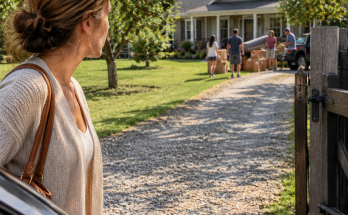
We left the diner after fifty-five minutes.
Not because everything was healed.
Because Sasha had decided when the conversation would end.
Outside, she stood beside the car with her arms folded tightly across her chest.
“I did it,” she whispered.
Omar smiled.
“You did.”
She looked at me.
“I thought I'd fall apart.”
“You didn't.”
“I thought I'd start apologizing.”
“But you didn't.”
Sasha laughed softly.
It was a nervous laugh, but it belonged to her.
Omar squeezed her hand.
“I’m proud of you.”
She looked at him.
“You were different today.”
“I’m trying.”
“Keep trying.”
He nodded.
That evening, Sasha called me from the house.
“We're changing things again.”
“What now?”
“We're putting a lock on the guest room.”
I smiled.
“Good.”
“And Omar says we're changing the bedroom furniture.”
“Why?”
“Because Denise used to sleep there.”
There was a pause.
“I don't want anything in this house reminding me that she took over.”
“Then change it.”
Sasha began reclaiming the property room by room.
She moved her favorite chair back beside the kitchen window.
She put her books on the shelves again.
She replaced the dishes that had disappeared during those chaotic weeks.
She even planted new flowers along the path to the orchard.
None of those things solved the deeper problem.
But they marked territory.
Not territory in the possessive sense.
Home.
A place where her choices did not require permission.
Omar continued therapy.
He began noticing how quickly he reacted whenever his mother expressed disappointment.
The first time Denise sent him a long message saying she had sacrificed everything for him, he nearly called her.
Instead, he showed the message to his therapist.
The therapist asked him a simple question.
“Are you responsible for fixing your mother's feelings?”
Omar sat with that for a while.
“No.”
“And what are you responsible for?”
“My behavior.”
He began practicing that answer.
It sounded simple.
It wasn't.
For years, Omar had learned to obey guilt before he even recognized it.
Meanwhile, Denise stayed away from the house.
That mattered.
She didn't suddenly become warm or humble.
She didn't send flowers every morning or write dramatic apologies.
She simply respected the boundary for several weeks.
Then, on a Thursday afternoon, another message arrived.
Sasha called me.
“Mom?”
“What happened?”
“Denise says she has some important family documents for Omar.”
“Where are they?”
“She wants to bring them here.”
“No.”
“I know.”
Omar had already told her the same thing.
He offered an alternative.
Meet at the coffee shop.
Or mail them.
Denise replied that her car was unreliable.
Sasha gave a small, humorless laugh.
“Funny how her car works whenever she wants something.”
“Did Omar answer?”
“He said she could mail them.”
“That was the right answer.”
Denise then sent several messages.
You don't care about me.
After everything I've done for you.
I guess I'm nothing now.
Sasha read them aloud.
I could hear the hurt in her voice.
“Don't answer.”
“But I feel guilty.”
“You were trained to feel guilty.”
She went quiet.
“Guilt isn't proof that you've done something wrong,” I told her.
The documents eventually arrived by mail.
They were not important.
An old school certificate.
A photograph of Omar as a little boy.
A birthday card.
A few papers that had no reason to require a trip to the house.
Omar stared at them.
“She wanted an excuse to come inside.”
Sasha looked at him.
“Do you think she even knows she's doing it?”
He thought for a moment.
“Maybe.”
That uncertainty was important.
They were no longer trying to diagnose Denise.
They were watching behavior.
A month later, Denise tried a different approach.
She left Omar a voicemail saying she was having chest pain and didn't know whether she would live through the night.
Omar heard the message and immediately grabbed his keys.
He drove halfway to her apartment before calling his father.
His father answered.
“She's fine.”
Omar's hands tightened around the steering wheel.
“What?”
“She is sitting on the sofa watching television.”
Omar pulled over.
For several seconds, he couldn't move.
Then he called Sasha.
“I almost went.”
“I know.”
“My body just reacted.”
“You can love her without obeying every emergency she creates.”
He closed his eyes.
“I’m afraid I'll fail you.”
Sasha's answer came quietly.
“Then keep choosing.”
He breathed out.
“Every day?”
“Every day.”
That night, Omar came to my apartment.
He sat at my kitchen table with his hands folded between his knees.
“I owe you an apology.”
“You've already apologized.”
“Not enough.”
I waited.
“You bought Sasha that house so she could be safe,” he said. “And I let my family turn it into a place where she couldn't breathe.”
I studied him.
“You can't undo those weeks.”
“I know.”
“But you can decide what they mean.”
He nodded.
“We're doing a postnuptial agreement.”
I raised an eyebrow.
“You are?”
“Yes.”
He explained that the property would remain Sasha's separate property. If the marriage ever ended, he would not claim it.
“I'm not doing this because I expect us to fail,” he said. “I'm doing it because she should never wonder whether staying married means risking her home.”
I nodded slowly.
“That is your decision.”
“I want her to feel secure.”
The following week, they met with Attorney Miller.
Sasha signed first.
Her hand did not shake.
Omar signed afterward.
When it was finished, Sasha called me.
“I feel protected,” she said.
“Good.”
There was a long pause.
“I never thought I'd say that about my own marriage.”
“You should never have had to.”
When Denise eventually learned about the agreement through Omar's father, she sent one message.
So she's planning to leave you.
Omar replied only once.
She's planning to stay safe. I should have wanted that from the beginning.
Then he stopped responding.
For several weeks, Denise became quiet.
Sasha expected another crisis.
None came.
Instead, she began working.
Her baking business started with one folding table at the local farmers market.
She made lemon bars, cinnamon rolls, peach jam, and small loaves of bread.
The first Saturday, everything sold out.
She called me afterward, laughing so hard she could barely speak.
“Mom, they bought everything.”
“I told you.”
“Omar helped me.”
“He should.”
“He built me another worktable too.”
That evening, I drove to the acreage.
Sasha was still wearing her market apron.
Flour dusted one cheek.
She looked tired.
She also looked alive.
We sat beneath the guava tree while the sun lowered behind the orchard.
“I used to think the house saved me,” she said.
I looked at her.
“It gave me a place to start,” she continued. “But I didn't know how to protect myself once I was inside it.”
“You know now.”
She nodded.
“I do.”
Omar came outside carrying three glasses of lemonade.
He handed one to Sasha before taking the chair beside her.
Nobody was ordering anyone around.
Nobody was shouting from another room.
Nobody was demanding tea.
The house behind us was quiet.
For the first time, that quiet felt like peace.
Then Sasha looked toward the road.
Her smile faded slightly.
“What?”
“I keep wondering whether Denise will really change.”
I considered the question.
“Maybe she will.”
“And if she doesn't?”
“Then you'll still be okay.”
She looked at me.
That answer seemed to settle something.
Because the real change was no longer happening in Denise.
It was happening in Sasha.
She had stopped waiting for someone else to become safe before allowing herself to feel safe.
She had learned that forgiveness did not require access.
Marriage did not require surrender.
Family did not mean obedience.
And a house given as a gift could become something much more important than four walls.
It could become the place where a person finally remembered her own name.
Sasha leaned back in her chair.
“Mom?”
“Yes?”
“Thank you for coming that morning.”
I smiled.
“You're my daughter.”
“I know.”
She looked toward the house.
Then she said something I knew she had not been able to say a month earlier.
“I think I finally understand that I belong here.”
I reached across the table and squeezed her hand.
“You always did.”
Click here to continue reading: PART 5: The First Real Test Came Quietly, When an Old Family Pattern Returned Without Anyone Raising Their Voice
I Came to Check on My Daughter and Found Eight People Living in the Home I Had Bought to Give Her a Second Chance
Part 4 of 8