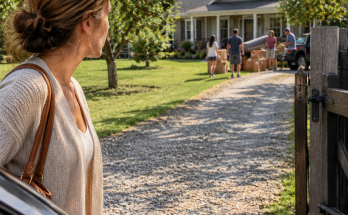
Denise stepped inside and stopped.
The pause was noticeable.
She looked toward the living room, then the kitchen, then the hallway.
“I've missed this place,” she said.
Sasha's expression tightened.
Denise immediately corrected herself.
“I'm sorry. That wasn't appropriate.”
Sasha nodded.
“Thank you.”
They sat at the dining table.
Omar poured coffee.
Denise placed the flowers beside her plate.
“I brought these for you.”
“Thank you.”
Nobody mentioned the past for several minutes.
They talked about the bakery.
Denise asked how many orders Sasha had received that month.
Sasha answered.
Then Denise asked whether she planned to expand.
“Eventually.”
“You should.”
Sasha smiled faintly.
“I'll decide when I'm ready.”
Denise nodded.
“You're right.”
The conversation remained surprisingly easy.
Then Denise asked, “Have you thought about having children?”
The room went still.
Omar looked at his mother.
“Mom.”
“What? I'm asking.”
Sasha placed her cup down.
“That isn't something we're discussing.”
Denise's face fell.
“Of course.”
The old reflex had appeared.
A question that sounded harmless but carried an expectation.
Sasha recognized it.
So did Omar.
The difference was that nobody allowed the moment to grow.
Denise apologized.
They continued lunch.
Afterward, Sasha showed her the baking station.
“This is where I work.”
Denise admired the shelves.
“You built all this?”
“Omar helped.”
Denise glanced at her son.
“You've become very good at supporting her.”
Omar smiled.
“I'm trying.”
Denise nodded.
“I can see that.”
The visit ended after ninety minutes.
Denise stood at the door.
“Thank you for letting me come.”
Sasha nodded.
“You're welcome.”
Denise hesitated.
“Could I come again?”
Sasha considered it.
“Not yet.”
Denise swallowed.
“All right.”
She left.
Sasha closed the door.
Omar looked at her.
“How do you feel?”
“Exhausted.”
“Me too.”
“But not unsafe.”
He smiled.
“That’s progress.”
For the next several weeks, contact remained limited.
Denise came for another lunch.
Then a short coffee visit.
She never asked to stay overnight.
She never brought another relative.
She never mentioned the bedroom.
Slowly, the family began rebuilding something that did not look like the old relationship.
It had more distance.
More honesty.
More consequences.
And, surprisingly, more respect.
Then one Sunday morning, Omar received a call from his father.
His mother had fallen.
Omar immediately stood.
“What happened?”
“She slipped in the kitchen.”
“Is she hurt?”
“Her wrist may be broken.”
Sasha grabbed her coat.
“Let's go.”
Omar looked at her.
“You don't have to.”
“I know.”
She picked up her purse.
“I want to.”
They drove to the hospital.
Denise sat in a bed with her arm immobilized.
When she saw Sasha, her face changed.
“You came.”
“Yes.”
Denise began crying.
“I didn't expect you.”
Sasha pulled a chair beside the bed.
“I wasn't coming because I forgot what happened.”
Denise nodded.
“I know.”
“I came because you're hurt.”
Denise looked down.
“That means more than you know.”
The doctor eventually confirmed a fracture.
Nothing life-threatening.
Still, Denise would need help for several weeks.
Her husband was recovering from his own health problems, and her other children lived out of town.
Omar looked at Sasha.
“We need to figure something out.”
Sasha thought.
“We can arrange home care.”
Denise shook her head.
“I can't afford it.”
Omar's expression tightened.
“How much?”
She told him.
Sasha immediately understood the danger.
Not because Denise was necessarily manipulating them.
Because dependence could quietly reopen old patterns.
“We'll help pay for the first week,” Sasha said.
Denise stared at her.
“Why?”
“Because you need help.”
“And after that?”
“We'll review what you actually need.”
Denise nodded.
Omar looked relieved.
They arranged a professional caregiver.
Sasha did not invite Denise back to the house.
That decision was deliberate.
When they returned home, Omar thanked her.
“You handled that better than I did.”
“You wanted to bring her home.”
“I did.”
“I know.”
He sighed.
“She looked so helpless.”
“She was helpless.”
“That's different from being entitled to our home.”
He nodded.
“I needed to hear that.”
The caregiver arrangement worked.
Denise recovered.
And something unexpected happened.
She began respecting Sasha more after Sasha refused to rescue her in the old way.
Not because Sasha was cruel.
Because the boundary forced Denise to recognize that help did not have to mean control.
Months passed.
Sasha's bakery moved from a market table into a small rented storefront.
She named it Orchard Bread.
The sign went up on a rainy Tuesday.
Omar stood beside her holding an umbrella.
I stood behind them, watching my daughter stare at the sign.
“You really did it,” I said.
She smiled.
“I think I did.”
The first morning the shop opened, Denise sent flowers.
No note asking to visit.
No message demanding photographs.
Just flowers.
Sasha placed them near the register.
Customers came steadily.
By noon, the shelves were almost empty.
A woman bought the last loaf and asked whether Sasha had another location.
“Not yet,” Sasha said.
The woman laughed.
“You will.”
That evening, Sasha locked the door.
She leaned against it.
“I’m tired.”
Omar smiled.
“Good tired?”
“The best kind.”
He kissed her forehead.
I watched them from the sidewalk.
The marriage that had once looked as though it might collapse was becoming stronger precisely because both people had finally learned that love did not erase boundaries.
Then came the letter.
It arrived two weeks later.
Not from Denise.
From an attorney.
Sasha opened it at the kitchen table.
Her face changed.
“What is it?”
She handed it to Omar.
He read the first page.
Then the second.
His jaw tightened.
“What?”
He looked at me.
“My mother is claiming she contributed money toward this property.”
Sasha went pale.
“She didn't.”
“I know.”
The letter stated that Denise believed she had a financial interest because she had allegedly paid for several household expenses after moving in.
The claim was absurd.
But the threat was real.
Sasha had spent years believing conflict could make her lose everything.
Now the fear returned.
Omar took her hand.
“We have the deed.”
“But what if she—”
“We have records.”
Attorney Miller reviewed everything.
The property was clearly Sasha's.
The money Denise claimed to have contributed amounted to household expenses, groceries, utilities, and personal purchases during the period she had occupied the house.
None established ownership.
Miller prepared a response.
Sasha signed it.
Then she sat quietly.
“I thought we were past this.”
“We may be,” Omar said. “But we don't control what someone else files.”
The letter was sent.
Weeks passed.
Nothing happened.
Then another envelope arrived.
This time, it was from Denise herself.
Sasha opened it carefully.
Inside was a handwritten note.
I was angry and frightened when I made the claim. I wanted to feel that I still had some power. I was wrong. I have withdrawn it.
Sasha read the sentence twice.
Then she looked at Omar.
“She admits it.”
He nodded.
“What do you want to do?”
Sasha folded the letter.
“I don't know.”
For the first time, she understood something important.
Forgiveness was not the same as trust.
Trust could be rebuilt.
But it could also be withdrawn again.
She placed the letter in a drawer.
“I'll think about it.”
That night, she couldn't sleep.
Around two in the morning, she walked into the kitchen.
The house was dark.
She stood beside the sink where she had once spent entire days washing dishes for people who treated her like she was invisible.
She touched the counter.
Then she smiled.
The sink was empty.
The house was hers.
And this time, nobody had to tell her.
Click here to continue reading: PART 7: The Last Boundary Was the Hardest, Because Keeping It Meant Accepting That Love Could Not Repair Everything at Once
I Came to Check on My Daughter and Found Eight People Living in the Home I Had Bought to Give Her a Second Chance
Part 6 of 8