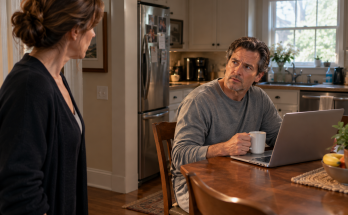
My husband quit his job three days after my father died. He told me this while I was sitting at the kitchen counter with Dad’s death certificate beside a cup of coffee I had forgotten to drink.
Mark came in wearing gray sweatpants and carrying a cardboard box from his office. His company badge rested on top of several folders, the plastic clip catching the afternoon light whenever he moved.
I looked at the box, then at him. “What happened?”
He opened the refrigerator, stared inside for a moment, and took out a bottle of water. “Nothing.”
“Then why are you carrying your office home?”
He twisted the cap loose. “I quit.”
For several seconds, the sentence did not fit inside my head. I had slept badly for three nights, answered dozens of calls from relatives, chosen flowers, spoken to the funeral home, and spent hours trying to accept that Walter James Hail was no longer going to answer his phone.
My father was seventy-two. He had taught me to change a tire, balance a checkbook, and recognize the particular smile people wore when they were about to sell me something I did not need.
Now his death certificate lay beneath my hand.
And Mark had quit his job.
“When?”
“This morning.”
“Your job?”
He gave me a tired look. “Yes, Clare. My job.”
“Mark, Dad’s funeral is Friday.”
“I know.”
“Then why would you leave a position you’ve held for nine years?”
He leaned against the refrigerator. There was an ease in his posture that bothered me more than the resignation itself. Mark had spent years complaining about his regional operations position, but complaining was different from walking away from a six-figure salary.
“I’ve been thinking about leaving for a long time,” he said.
“You told me we couldn’t afford for you to leave yet.”
“Things changed.”
I watched him carefully. “What changed?”
His eyes met mine.
“Your father died.”
The words landed harder than he seemed to expect. He straightened immediately.
“That isn’t how I meant it.”
“Then tell me how you meant it.”
He came around the counter and put his hands lightly on my shoulders. Usually that gesture made me feel safe. That morning, it felt as if he were preparing me for an argument.
“I’m saying we don’t have to live so cautiously anymore.”
“We weren’t living cautiously.”
“You know what I mean.”
“No. I really don’t.”
His voice softened. “Clare, your dad did well. Very well. You shouldn’t have to worry about money anymore.”
I stared at him.
Money.
That was the first word that made the whole conversation change shape.
Since the hospital called on Sunday night, I had not asked what my father owned. I knew he had been successful. He had built Hail Mechanical from a borrowed van, a used toolbox, and years of exhausting work. By the time he sold most of the company, it employed more than a hundred people.
He had property. Investments. Accounts I had never seen.
But Dad never discussed wealth as though it were a family sport.
“You quit because you think I’m inheriting a fortune?”
Mark’s expression tightened. “That’s not fair.”
“It’s what you just implied.”
“I’m saying maybe your father left enough for us to make different choices.”
“We already made our choices.”
“I worked sixty hours a week.”
“And now you work none.”
His jaw shifted.
I regretted the sharpness, but I did not apologize for it.
Outside, rain darkened the maple branches. Dad’s old pickup was still parked beside the garage. I had not been able to move it since Sunday. I kept expecting to see him behind the wheel, one hand resting over the steering column, impatiently waiting for me to finish whatever errand had taken too long.
Mark followed my gaze.
“I thought you’d be relieved,” he said.
“About what?”
“That I can be here.”
“If you wanted time for the funeral, you could have taken bereavement leave.”
“That isn’t what I mean.”
“Then what do you mean?”
He looked at me for a long moment.
“For once, we can stop worrying about every financial decision.”
I almost laughed.
We had a mortgage we could comfortably afford. We had retirement savings, insurance, and an emergency fund. Both cars were paid off.
Mark wanted more.
That was not the same thing as us needing rescue.
His phone rang.
He glanced at the screen.
“Mom.”
He answered without leaving the kitchen.
“Hey.”
I looked down at the death certificate, but his side of the conversation made it impossible to ignore.
“Yes, she’s here.”
A pause.
“No, nothing yet.”
Another pause.
“I don’t know when Samuel is meeting with her.”
My fingers stopped moving.
Mark looked at me.
“No, Mom. Don’t start making plans.”
Then he laughed quietly.
“Seriously. Not yet.”
He ended the call.
I put the death certificate down.
“What is your mother planning?”
“Nothing.”
“Mark.”
He rubbed the back of his neck.
“She asked about the house.”
My father’s house.
I waited.
“She wanted to know what you might do with it.”
“Dad hasn’t even been buried.”
“I told her that.”
“And?”
He hesitated.
“She thought that if you didn’t want it, there might be other possibilities.”
“What possibilities?”
“For family.”
The grief that had kept me numb for two days suddenly gave way to something cleaner and colder.
“Your mother wants my father’s house?”
“She didn’t say that.”
“What did she say?”
“She’s been thinking about downsizing.”
I looked around the kitchen Dad had remodeled himself after Mom died. The oak cabinets still held tiny pencil marks inside one door where he had measured hinges. His chipped blue mug sat upside down beside the sink.
“Who else knows about this?”
Mark shrugged.
“I don’t know.”
“That isn’t an answer.”
“She could use help with the bakery,” he added.
I closed my eyes.
There it was again.
Another expense being planned against an inheritance I had not even received.
“How much help?”
“I don’t know.”
“Then why are you telling me?”
“Because if the estate is what everyone thinks it is—”
“Who is everyone?”
He stopped.
That silence told me more than an explanation would have.
My phone rang before I could press him.
Samuel Green.
Dad’s attorney.
I answered immediately.
“Samuel?”
“Clare, I’m sorry to call during all this.”
“You’re not bothering me.”
“I wanted to confirm Friday’s arrangements. There’s also something your father instructed me to handle after the funeral.”
Mark had stopped moving.
Samuel continued.
“Could you come to my office Saturday morning?”
“Yes.”
“At ten?”
“Yes.”
He paused.
“Alone, please.”
I looked across the kitchen.
Mark’s face had changed.
“Alone?”
“That was your father’s explicit instruction.”
A chill moved through me.
“Did Dad leave something I need to know about?”
“More than something.”
I tightened my grip on the phone.
“He left a personal letter for you. He wanted you to read it before we discuss the estate.”
“Did he know he was dying?”
“No. Not specifically.”
Samuel’s voice became quieter.
“But he knew there were things he might not always be here to explain.”
“What kind of things?”
“I think Walter should answer that himself.”
I heard papers moving on his desk.
Then Samuel said, “There is something written on the outside of the envelope.”
“What?”
A pause.
“He wrote, ‘Give this to Clare before anyone asks her for anything.’”
I looked at Mark.
His cardboard office box sat between us on the kitchen counter.
For the first time since Dad died, I understood that grief was no longer the only thing waiting for me.
Click here to continue reading: PART 2: Before I Could Choose My Father’s Suit for Burial, My Husband’s Family Was Already Measuring the House and Spending an Inheritance Still Locked Away
Three Days After Dad’s Funeral Arrangements Began, Mark Came Home With His Job in a Box and a Future He Had Already Planned
Part 1 of 12