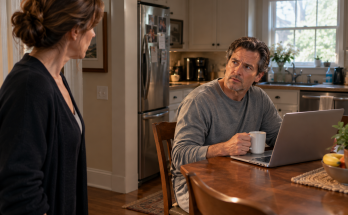
Mark waited until I ended the call before speaking.
“What did Samuel want?”
I placed my phone face down.
“He wants to see me Saturday.”
“What time?”
“Ten.”
“I’ll drive you.”
“You’re not going.”
His expression changed.
“Excuse me?”
“Dad asked Samuel to meet with me alone.”
“Why?”
“I don’t know.”
“That’s strange.”
“Maybe.”
He stared at me.
“I’m your husband.”
“I know.”
“If this is about the estate, I should be there.”
“It’s not your estate.”
The words came out quietly.
That seemed to make them worse.
He opened his mouth, then closed it.
I could almost see the correction settling between us.
My father’s estate.
Not ours.
That afternoon, I drove to our house after spending several hours at the funeral home. I needed clothes and a few things for Friday. When I walked through the front door, the answering machine was blinking.
Two messages.
The first was Diane, Mark’s mother, offering condolences and asking whether I needed help “sorting through Walter’s things.”
The second was Melissa.
I replayed it.
Her voice filled the room.
“Clare, I heard the house might be available eventually. If you’re thinking of selling quickly, I know someone who could give you a fair valuation.”
The machine clicked.
Mark came down the stairs.
I turned toward him.
“Who told Melissa I might sell Dad’s house?”
He stopped.
“She’s trying to help.”
“That wasn’t my question.”
“I might have mentioned there would be decisions.”
“When?”
“Yesterday.”
My father had been dead roughly twenty-four hours.
I walked into the living room because I needed distance between us. Our wedding photograph stood on the bookshelf. Mark was thirty-one in it, laughing because Dad had whispered something just before the picture was taken.
Dad’s hand rested on Mark’s shoulder.
For years, I had loved that photograph because it looked as though the three of us belonged together.
That afternoon, I could not stop wondering what Dad would have thought if he had known the conversation happening around his daughter before his funeral.
Mark followed me.
“You’re making this uglier than it is.”
“I’m repeating what happened.”
“You’re grieving.”
“So I imagined Melissa’s message?”
“No.”
“Then don’t use grief to make me doubt what I heard.”
He looked ashamed.
“Okay.”
I sat down.
For a while, neither of us spoke.
Then Mark said, “Your dad and I talked about money before.”
I looked up.
“When?”
“Over the years.”
“What money?”
“Business. Investments. Things like that.”
“Dad discussed his finances with you?”
“Not exactly.”
“What exactly?”
He stood.
“Clare, it wasn’t important.”
“That phrase is becoming difficult to hear.”
He paced once across the room.
“Your father wanted to make sure you were taken care of.”
“That sounds like him.”
“He told me you’d never have to worry.”
“That also sounds like him.”
Mark relaxed.
Then he added, “He built everything for you.”
“No. He built his life. He happened to want me protected.”
“You know what I mean.”
“I’m starting to think I don’t.”
The next morning, I went to Dad’s house alone.
I needed to choose the suit he would be buried in.
There are things grief asks you to do that feel almost indecent. Choosing a shirt for your dead father is one of them.
His closet still smelled faintly of detergent. Work shirts occupied most of one side despite his retirement. Denim. Flannel. A canvas jacket with a burn mark near the cuff.
On the top shelf sat an old metal lunchbox.
I pulled it down.
Inside were receipts, photographs, a small screwdriver, and a drawing I had made when I was a child.
Three crooked figures stood beside a blue house.
Mom.
Dad.
Me.
My father had written the date on the back more than thirty years earlier.
I sat on the closet floor.
That was where Mark found me.
He had used his spare key.
“You should have called me,” he said.
“I wanted to be alone.”
“I know. I thought you might need help.”
For several minutes he did exactly what I needed.
Nothing.
He simply sat beside me while I held the drawing.
Eventually I leaned against his shoulder.
“I keep expecting Dad to walk through that door.”
Mark kissed my hair.
“I know.”
For a moment, he was the man I remembered.
Then his phone buzzed.
He looked at the screen.
“Melissa.”
“Answer it.”
“I can call her later.”
“Answer it.”
He accepted the call.
“Hey.”
Melissa’s voice was loud enough for me to hear fragments.
Square footage.
Taxes.
Then a sentence that made me sit upright.
“Mom says Clare probably won’t want a place that big.”
Mark stood.
“I’ll call you back.”
He ended the call.
I stared at him.
“Your mother and sister are discussing the size of my father’s house?”
“I didn’t ask them to.”
“Did you tell your mother she could have it?”
“No.”
His answer was immediate.
Then his eyes shifted away.
“What did you tell her?”
He exhaled.
“That there was a possibility.”
“A possibility of what?”
“If you inherited the house and didn’t want it, Mom could move in instead of renting.”
I stood.
“You offered my father’s house to your mother before asking me?”
“I didn’t offer it.”
“You told her it was possible.”
“That’s not the same thing.”
“It is when the property doesn’t belong to you.”
His face hardened.
“We’re married, Clare.”
“What does that mean?”
“It means decisions about our future affect both of us.”
“Decisions about our house do.”
“Anything you inherit changes our financial situation.”
There it was again.
Not Dad.
Not me.
Financial situation.
I looked at the drawing in my hand.
Dad had saved a worthless piece of paper for thirty-four years.
My husband had discussed a house worth hundreds of thousands before the funeral.
“Give me the spare key.”
Mark blinked.
“What?”
“To Dad’s house.”
“Why?”
“Because I asked to be alone and you came in anyway.”
“I was checking on you.”
“I’m telling you I need the key.”
His expression moved from disbelief to irritation.
Still, he reached into his pocket.
The brass key landed in my palm.
I closed my fingers around it.
“Clare, this is getting ridiculous.”
“No. What’s ridiculous is that I’m choosing Dad’s burial clothes while your family is discussing who might move into his bedroom.”
He looked wounded.
“That isn’t fair.”
“Maybe.”
I put the key in my pocket.
“But it’s happening.”
He left.
He did not slam the door.
Somehow that made the silence afterward heavier.
I chose Dad’s charcoal suit, the pale blue shirt, and the burgundy tie Mom had given him years ago.
When I carried them downstairs, the answering machine blinked again.
Four messages.
The first two were condolences.
The third was from Carlos, one of Dad’s former employees. He cried while telling me Dad had kept him on payroll during his wife’s cancer treatment.
The fourth was Samuel.
“Walter, it’s Samuel. I’ve completed the revisions we discussed. Everything is structured according to your instructions. Call me when you have time.”
The message was eight months old.
I replayed it.
Revisions.
Structured.
Instructions.
I thought about Samuel’s warning.
Before anyone asks her for anything.
For the first time, I wondered whether Dad had prepared for more than death.
That evening Diane came to our house carrying a casserole. Her rose perfume mixed with the smell of onions and butter.
She hugged me.
“I’m so sorry, sweetheart.”
“Thank you.”
For several minutes, she was simply kind.
Then we sat at the table.
Mark poured wine.
Diane folded her napkin.
“I hope you know I would never pressure you about Walter’s house.”
I looked at Mark.
He stared into his glass.
“I didn’t realize we were discussing it tonight.”
“We aren’t,” I said.
Diane flushed.
“I only wanted to clear the air.”
“What air?”
She glanced at Mark.
“He said you were upset.”
“Did he tell you why?”
She hesitated.
“He said there had been a misunderstanding.”
I almost smiled.
“No misunderstanding. He suggested you might move into Dad’s house.”
Her eyes widened.
“Only if you didn’t need it.”
“I haven’t decided anything.”
“Of course.”
“I don’t even know what Dad legally left me.”
“Of course.”
Her agreement came too quickly.
Then she touched my wrist.
“Your father was successful. I’m sure he wanted his family comfortable.”
His family.
I gently moved my hand away.
“My father was very specific about what he wanted.”
Diane gave a small smile.
“Then that’s what matters.”
Later, after she left, Mark stood at the sink.
“She didn’t mean anything bad.”
“I know.”
He looked surprised.
I did know.
Diane had been told a future might be available. She had allowed herself to imagine it.
That was different from the person who had created the expectation.
Before bed, Samuel called.
“I wanted to remind you of something Walter told me.”
“What?”
“He said that if anything happened to him, you might hear plans presented as though you had already agreed to them.”
I sat on the edge of the mattress.
“What plans?”
“He never specified.”
“Samuel, was Dad worried about Mark?”
Silence.
“I think Walter wanted you to reach your own conclusions.”
“That isn’t really an answer.”
“No.”
His voice remained gentle.
“But it is the answer he instructed me to give.”
I looked toward the bathroom.
The faucet stopped.
Samuel continued.
“Come Saturday. Read the letter. Then ask whatever you need.”
“Okay.”
“And Clare?”
“Yes?”
“Until then, don't agree to anything involving the estate.”
My eyes settled on Mark as he walked out of the bathroom.
“I won’t.”
Click here to continue reading: PART 3: At My Father’s Funeral, Mark Tried to Be the Husband I Remembered, Until One Question About the Estate Changed What I Saw
Three Days After Dad’s Funeral Arrangements Began, Mark Came Home With His Job in a Box and a Future He Had Already Planned
Part 2 of 12