The first thing I noticed was the way Jessica laughed when she handed me the birthday card.
It was not a warm laugh. It had a little edge to it, as if she had been waiting all evening for everyone else at the table to understand the joke she had already told herself.
She slid a small envelope across the table with two fingers.
“Here,” she said. “Something fun.”
The dining room was crowded with half-finished plates, crumpled napkins, and the remains of a grocery-store cake Colin had insisted on buying because, according to him, nobody wanted to spend my birthday cooking.
I smiled and opened the envelope.
Inside was a two-dollar scratch-off ticket.
For a moment, I simply looked at it.
Jessica leaned back in her chair.
“Maybe today is your lucky day.”
Colin chuckled from beside her, though his eyes stayed on his plate.
I had known my daughter-in-law for almost nine years by then. I had learned the difference between her genuine amusement and the particular laugh she used when she wanted someone to feel small without giving them anything concrete enough to object to.
So I did what I had become very good at doing.
I smiled.
“Thank you,” I said.
Jessica's mouth curved again.
“Don't get too excited.”
I ran my thumb over the smooth edge of the ticket.
Across the table, my grandchildren were arguing over who had taken the last piece of frosting. Lucas was eight, Sophie six, and neither had noticed anything unusual. Colin reached over to separate them while Jessica watched me scratch the silver coating away.
The little coin scraped softly against the ticket.
Once.
Twice.
Three times.
Then I stopped.
I saw the numbers.
For several seconds, I thought I was reading them incorrectly.
My heart gave one hard, painful beat.
I looked again.
There was no mistake.
The prize was eleven million dollars.
I lowered the ticket.
Jessica was watching me.
“Well?”
I made myself laugh lightly.
“Nothing.”
She tilted her head.
“Nothing?”
“I didn't win anything worth talking about.”
Colin looked over.
“Told you.”
Jessica laughed.
“What did you win?”
I turned the ticket face down.
“Not even enough for bus fare.”
That made her laugh harder.
“Happy birthday, Margaret.”
I thanked her again.
Then I slipped the ticket beneath the birthday card.
Nobody at that table knew what I had just seen.
Nobody would know for quite some time.
That night, after everyone had gone to bed, I carried the ticket into the bathroom and locked the door.
I sat on the closed toilet lid with the ticket in my lap.
My hands were shaking.
Not because of the money.
Not entirely.
The number was so large that it didn't feel real. Eleven million dollars was the kind of amount that belonged in newspaper stories, not in the hands of a seventy-three-year-old woman who had spent most of her adult life comparing grocery prices and saving leftovers.
I stared at those numbers until my eyes watered.
Then I remembered Jessica's laugh.
I remembered the way she had said it was something fun.
And suddenly, the ticket didn't feel like a joke anymore.
It felt like a door.
The next morning, I called the lottery office from my bedroom.
They told me what I already suspected: I needed to bring the ticket in person, secure it, and speak with the appropriate people before doing anything else.
I asked how long I had to claim it.
The answer was generous.
That was the first piece of luck I had received that didn't come printed on cardboard.
I put the ticket inside an old envelope and tucked it behind a stack of winter clothes.
For the next several days, I behaved exactly as I always had.
I made breakfast.
I packed lunches.
I drove Sophie to school when Jessica said she was too busy.
I folded laundry.
I washed dishes.
I listened when Colin complained about work.
Nobody suspected that I had begun meeting privately with a lawyer and a financial adviser.
The first appointment took place in a small office downtown with beige walls and a coffee machine that made everything smell faintly burnt.
The attorney, Mr. Harris, looked at the ticket twice.
Then he looked at me.
“Are you certain you want to proceed?”
“Yes.”
“And your son?”
I folded my hands in my lap.
“My son doesn't know.”
He studied me for a moment.
“Does anyone know?”
“No.”
That answer surprised him.
It surprised me, too.
But I had spent enough years being told what was best for me that the idea of keeping one decision entirely to myself felt almost revolutionary.
The claim process took time.
There were forms, signatures, verification, and conversations I barely understood.
I learned that suddenly having money did not make paperwork disappear. It multiplied it.
I also learned something more important.
Money could buy privacy.
It could buy professional advice.
It could buy choices.
But it could not tell me what I should do with my life.
That part was still mine.
For the first few months, I changed almost nothing.
I continued living in Colin and Jessica's house.
I continued helping with the children.
I continued contributing whenever there was a household expense Jessica complained about.
And I continued pretending that the scratch-off ticket had been worthless.
It was easier that way.
At least, that was what I told myself.
The truth was more uncomfortable.
I had begun noticing things I used to excuse.
The way Jessica would leave grocery bags on the kitchen floor because she assumed I would put everything away.
The way Colin would say, “Mom, can you handle this?” without ever asking whether I had other plans.
The way they spoke about my future as though it were an administrative matter.
At first, I thought I was imagining it.
Then I started writing things down.
Not accusations.
Just facts.
A Tuesday when Jessica scheduled a doctor's appointment for me without asking.
A Saturday when Colin told me they were taking the children somewhere and assumed I would watch them afterward because “Mom doesn't mind.”
A Sunday afternoon when Jessica moved my sewing supplies out of the spare room because she wanted to turn it into a storage area.
I said nothing.
She thanked me for being understanding.
That sentence stayed with me.
Understanding had become another word for surrender.
By the fourth month, the money had been secured and divided into carefully protected accounts.
I could have bought a mansion.
Instead, I started looking at modest houses.
Places with porches.
Places with gardens.
Places where I could wake up without hearing someone else's alarm clock through the wall.
I found a small yellow cottage in South Carolina.
It had a wraparound porch, a patch of grass that needed attention, and wild roses climbing along one side of the fence.
The kitchen was outdated.
The floors creaked.
The bathroom needed work.
I loved it immediately.
I didn't tell Colin.
I didn't tell Jessica.
I told myself I was simply keeping an option open.
In June, I bought it.
The deed had my name on it.
The first night I stayed there, I sat on the porch until dark.
A woman named Helen lived down the road. She brought me peach bread the following morning and asked whether I had grandchildren.
I told her I did.
She asked whether they lived nearby.
I said no.
That was the first time in years I had answered a question about my family without carefully choosing words to keep everyone comfortable.
When I returned home, nothing had changed.
That was the strange part.
The house looked exactly the same.
The kitchen still smelled like coffee.
Lucas's shoes were still under the bench.
Sophie had left a purple marker without its cap on the counter.
Jessica still walked into rooms without knocking.
Colin still called me Mom.
But I was different.
Not richer.
Not braver.
Simply less trapped.
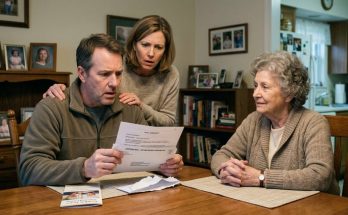
Then, one October evening, Colin came home carrying a glossy brochure.
He placed it beside my plate at dinner.
“Mom, we need to talk about something.”
I looked at the brochure.
A photograph showed a bright brick building surrounded by immaculate landscaping.
Across the front, in tasteful lettering, were the words OAKRIDGE ESTATES.
Jessica sat beside him with her hands folded.
I looked from one of them to the other.
“What is this?”
Colin cleared his throat.
“We've been thinking about the future.”
Something in my stomach tightened.
Jessica reached for the brochure.
“It isn't a nursing home.”
“I didn't say it was.”
“You're going to like it,” she continued. “They have private rooms, transportation, activities, medical staff. Everything.”
I looked at the photograph again.
Then I looked at my son.
“Why are you showing me this?”
Colin hesitated.
“Because we think it might be time for you to consider moving somewhere with more support.”
I put my fork down.
The room went quiet.
Jessica smiled gently.
“We're only trying to make things easier.”
I nodded.
“I see.”
Colin relaxed slightly.
“You do?”
“Yes.”
I closed the brochure.
“I think it's very nice.”
Jessica exchanged a glance with him.
Neither of them noticed the expression on my face.
They didn't know that I already owned a house.
They didn't know that I had eleven million dollars.
They didn't know that, for the first time in my life, I was no longer asking whether I could afford to leave.
I was asking whether I wanted to stay.
Click here to continue reading: PART 2: They Had Already Chosen My New Address, Yet They Still Had No Idea I Had Quietly Started Choosing One for Myself
The Birthday Joke That Left a Strange Little Secret in My Hands Before Anyone Realized How Much Had Changed
Part 1 of 12