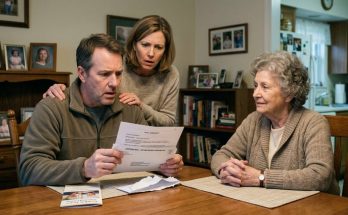
My eightieth birthday was approaching when Colin asked to see me alone.
He arrived on a cool October afternoon.
There were leaves scattered across the driveway.
He parked near the porch and walked toward the house carrying nothing.
“No flowers?” I asked.
“I forgot.”
“Good.”
He laughed.
“Why good?”
“Now I know you're here for something other than charm.”
He sat across from me.
For several minutes, he simply looked at his hands.
“What is it?”
“I've been thinking about the inheritance.”
I smiled.
“Of course you have.”
“That's not why I'm here.”
“Then tell me.”
He took a breath.
“I don't want you to leave me millions.”
I waited.
“I mean it.”
“Why?”
“Because I don't need it.”
“That has never stopped people.”
“I know.”
He looked at me.
“And because I don't want Lucas and Sophie thinking their future is guaranteed because Grandma has money.”
I leaned back.
“Go on.”
“I want them to work.”
“They will.”
“I want them to understand that money is a tool.”
“Yes.”
“Not a personality.”
I smiled.
“You have been listening.”
He laughed.
“I had a lot of time to think.”
We sat quietly.
Then he said something I hadn't expected.
“I want you to give more of it away.”
I raised an eyebrow.
“To whom?”
“People who need it.”
“That's vague.”
“I know.”
He looked embarrassed.
“I just keep thinking about that birthday.”
“The ticket?”
“Yes.”
“I thought you didn't want to talk about it.”
“I didn't.”
He looked toward the garden.
“Now I do.”
He told me that he had recently watched a video of an older woman talking about financial abuse within families.
It had made him uncomfortable.
Not because he had done anything illegal.
Because he recognized something in himself.
The assumption.
The quiet entitlement.
The belief that because someone was his mother, her resources were somehow part of the family pool.
“I don't want my children to think like that,” he said.
“They won't if you teach them differently.”
“I want you to help me.”
“How?”
“Give them responsibility.”
I nodded.
“That I can do.”
We changed the structure of their trusts.
Not by removing the money.
By changing how it could be accessed.
Education.
Health.
Housing under specific conditions.
Starting a business with oversight.
Emergency situations.
Not luxury spending simply because the balance existed.
Lucas was old enough to understand.
Sophie was too.
When I explained it, neither complained.
Lucas said, “That seems fair.”
Sophie asked questions.
Good questions.
I answered them.
Then she looked at me.
“Grandma, did you make these rules because you don't trust us?”
“No.”
“Then why?”
“Because I love you enough not to make life too easy.”
She smiled.
“That sounds annoying.”
“It is.”
We laughed.
The arrangements were finalized before Christmas.
The scholarship fund grew.
The senior center received another contribution.
I funded repairs for several elderly homeowners in the county.
None of it made the news.
I didn't want it to.
Money did not become more meaningful because strangers knew where it went.
In the spring, Helen came to my house carrying a basket of tomatoes.
“I have news.”
“What kind?”
“My granddaughter is getting married.”
I smiled.
“That is wonderful.”
“She needs help.”
I waited.
Helen looked embarrassed.
“Not money.”
“Then what?”
“She needs someone to talk to.”
I laughed.
“You brought me a person?”
“Apparently.”
I welcomed the granddaughter.
She sat at my table for two hours.
She talked about wedding expenses, family expectations, and fear.
I listened.
When she left, Helen hugged me.
“You're good at this.”
“I've had practice.”
The years continued.
Lucas married.
Sophie became a veterinarian.
Jessica and Colin bought a modest home they could comfortably afford.
They invited me to help choose the kitchen cabinets.
I chose nothing.
They laughed.
“You're really going to make us decide?”
“Yes.”
“That seems cruel.”
“No.”
I smiled.
“It is healthy.”
Their new house was smaller than the old one.
But it was theirs.
Nobody lived there because they had nowhere else to go.
Nobody stayed because they were afraid to leave.
They had learned.
So had I.
On my eighty-first birthday, Colin gave me a photograph.
It showed all of us standing on my porch.
Three generations.
Different lives.
One family.
On the back, he had written:
We stopped confusing love with ownership.
I cried when I read it.
He hugged me.
“You okay?”
“Yes.”
“Good.”
I looked at the photograph again.
“I think that's the nicest thing anyone has ever written to me.”
He smiled.
“Even better than the lottery ticket?”
“Much better.”
The ticket had changed my circumstances.
The people had changed themselves.
That was harder.
And more valuable.
Later that year, I began sorting through my husband's belongings.
I found an old notebook.
His handwriting filled the first pages.
Budgets.
House repairs.
Grocery lists.
Then I found a sentence written near the bottom of one page.
Make sure Margaret always has a place that is hers.
I sat down.
My hands trembled.
He had written it decades earlier.
Before the lottery.
Before the conflict.
Before Oakridge.
Before the cottage.
I read it again.
Then again.
I cried.
Not because I was sad.
Because suddenly I understood something.
The life I had built after the ticket wasn't a betrayal of my marriage.
It was the life my husband had wanted for me all along.
A place that was mine.
A decision that was mine.
A future that did not depend on anyone's permission.
I put the notebook beside the old birthday card.
Two small objects.
Two different reminders.
One told me how I had changed.
The other reminded me why I had been capable of changing.
When Colin visited that weekend, I showed him the notebook.
He read the sentence.
“He knew.”
“Yes.”
“He would have liked this house.”
“Yes.”
“He would have been proud of you.”
I looked away.
“I hope so.”
Colin touched my shoulder.
“I know so.”
That evening, we sat outside.
The sunset turned the sky orange.
He told me about work.
I told him about the garden.
Nothing dramatic happened.
That was the beauty of it.
The family crisis had ended not with a grand victory but with ordinary evenings that no longer required anyone to defend their right to exist.
Before Colin left, he hugged me.
“Mom?”
“Yes?”
“If you had never won that ticket, I hope you know something.”
“What?”
“You still deserved the life you wanted.”
I looked at him.
“I know now.”
He smiled.
“Good.”
He walked to his car.
I watched him go.
Then I turned toward the house.
The porch light was on.
My door was waiting.
My home was waiting.
And so was the rest of my life.
Click here to continue reading: PART 12: At Eighty-Two, I Finally Put the Old Ticket Away for Good and Realized the Secret I Had Protected Was Never Really About Money
The Birthday Joke That Left a Strange Little Secret in My Hands Before Anyone Realized How Much Had Changed
Part 11 of 12