Travis was in the kitchen before I was the next morning.
He had made coffee and left the grounds scattered around the machine.
His duffel bag was still beside the pantry.
The fishing reel sat on the counter, its cardboard box catching the morning light.
He looked at me over his mug.
"Sleep okay?"
"Some."
He nodded as though that answered everything.
I poured myself coffee and sat at the table.
For a few minutes, neither of us spoke.
Then I put my mug down.
"I want to see where the money went."
He looked at me.
"What?"
"The money from the joint account."
He set his mug on the counter.
"I told you I moved it."
"I know. I want to know where."
"Why?"
"Because it was money I used to pay household bills, too."
His jaw tightened.
"It was my paycheck."
"It was in our joint account."
"Because I put it there."
I nodded slowly.
That was true.
It was also the reason I had once felt safe.
I had believed that putting money into a shared account meant we had agreed to share responsibility for what happened to it.
Apparently, Travis had understood it differently.
"You could've told me," I said.
"I didn't think I needed permission to move my own money."
"Did you think you needed to tell your wife?"
He looked away.
The pause was brief, but I noticed it.
He picked up his mug again and took a drink.
"I don't want to get into a legal argument over breakfast."
"I'm not arguing about the law."
"Then what are we arguing about?"
"Whether you think I deserve to know what's happening in my own household."
He placed the mug down harder than necessary.
"You have a roof over your head. The bills are paid. What exactly are you worried about?"
I thought of the failed bank login.
The closed account.
The money I couldn't reach.
The property notice sent to a man who had removed my contact information.
I thought of the washing machine grinding through another load while I wondered whether I could afford to replace it.
"I'm worried because I didn't know what you had done until I tried to find out."
He shook his head.
"You always make things bigger than they need to be."
I looked at him.
That sentence had followed me through so many small disagreements that I could almost hear it before he spoke.
The problem was never the thing he had done.
The problem was that I noticed.
"I need the account information," I said.
He took his mug to the sink.
"I'll get to it."
"When?"
He turned around.
"Why are you interrogating me?"
"I'm asking when."
"June, I just got home yesterday."
"And I have been waiting seventeen days for you to explain why you removed me from the account."
His expression changed.
For the first time that morning, he seemed to hear the number instead of the complaint.
He looked at the clock above the stove.
Then he reached for his phone.
"I have things to do today."
"So do I."
He stared at me for a moment.
I didn't raise my voice.
I didn't move toward him.
I simply sat at the table with both hands around my coffee mug.
Finally, he put the phone in his pocket.
"I'll show you later."
It wasn't an answer.
But I had learned that I couldn't force honesty out of someone by asking the same question more gently.
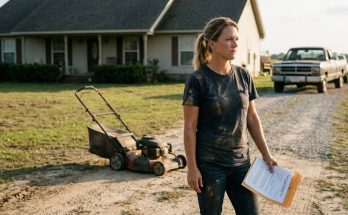
I finished my coffee and went outside.
The morning air was already warm.
Dew clung to the grass along the gravel drive, and the old oak trees cast long shadows over the yard.
I walked past the workshop my father had built behind the house.
The door needed paint.
One hinge had started to sag.
For years, I had kept a mental list of every repair that needed attention, measuring each against what Travis said we could afford.
I stopped beside the workshop and looked at the door.
I could decide whether to repair it.
I could get a quote.
I could wait until next month if that made more sense.
Those choices were ordinary.
I had forgotten how much ordinary decisions mattered when I was no longer required to justify every one of them.
At the pond, I stood still and watched the surface move beneath a light breeze.
My father used to come out here early in the morning.
He would carry a cup of coffee and stand in the same spot, looking at the water before he started his day.
He had never told me I needed to be helpless to prove I trusted someone.
He had never treated a question as an insult.
I went back inside before the sun climbed too high.
Travis had left his mug in the sink.
His truck was gone from the drive.
I didn't know whether he had left to run an errand or to avoid the conversation.
I didn't call him to ask.
Instead, I sat at the desk and reviewed my list of household expenses.
Electricity.
Water.
Insurance.
Property taxes.
Food.
Fuel.
Repairs.
The list was not a complete picture of our finances, because I still didn't have access to the information Travis had moved.
But it was a picture of what the house required.
I made a note beside the washing machine.
Then I wrote down the date of the tax office visit.
Under that, I wrote the date I had discovered the account was closed.
I kept my notes factual.
I didn't write that Travis was cruel.
I didn't write that I felt betrayed.
Those things were real, but they weren't the information I needed to gather first.
That afternoon, he returned with a bag of groceries.
He put them away without speaking about the morning.
I was at the kitchen table with the yellow folder open beside me.
He noticed it immediately.
"You're still doing that?"
"Yes."
He pulled a chair out, then seemed to reconsider and remained standing.
"Look, June. I don't want you thinking I'm trying to leave you with nothing."
I looked up.
"Then why did you remove my access?"
He rubbed his face.
"I wanted to separate things for a while."
"Why didn't you tell me?"
"Because I knew you'd react like this."
The answer landed between us.
He had decided what I would say, used that prediction to justify hiding what he had done, and then pointed to my confusion as proof that he had been right to hide it.
I had spent years accepting that kind of reasoning.
I didn't accept it that afternoon.
"You could have told me before you changed anything."
He pulled the chair out again and sat down.
"I was trying to get things organized."
"What things?"
"Our finances."
"Which finances?"
He frowned.
"All of them."
I kept my voice steady.
"Then show me the records."
He looked at the folder.
"I don't have everything with me."
"Where is it?"
"At work. On my laptop."
"Can you show me when you get it?"
He stared at me.
I could see that he wanted to turn the question into a disagreement about my tone.
I waited.
Finally, he said, "I'll see."
I closed the folder.
"All right."
He looked almost irritated that I had stopped asking.
For years, he had been able to end a conversation by refusing to continue it.
He still could.
What he couldn't do was make that refusal answer my question.
That evening, we ate leftovers at the kitchen table.
The conversation stayed on harmless subjects.
A problem with his truck.
The weather forecast.
A neighbor who had cut down a tree near the road.
Afterward, he watched television while I folded laundry.
When I carried the last basket upstairs, the air conditioner struggled to push cool air through the bedroom vent.
I stood beneath it and felt the weak stream against my cheek.
I had delayed replacing it because Travis said we could manage another season.
Now I wondered how many of our decisions had been made because he wanted something else more.
I didn't order a new unit that night.
I didn't make a dramatic announcement.
I wrote down the model number and started looking for the paperwork from the last service call.
The decision could wait until I understood the cost.
The information didn't have to.
When I returned downstairs, Travis was still on the couch.
"You're making a lot of lists lately," he said.
"I'm trying to understand things."
He turned his attention back to the television.
"You're going to wear yourself out."
Maybe I would.
But I was no longer willing to confuse exhaustion with proof that I had done something wrong.
Click here to continue reading: PART 11: The Deed Was Only One Page, but It Forced Me to Look at Nine Years of Decisions Differently
The Missing Tax Notice Was a Small Problem Until a Clerk Looked at My File and Told Me Something I Never Expected
Part 10 of 12

One Comment on “PART 10 – He Thought Moving the Money Had Settled the Matter, Until I Asked One Question He Couldn’t Answer for Me”