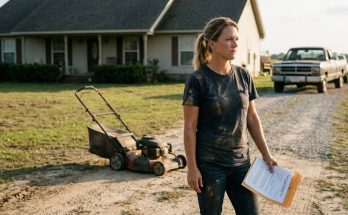
The yellow folder stayed in the desk drawer.
I didn't carry it around the house.
I didn't leave the deed on the kitchen table for Travis to find.
It wasn't a weapon, and I wasn't trying to frighten him.
It was a record.
I had spent too many years allowing the practical details of my life to become things I trusted someone else to remember.
Now I wanted to know them myself.
Travis never gave me the account information that week.
He said he would find the records.
He said things had become complicated.
He said I was making a difficult situation worse by refusing to let it go.
Each explanation moved the conversation away from the question I had asked.
I stopped trying to make those explanations add up to an answer.
Instead, I kept the household records I had.
I checked the dates on the utility bills.
I gathered the property insurance paperwork.
I made a list of expenses that would come due in the next month.
I did not assume that I could use money I couldn't access.
I did not assume that Travis would pay everything simply because he always had before.
The difference was small on paper.
In practice, it changed how I moved through each day.
When the washing machine made its grinding sound, I wrote down what it was doing.
When the air conditioner struggled upstairs, I checked the service paperwork.
When I paid for groceries, I kept the receipt with the other household expenses.
None of those things was dramatic.
They were ordinary tasks, and I had always done them.
What changed was that I no longer treated my work as proof that I didn't need information.
One afternoon, Travis came into the kitchen while I was checking the mail.
He noticed the stack of papers beside me.
"What's all that?"
"Household records."
"You've got plenty of time for paperwork lately."
I sorted the envelopes into two piles.
"I've always handled the house."
"That's not what I meant."
I looked up.
"Then what did you mean?"
He opened his mouth, then closed it.
For once, I didn't supply an easier interpretation for him.
He picked up an envelope addressed to him and carried it toward the living room.
I returned to the mail.
Later, while he watched television, I walked out to the pond.
The light was low, and the water reflected the branches above it.
My father had left me the property because he wanted me to have somewhere secure.
He had never imagined that nine years into my marriage, I would be standing by the pond trying to understand how a house could feel familiar and uncertain at the same time.
I thought of him carefully keeping papers in labeled folders.
Back then, I had found his habits fussy.
He wanted receipts.
He wanted names written down.
He wanted copies of documents stored somewhere safe.
I understood him better now.
Paperwork couldn't make people honest.
It couldn't guarantee that a marriage would last.
But it could keep a fact from disappearing just because someone else preferred a different version of it.
When I went inside, Travis was in the kitchen.
He had turned off the television.
"We need to talk," he said.
I set my keys on the counter.
"Okay."
He pulled out a chair and sat down.
I sat opposite him.
For a moment, he rubbed his palms against his jeans.
"I don't like how things have been between us."
"Neither do I."
"I feel like you're looking for a reason to make me the bad guy."
I let the words settle.
"I asked why you closed the account."
"I told you. I wanted to organize things."
"You didn't tell me where the money went."
He looked toward the window.
"I moved it to an account I control."
"Can I see the records?"
He pressed his lips together.
"Why does that matter if the bills are being paid?"
"Because I need to know what money is available and what obligations we have."
He shook his head.
"You never used to care about this stuff."
"I cared. I trusted you to handle it."
"What's the difference?"
"The difference is that I used to know I could ask you a question and get an answer."
He leaned back in his chair.
I could tell he was searching for a way to turn that into an accusation.
I waited.
Finally, he said, "I don't want you worrying about every dollar."
"I don't want to be excluded from every decision."
For several seconds, neither of us spoke.
The refrigerator hummed behind him.
Outside, a branch tapped lightly against the side of the house.
I had imagined this conversation going many different ways.
In some versions, he apologized before I finished speaking.
In others, he became angry and told me I was ungrateful.
The real conversation was quieter and less satisfying than either version.
He looked tired.
I felt tired, too.
But neither of us could make the question disappear.
"I don't know what you want me to say," he said.
"I want you to explain what happened."
"I moved the money."
"That isn't an explanation."
He looked at me for a long time.
Then he stood.
"I can't do this right now."
I remained seated.
"All right."
He paused, perhaps waiting for me to follow him or ask him to stay.
I didn't.
He went into the living room and turned the television back on.
I gathered the papers from the table.
The conversation had not fixed anything.
It had not even brought us closer to agreement.
But I had said what I meant without apologizing for asking.
That night, I opened the yellow folder one last time before bed.
The deed was at the back.
I read my name again.
June Parker.
My father's name appeared in the earlier records, a reminder of where the property had come from.
I thought about the years Travis had called it our house.
I didn't regret sharing it with him.
I regretted allowing the word "ours" to become a reason I stopped paying attention to what was legally and practically true.
The deed could establish ownership.
It could not decide whether I should stay married.
It could not tell me where the money had gone.
It could not make Travis answer a question he didn't want to answer.
And it could not turn nine years of shared life into something simple.
I put it back in the sleeve and closed the folder.
The next morning, I made coffee and stood at the kitchen window.
The gravel drive was quiet.
The old oak trees moved slightly in the breeze.
The workshop door still needed paint.
The upstairs air conditioner still struggled.
The washing machine still made that grinding sound.
My life hadn't transformed overnight.
I still had bills to pay, repairs to consider, and a marriage I didn't yet know how to understand.
But I no longer believed that my only choices were to stay quiet or destroy everything.
I could ask questions.
I could learn what I needed to know.
I could keep my own records.
I could decide what to do after I understood the situation, rather than letting someone else's confidence stand in for an answer.
When Travis came into the kitchen, he reached for his mug.
"Morning," he said.
"Morning."
He glanced at the folder beside the desk.
"Are you still keeping all that paperwork?"
"Yes."
He shook his head.
"You really don't trust me anymore."
I held my mug with both hands.
"I want to be able to trust you."
He looked at me, but he didn't respond.
I didn't add anything to soften the sentence.
Trust had been part of our marriage long before I understood how much I had allowed it to replace information, access, and choice.
I couldn't rebuild it by pretending nothing had happened.
I couldn't demand that he repair it in a single morning.
All I could do was stop calling silence the same thing as peace.
After breakfast, I took the folder back to the desk.
I made sure the deed was inside.
Then I placed the property tax notice beside it, with the updated contact information recorded on my notes.
I closed the drawer.
The house stood on the land my father had left me.
The pond lay beyond the workshop.
The oak trees shaded the long gravel drive.
Those things had been there before Travis and I married, and they would remain part of the life I had to make decisions about now.
I loved the house.
I had loved my husband.
I wasn't ready to pretend that either fact canceled the other.
For seventeen days, I had waited for Travis to come home and explain why he had removed me from our accounts.
When he finally returned, I learned that his presence alone would not give me the answers I needed.
The courthouse had not given me a way to control him.
It had given me a copy of a record I could verify for myself.
That mattered.
Not because the deed made me invulnerable, and not because my name on a page decided the future of my marriage.
It mattered because I had spent too long believing I was powerless simply because Travis controlled the money.
I wasn't powerless.
I was uncertain.
I was hurt.
I had questions that still needed answers.
Those were not the same thing.
I turned off the desk lamp and went back to the kitchen.
Travis was outside near the workshop, looking at the hinge on the door.
I watched him for a moment through the window.
Then I turned away and began making my list for the day.
There were still things to repair.
There were still conversations we might have.
And there were decisions I would make only after I knew enough to make them for myself.
The End
Read more original stories on Feel Every Story.
The Missing Tax Notice Was a Small Problem Until a Clerk Looked at My File and Told Me Something I Never Expected
Part 12 of 12