I used to believe that doing the right thing would count for something.
That night, I learned how little it counted in my father's house.
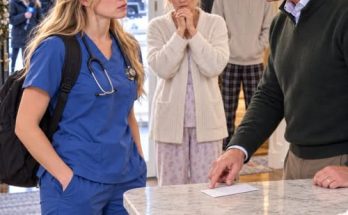
At 12:20 a.m., I stood on the porch in my blue scrubs, pulling at a front door that would not open.
The wind pushed snow against my back.
I tried the handle again, although I already knew what was stopping it.
A chain.
My father had secured it from the inside.
I had spent the previous hour helping an injured old man survive a blizzard on a rural road. My knees were wet, my fingers hurt, and the temperature had dropped far below anything a person should have to endure while sitting in a parked car.
But the door stayed shut.
I stood there for a few seconds, waiting for someone to notice me through the glass.
Nobody came.
My name is Kayla, and I was twenty-four years old when I finally began to understand that being a good daughter and being safe were not always the same thing.
It had started at the hospital.
My shift was supposed to end before the worst of the storm arrived, but the weather had trapped several members of the night staff on the highway. One of the county snowplows had overturned near Foley, and the emergency department was filling faster than we could clear beds.
My supervisor found me near the nurses' station.
"Kayla, I need you to stay until we can get someone else here."
I looked toward the emergency room doors.
A man in one bed was reporting chest pain. In another, a teenager was waiting for treatment for a shoulder that had come out of its socket.
There was no way I could leave them simply because my scheduled hours were over.
"Okay," I said.
My supervisor looked relieved.
I wasn't sure why I felt the need to apologize for agreeing to do my job, but I did.
At 8:15 p.m., I finally had a moment to check my phone.
I sent a message to the family group chat.
"I'm being held over. Some of the night nurses can't get through the storm. I'll leave as soon as someone takes over."
Mom responded with a heart.
Dad sent one word.
"Red."
That was what he called me when he thought I was approaching a boundary. He had used the nickname since I was a teenager, usually when I came close to breaking one of his rules.
I stared at the screen longer than I should have.
Marisol, another nurse, noticed.
"Your dad?"
I turned the phone facedown.
"Yeah."
She leaned against the counter beside me.
"You know the overnight position is still available, right? Seven at night until seven-thirty in the morning. Better pay, too."
I knew.
The position came with an extra four dollars and fifty cents an hour. It would also give me experience with the kinds of emergencies I wanted to handle as my career progressed.
"I can't take it," I told her.
"Why not?"
I could have explained the curfew.
Instead, I gave her the answer I had used so often that it barely sounded like a choice anymore.
"House rules."
Marisol didn't argue.
She only looked at me for a moment before returning to her work.
At 10:01, I checked my phone again.
Nothing from Dad.
No question about the roads. No request for an update. No acknowledgment that I was still at the hospital because other people needed help.
I returned to my patients.
Brooke, the nurse who was supposed to take over, arrived through the ambulance entrance at 10:15. Snow covered her hair and shoulders.
"I'm sorry," she said as she caught her breath. "The roads are awful."
"I know."
I gave her the information she needed, made sure my patients were settled, and handed over the last of my responsibilities.
By the time I reached the parking lot, the wind had picked up.
I scraped the ice from my windshield at 10:25, working the plastic scraper back and forth until I could see through the glass.
My blue Corolla was old, but it started reliably.
That was one thing I appreciated about it.
The registration and insurance were still in Dad's name, though. He had helped me get the car, and he reminded me of that whenever he wanted me to understand how much control he had over my life.
I climbed inside and started the engine.
Before putting the car in gear, I practiced what I would say when I got home.
"I'm sorry, Dad. I couldn't leave while we were short-staffed."
I tried it again.
"I know I was late, but people needed help."
The second version sounded argumentative, so I abandoned it.
I wanted him to understand.
More than that, I wanted him to tell me that I had done the right thing.
That was embarrassing to admit, even to myself.
I was a licensed nurse. Every day, I made decisions that affected people who trusted me with their lives.
Yet I still rehearsed apologies in my car because I was afraid of disappointing my father.
Highway 10 had been closed, so I took County Road 75 toward Sock Rapids.
I slowed to thirty miles an hour.
The snow made the road disappear a few feet ahead of my headlights. My wipers dragged wet lines across the windshield, and the heater struggled to keep the glass clear.
I kept both hands on the steering wheel.
There was no reason to rush.
If I arrived late, I would arrive late.
I repeated that to myself until I remembered who was waiting at home.
Then I began worrying again.
About fifteen minutes into the drive, I saw orange lights flickering below the road.
At first, I thought they belonged to a snowplow.
Then I noticed how low they were.
A car had gone into the ditch.
Its rear end was partly buried, and the hazard lights flashed through the blowing snow. The vehicle sat at an awkward angle, its front end pointing down the slope.
I pulled onto the shoulder.
My first thought was that someone might still be inside.
My second was that stopping could put me in danger, too.
Nursing school had taught me that helping someone did not mean abandoning common sense. If I became injured, I would only create another emergency.
I switched on my hazard lights and called 911.
Then I got out.
The wind struck my face so hard that my eyes watered immediately.
I worked my way down the slope, planting each boot carefully.
An elderly man was sitting beside the driver's door, leaning against one of the tires.
He looked to be in his seventies.
His mustache was white, his coat was soaked, and blood had frozen along a cut on his forehead. His left wrist was bent at an angle that made me stop for half a second.
He was shivering so violently that his words came out broken.
"Deer," he managed.
I crouched beside him.
"You hit a deer?"
"Swerved. Went right off."
He tried to move his injured hand and winced.
I told him not to use it.
"My name's Kayla," I said. "What's yours?"
"Walt."
"All right, Walt. I'm going to help you get out of here."
He looked toward the car.
"Was trying to dig it out."
"Your engine still running?"
He shook his head.
That worried me.
He had been exposed to the cold, his clothing was wet, and he was injured. Waiting beside a disabled vehicle in that weather was dangerous.
I explained what I wanted to do before touching him.
Then I supported him as he struggled to his feet.
We moved slowly, stopping whenever he needed to catch his breath. The snow shifted beneath our boots, and twice I had to brace myself to keep us from sliding backward.
By the time we reached the road, my knees were soaked.
I opened the passenger door and helped him into the heated car.
His shoulders were wet through his coat.
I took mine off and placed it around him, then pulled an emergency blanket from the trunk and covered his legs.
The blanket was thin and silver, but it was better than nothing.
I kept talking to him while we waited.
His wife's name was Joanie.
He had spent thirty-one years driving county snowplows before retiring.
"I used to clear this road," he told me.
He tried to laugh, but the sound turned into a cough.
I smiled at him.
"Then you know better than anyone how bad it gets out here."
He nodded, still shivering.
A few minutes later, I stepped outside to inspect the car's exhaust.
Snow had begun piling around the rear bumper.
I cleared the area carefully so exhaust could escape instead of collecting beneath the vehicle.
Walt watched me through the passenger window.
When I climbed back inside, he studied my face.
"Why'd you go out there again?"
"Had to make sure the tailpipe wasn't blocked. We don't want exhaust coming into the car."
He considered that, then gave a small nod.
"Joanie would like you."
I didn't know what to say.
So I asked him another question about his years working on the roads, and he told me about a winter when the county had run short of drivers.
His voice became steadier as we talked.
At 11:20, a state trooper finally reached us.
Trooper Hansen approached the car with his collar pulled high against the wind. An ambulance arrived eighteen minutes later, its lights reflecting off the snow.
I gave Hansen a clear account of what I had found and when I had stopped.
I described Walt's exposure, his injured wrist, the cut on his head, and the condition of his hands.
The paramedics took over.
Before they carried him away, I made sure he was still wrapped in my coat.
One of them asked whether I wanted it back.
I shook my head.
"He needs it more than I do."
Hansen took my contact information in case Walt's family needed to reach me.
I told him that would be fine.
Then the ambulance doors closed, and the vehicle disappeared into the storm.
I stood beside my Corolla for a moment.
My scrubs were wet at the knees. My hands had started to ache, and the cold was working its way through my clothes.
I checked the dashboard.
11:55 p.m.
My curfew had been ten.
For the first time that night, I had forgotten all about it.
I had been too busy helping a stranger to worry about what my father would say.
I got back into the car and headed home.
Surely, I thought, he would understand this.
Surely, saving someone's life was a good enough reason to be late.
I held on to that belief as I drove through Larksburg Court and pulled into our driveway.
Then I walked to the front door, reached for the handle, and felt it move only a few inches.
The chain caught.
And everything I had told myself on the drive home fell apart.
Click here to continue reading: PART 2: The Message My Mother Sent Before Dawn Explained Why the House Was Dark, but Not Why My Brother Could Come Home Whenever He Wanted
I Thought Coming Home After Saving a Stranger Would Be the Hardest Part of My Night, Until I Saw the Chain
Part 1 of 12