I knew what the card said before I picked it up.
Three numbered lines.
Three simple explanations.
And not one of them was true.
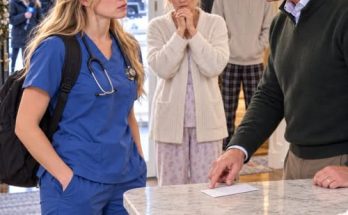
Dad stood beside the kitchen island with his arms folded. The television crew was still outside, and I could see the red parka of the reporter through the narrow window beside the door.
Mom kept rubbing the edge of her robe between her fingers.
Tyler leaned against the doorway, looking at the floor.
Dad pushed the card closer to me.
“Read it carefully before you go outside.”
I looked down.
The first line thanked Walt Brandt's family for recognizing my work.
The second said the storm had frozen our front lock, leaving me unable to enter.
The third explained that I had decided to remain in my car rather than disturb my parents in the middle of the night.
It was neat.
Believable.
Convenient.
I turned the card over, hoping there might be something else written on the back.
There wasn't.
“The lock wasn't frozen,” I said.
Dad's expression barely changed.
“Kayla, we are not going to argue about a door.”
“The chain was across it.”
Mom finally looked at me.
“Please don't make this harder than it has to be.”
I wanted to ask her what she thought the hardest part had been.
Was it the cold?
The damp scrubs against my knees?
The hours spent waking every fifty minutes to check the exhaust pipe?
Or was it the moment I realized that my mother knew exactly where I was and had chosen not to let me inside?
I didn't ask.
I'd spent years learning that some questions made the room colder even when everyone was standing beside a heater.
Dad tapped the card.
“People don't understand what happens inside another family's home. They hear one sentence, decide they know everything, and then they make judgments.”
He straightened the card until it lined up with the edge of the counter.
“I've worked in education for twenty-six years. I know how quickly a small misunderstanding can spread.”
I thought of the laminated rules on the refrigerator.
The blue pen.
The brass chain.
They had all been ordinary things until that night.
Now I couldn't look at any of them without remembering the car.
“What if I tell them what happened?” I asked.
Dad's eyes settled on mine.
“You can thank the family and talk about the rescue. That's what matters.”
“And the rest?”
“There is no reason to discuss private family business with strangers.”
He spoke quietly, almost kindly.
That was how he made his decisions sound reasonable.
He rarely shouted. He didn't need to.
At school, he could probably have explained a punishment to a room full of parents without raising his voice once.
At home, he'd used that same calm tone to tell his daughter she could spend the night outside in twelve-below weather.
“The Corolla is registered to me,” he continued. “The insurance is in my name, too.”
I looked at the keys in my hand.
He hadn't asked whether I was warm.
He hadn't asked whether my hands still hurt.
He had reminded me who owned the car.
“I understand,” I said.
He seemed satisfied with that answer.
“Good. Then we can handle this properly.”
I took the index card.
Not because I intended to follow it.
I wanted to see the handwriting one more time.
The blue ink was the same shade Dad used on detention slips and notes sent home to parents. His letters were narrow and tidy, with the same slight slant to the right.
He'd written it before I came downstairs.
While I slept.
While the reporters waited outside.
While Mom was still in her robe.
He had prepared my explanation before giving me the chance to speak.
I folded the card once and placed it in my coat pocket.
Dad nodded toward the door.
“Five minutes should be enough.”
I went upstairs instead.
He called after me, but I kept walking.
In my bedroom, I closed the door and sat on the edge of the bed.
My phone lay beside the pillow.
The screen showed several messages from Dana, along with an unanswered question I'd sent her earlier about Walt's condition.
I called her.
She answered so quickly that I heard movement before she spoke.
“Kayla?”
“I'm sorry to bother you.”
“Don't start with that.”
Her voice was tired, but there was no irritation in it.
“I need to ask you something. Did you tell the television station about my family?”
There was a pause.
“Yes,” she said. “I did.”
She didn't try to soften the answer.
“I posted about what happened because I wanted people to know what you did for Dad. I mentioned the cold and the locked door. The station contacted me after people started sharing it.”
I watched a thin strip of sunlight move across the floor.
“How much did you tell them?”
“What happened. Nothing more.”
She took a breath.
“I should have asked you first. I'm sorry.”
I appreciated that she didn't pretend her intentions erased the consequences.
“I know you were trying to help.”
“I was angry,” she admitted. “My dad kept asking whether you'd made it somewhere warm. He was lying in a hospital bed with a broken wrist, and he was worried about you.”
I closed my eyes.
That image had stayed with me all morning.
Walt, injured and exhausted, asking about the nurse who had stopped beside his car.
My father, uninjured and warm, watching from the kitchen window.
“I don't want you to think I'm asking you to take anything back,” I said. “But I need to decide what I say about my own life.”
“You should.”
“I'll talk about Walt. I won't give them every detail about my family.”
“That's your choice.”
The simplicity of her answer surprised me.
No argument.
No warning.
No reminder of what I owed her.
Just permission to decide for myself.
“How is he doing?” I asked.
“His temperature is almost normal. They fixed him up as best they could for now. The wrist is broken in two places, and the cut on his head looks worse than it is.”
“That's good.”
“He keeps asking whether you're warm.”
I looked at the bed beneath me.
“I am now.”
It wasn't entirely true, but it was closer than the lie I'd sent her from the car.
Dana hesitated.
“He wants to see you when he's able. He says he owes you a coat.”
I glanced at the folded olive-green blanket resting over the back of my desk chair.
“He doesn't owe me anything.”
“I told him that.”
“And?”
“He said you two could argue about it when he gets out.”
For the first time that morning, I smiled.
Then I looked toward the hallway.
Dad was waiting downstairs.
“I have to go.”
“Kayla?”
“Yes?”
“You don't have to make yourself smaller to keep other people comfortable.”
I didn't answer immediately.
I had heard versions of that advice before, usually from people who didn't understand how carefully I'd arranged my life around avoiding conflict.
But Dana had seen me sitting in a freezing car.
She knew what my efforts to keep everyone comfortable had cost me that night.
“Thank you,” I said.
When I ended the call, I removed Dad's index card from my pocket.
I unfolded it and read the three lines again.
Then I placed it on my dresser beside my nursing badge.
I didn't tear it up.
I didn't need to.
I wanted to remember what it felt like to have someone else write my words for me.
Downstairs, the front door opened and closed.
I heard Dad's steps on the stairs.
He stopped outside my room.
“Are you ready?”
I stood and put on my coat.
“Yes.”
He looked at the index card beside my badge.
“Take that with you.”
“I won't need it.”
His mouth tightened.
“Then remember what we discussed.”
I walked past him.
For once, I didn't promise anything.
Outside, the wind had eased, but the snow remained piled along the driveway.
The reporter approached me, her microphone held low enough not to feel like a threat.
“Thank you for speaking with us,” she said. “We'd like to focus on the rescue. Is that all right?”
“Yes.”
She introduced herself as Nina Alrech from Channel 7.
The cameraman adjusted his position near the Corolla.
Nina asked me to explain what I'd seen on County Road 75.
I told her about the orange hazard lights, the car tilted into the ditch, and the man sitting beside his driver's door.
I explained why I'd called for help before going down the slope.
A rescuer who gets hurt can turn one emergency into two.
I described Walt's frozen clothes and the blood on his forehead. I told her how I'd helped him reach the road and warmed him in the passenger seat.
When I mentioned giving him my coat, Nina glanced toward the house.
I kept talking.
I told her about the years Walt had spent clearing snow from county roads. He'd laughed about trying to dig his car out himself, even though his wrist was already badly injured.
“He was worried about getting home,” I said. “He wasn't thinking much about himself.”
Nina nodded.
“That's what his daughter told us, too.”
I looked at the camera.
“People should know that the emergency department was full last night. Nurses were trying to reach the hospital through the same storm. Some of them were stranded, and others drove through dangerous conditions to help people they'd never met.”
My voice steadied as I spoke about work.
That part was easy.
I knew what I had done, and I knew why.
Nina lowered the microphone slightly.
“Dana also told us you spent the night in your car after getting home late.”
Behind her, the storm door opened.
Dad stepped onto the porch.
I could see him watching me.
For a moment, I remembered the card in my bedroom.
The frozen lock.
The decision not to wake anyone.
The neat little story that would have allowed everyone to return to breakfast without discussing what had happened.
Nina waited.
“Is that accurate?” she asked.
I looked toward the house.
Dad gave me a small nod.
It was the same signal he'd used at school events when he wanted me to know he was watching.
I turned back to Nina.
“Yes. I got home after midnight, and the door was chained.”
The words came out evenly.
I didn't describe the temperature or the hours in the car.
I didn't mention Mom's message.
I didn't tell the reporter that Tyler had been allowed into the garage while I sat outside.
“I'd rather keep the rest of my family life private,” I added. “I'm here because Walt survived a terrible night, and I'm glad I could help him.”
Nina accepted my answer.
“All right. We'll leave it there.”
Relief came first.
Then something else.
I had told the truth without giving away everything.
It was a small distinction, but it felt like the beginning of a choice.
Nina handed me her card and thanked me again.
The cameraman filmed a few seconds of the Corolla, then lowered his equipment.
Dad had already gone inside.
I stood in the driveway until the crew finished packing.
The cold pressed through my coat, but I didn't rush toward the house.
For the first time that morning, I wasn't waiting for permission to speak.
Click here to continue reading: PART 6: The Message From a Girl I Once Protected Reminded Me That Someone Had Remembered the Person I Tried to Be
I Thought Coming Home After Saving a Stranger Would Be the Hardest Part of My Night, Until I Saw the Chain
Part 5 of 12