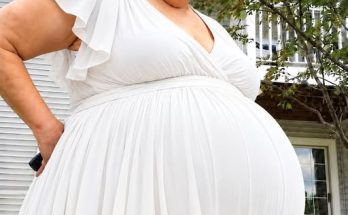
I woke to the sound of a machine beeping beside my bed.
For several seconds, I could not remember where I was.
My mouth was dry, my throat hurt, and something heavy seemed to press across my lower abdomen. I tried to lift my head, but a wave of dizziness pushed me back against the pillow.
Then I remembered the operating room.
I remembered the surgeon telling me that the membrane was under tension.
I remembered the cold spreading through my arm as the anesthetic took hold.
After that, there was nothing.
I turned my head toward the window. The curtains were pale blue, and morning light slipped through a narrow opening.
A nurse noticed I was awake and came to my bedside.
“Mrs. Whitmore? Can you hear me?”
I nodded.
“You're in recovery. The operation is over.”
I tried to speak, but my voice came out as a whisper.
“Did you find it?”
The nurse leaned closer.
“Your surgeon will explain everything when you're ready.”
I caught her wrist before she could turn away.
“Please. I need to know if it's gone.”
Her expression softened.
“Yes, Mrs. Whitmore. They removed the mass. You're safe in recovery.”
I released her hand.
For the first time in months, I felt no fluttering beneath my skin.
The absence was so sudden that I could not decide whether to be relieved or frightened. My body had become unfamiliar to me, and now something that had occupied it for so long was gone.
I closed my eyes.
I had imagined this moment many times, but never like this. I had pictured myself sitting upright in a doctor's office, hearing a clear explanation and making a decision with my children beside me.
Instead, I had been rushed into surgery in the middle of the night because my own body had become an emergency.
When I woke again, Daniel was sitting beside the bed.
His hair was flattened on one side, and his shirt was wrinkled beneath his jacket. He had both hands clasped between his knees.
He looked older than he had the evening before.
“Mom?”
I turned toward him.
He stood so quickly that his chair scraped against the floor.
“You're awake.”
“Apparently.”
My attempt at humor made him laugh once, but the sound broke apart almost immediately.
He bent over me and pressed his forehead against my hand.
“I thought I was going to lose you.”
I looked at his bowed head.
“You nearly did.”
He lifted his face. His eyes were red.
“I know.”
I wanted to comfort him. He was my youngest child, even at fifty-six, and I had spent most of his life wanting to protect him from the things that hurt.
But there were questions between us now, and pretending otherwise would not help either of us.
“Tell me what the surgeon said.”
“They removed everything they needed to remove. The doctor said the procedure went well, considering the condition they found.”
“What condition?”
Daniel glanced toward the door.
“He said he'd explain it himself. He wanted you awake enough to understand.”
I watched my son for a moment.
“Then you can sit there and wait with me.”
“I will.”
He pulled his chair closer.
For a while, neither of us spoke. I could hear the cart wheels in the corridor and the soft voices of staff moving between rooms.
I thought of my kitchen at home.
The cinnamon tin stood beside the stove. The fourth stair creaked if someone put their weight on the middle of it. Robert's armchair still faced the window because I had never found a reason to turn it toward anything else.
Those ordinary things seemed impossibly far away.
I had spent twelve years living with the fact that Robert was dead. I had learned how to shop for one, how to sleep on one side of the bed, and how to make a small dinner without feeling wasteful.
I had believed I understood the loneliness he left behind.
Now I wondered how much of my life I had spent living inside a lie he had carried to his grave.
The surgeon arrived shortly after eight.
He introduced himself as Dr. Lewis, one of the surgeons who had assisted with the operation. He brought a chair and sat down rather than speaking over me.
“Mrs. Whitmore, the procedure was successful. We removed the abnormal mass and the material associated with it.”
“What was it?”
He folded his hands.
“It was not a pregnancy.”
I had known that already, in the deepest part of myself, but hearing the words still made my stomach tighten.
“There was no baby?”
“No. The ultrasound showed a collection of material and fluid that produced an appearance which could be confusing without further investigation. What we found during surgery was very different from a pregnancy.”
I looked at Daniel.
He was staring at the floor.
The surgeon continued carefully.
“The mass involved an artificial membrane containing preserved biological tissue. There was also fluid around it, and the surrounding tissue showed signs of inflammation.”
“Preserved tissue,” I repeated.
“Yes.”
“Whose tissue?”
“We're arranging additional testing. The records indicate that biological material connected to an earlier research project may have been used. We cannot confirm every detail until the laboratory completes its analysis.”
I remembered Evelyn Carter's silver case.
I remembered the hospital marker and the folder Daniel had found in his father's basement.
Most of all, I remembered the line printed on the paper with my copied signature.
SUBJECT MUST REMAIN UNAWARE OF IMPLANTATION.
“Was that thing inside me for twelve years?”
“The records suggest the implantation occurred around that time. We will need to compare the surgical findings with the documentation before we can establish the full history.”
I felt my fingers tighten around the blanket.
“What made it move?”
“The membrane and the fluid around it could shift as your position changed. The internal pressure and movement of the surrounding structures may have contributed to the sensations you experienced.”
“So I wasn't imagining it.”
“No, ma'am. You were feeling something real.”
I stared at the ceiling.
For months, I had wondered whether age was playing tricks on me. I had wondered whether I was becoming one of those old women whose family spoke gently to her while quietly deciding that her judgment could no longer be trusted.
I had even considered keeping the swelling secret because I was embarrassed by how strange it sounded.
Now a surgeon was telling me that the movement had a physical cause.
I was not confused.
I had not invented it.
Someone had put something inside my body and left me to discover it decades later.
“What happens now?”
“We'll monitor your recovery closely. Because the membrane was under tension and the surrounding tissue was inflamed, we'll be watching for infection, bleeding, and other complications. At the moment, your vital signs are stable.”
“And the material you removed?”
“It has been preserved for examination. Nothing will be discarded while the investigation is ongoing.”
I looked directly at him.
“I want the results.”
“You will receive them.”
“I want copies of every report, every image, and every record connected to this procedure.”
He nodded.
“We can arrange that.”
“And I want to know who authorized the original operation.”
The surgeon paused.
“That is a question the medical records and the research documentation should help answer.”
“I already know one name.”
I said Evelyn Carter's name quietly.
Daniel finally looked up.
The surgeon did not react with surprise, but his expression grew more serious.
“Dr. Carter has been contacted about the historical records. Your treating team will coordinate with the appropriate hospital administrators.”
“I don't want this handled quietly because someone important might be embarrassed.”
“It won't be.”
I studied his face, trying to decide whether he understood what I meant.
Then I remembered the nurse's hand beneath my fingers and the relief I had felt when she told me the mass was gone.
I was eighty years old. I had lived through births, funerals, debts, broken appliances, family arguments, and the long work of caring for people who believed I would always be there.
I did not intend to spend whatever time remained to me being polite about an invasion of my own body.
“Good,” I said. “Because I have been quiet long enough.”
The surgeon left us to rest.
Daniel moved his chair closer to the bed again.
“Mom, I need to tell you something.”
I turned toward him.
“Then tell me.”
“When Dad asked me to participate in that family compatibility study, I thought it was legitimate. He said it was connected to research he and Evelyn were doing.”
“You gave them samples?”
“Blood samples. They also did some examinations. I was told they were comparing biological markers among family members.”
“Did you know they were going to use your tissue in me?”
“No.”
His answer came quickly, but I did not mistake speed for proof.
“Did you know they planned to put anything inside me?”
“No, Mom. I swear I didn't.”
I watched him.
He looked exhausted and frightened, but those feelings did not tell me whether his memory was complete.
“You found the folder after your father died.”
“Yes.”
“And you kept it.”
“I kept it because I didn't understand what it meant. I should have told you, but I didn't know how to explain something I couldn't explain to myself.”
“You could have shown it to me.”
He lowered his eyes.
“Yes.”
The admission sat between us.
I had spent my life teaching my children that a mistake could be faced and repaired. I had never promised that facing it would prevent consequences.
“Why did you say nothing?”
“I was afraid.”
“Of what?”
“That Dad had done something terrible. That the papers might mean I had been involved without understanding it. And that you would think I had betrayed you.”
I turned my face toward the window.
“You were worried I would think you had betrayed me, so you let me remain unaware of what might have happened to me.”
“I know how that sounds.”
“It sounds like you were protecting yourself from a conversation you didn't want to have.”
He swallowed.
“Yes.”
I did not raise my voice.
I had no strength for shouting, and shouting would not change the past.
“I believe you may not have known what they intended to do. But I cannot give you the comfort of pretending that keeping quiet was harmless.”
“I understand.”
“I hope you do.”
He sat very still.
Then he reached into his jacket and placed a folded sheet of paper on the bedside table.
“I brought the copies I made from the basement folder. The hospital said they needed the originals preserved, so these are the ones I had at home.”
I looked at the paper.
“You brought them here?”
“I thought you should have them.”
I could not lift my arms comfortably, so Daniel unfolded the sheet for me.
It was a copy of an old research summary. The lettering was faint in places, but one heading remained clear.
PROJECT MARGARET — PHASE ONE.
Below it were references to biological compatibility, implantation, and a planned follow-up procedure.
I read the lines slowly.
There was no warmth in the language. No mention of a wife, a mother, or an eighty-year-old woman who would one day wake in pain and wonder what had happened to her.
I was a subject.
A collection of biological possibilities.
A name on a page.
“Keep these safe,” I told Daniel.
“I will.”
“No. I want them kept with the official records, and I want a receipt showing that they were handed over.”
He nodded.
“I'll arrange it.”
“And don't let anyone persuade you to change your account because you feel guilty.”
His eyes filled again.
“Mom, I never wanted this to happen.”
“I know you say that. Now you need to tell the truth about everything you remember.”
He looked down at the paper.
“I will.”
When the nurse returned, she adjusted my medication and reminded me that I needed to rest. I was still weak, and the pain in my abdomen grew sharper whenever I tried to move.
Before she left, I asked her to place the research copy where the hospital staff could secure it.
She did so without argument.
That small act gave me more comfort than I expected.
For years, I had thought of my age as a reason to accept help without asking too many questions. I had told myself that doctors understood things I could not understand and that my children would explain anything important.
I had confused trust with surrender.
There was a difference.
I could accept help and still demand answers.
I could be frightened and still make decisions.
I could love my son without excusing every choice he had made.
As the morning passed, the medication eased the worst of my pain. Daniel stayed beside me, occasionally rubbing his hands together as if he could warm away what he had learned.
I watched him and thought of the little boy who had once come running into the kitchen with a scraped knee, certain that his mother could fix anything.
I wished I could tell that boy that his father had not been the man he believed.
I wished I could tell him that the world was simpler than the folder in front of us.
But Daniel was fifty-six, and I was no longer the woman who could protect him from every painful truth.
We would have to face this as we were.
A mother and her grown son, sitting beside a hospital bed, with the remains of a secret between them.
For the first time since the swelling began, I felt the space inside my abdomen without wondering what might move next.
There was pain.
There was weakness.
There was fear.
But the thing that had occupied me was gone, and I intended to find out exactly why it had been put there.
Source: calismaportali.com
Click here to continue reading: PART 6: The Research Papers Revealed a Decision Made Behind My Back, While the Woman Who Knew the Truth Finally Had to Face Me
At Eighty, I Felt Something Move Inside My Swollen Stomach, and the Memory of My Dead Husband Suddenly Became Impossible to Ignore
Part 5 of 9