FINAL PART: THE BLACK FOLDER THAT CHANGED EVERYTHING
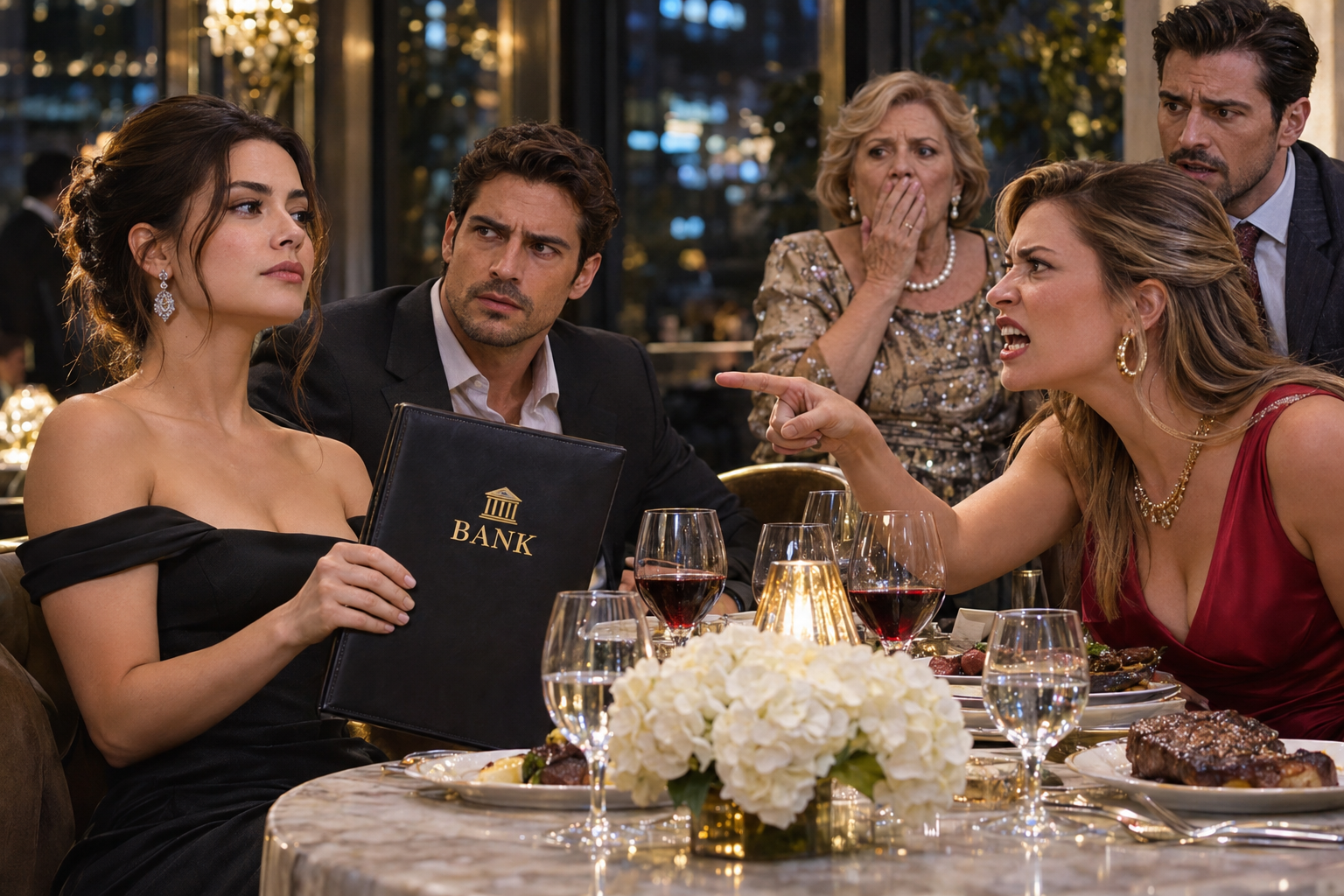
I opened my purse.
And pulled out the black folder from the bank.
Nobody at that table knew what was inside.
Not Chelsea, who had spent the entire evening reminding me that I was unemployed.
Not Richard, who had just asked my husband to risk our house to save his failing business.
Not Helen, my mother-in-law, who was looking at Daniel as though refusing to sign those papers would make him the worst son in the world.
And certainly not Daniel.
My husband was sitting beside me, his face pale, his fingers still wrapped around the fork he had dropped onto his plate.
I placed the folder on the table.
Chelsea looked at it and laughed.
“What is that? Your résumé?”
Richard smirked.
“Maybe she finally found a job.”
I didn’t smile.
I looked straight at him.
“Richard, before we discuss my husband’s house, I have a question.”
He leaned back in his chair.
“Go ahead.”
“How much money do you actually owe?”
His expression changed.
Only for a second.
But I saw it.
“What kind of question is that?”
“A simple one.”
Chelsea rolled her eyes.
“Seriously, Maya? My husband is trying to save his business, and you’re interrogating him?”
I kept looking at Richard.
“Is it twenty-five thousand dollars?”
He said nothing.
“Fifty thousand?”
His jaw tightened.
“Or is it closer to four hundred thousand?”
The silence that followed was so sudden that I could hear glasses clinking at the next table.
Richard’s face went red.
“Where did you get that number?”
Chelsea turned toward him.
“What number?”
I opened the folder.
And took out the first document.
It wasn’t a bank statement.
It was a public filing I’d requested after my financial adviser helped me look into Richard’s businesses.
His company had multiple outstanding judgments and tax liens.
There were creditors pursuing him.
Two of his salon locations were behind on rent.
And the expansion he had been bragging about over lunch?
There was no expansion.
There was only debt.
I slid the document across the table.
“Your businesses aren’t growing, Richard. They’re collapsing.”
Chelsea grabbed the paper.
Her eyes moved quickly over the numbers.
“What is this?”
Richard reached for it.
“Give me that.”
But she pulled it away.
“Richard, what is this?”
He lowered his voice.
“Not here.”
“Answer me.”
He looked around the restaurant, suddenly aware of the people sitting nearby.
“These are complicated business matters.”
I almost laughed.
That was the same phrase he’d used at family dinners for years.
Complicated business matters.
Whenever he bought another expensive car.
Whenever Chelsea showed off a new handbag.
Whenever they went on another luxury vacation while telling Daniel they were temporarily short of cash.
There was always a complicated business matter.
And somehow, my husband’s wallet was always part of the solution.
I turned to Daniel.
“Do you remember when Richard asked you for eight thousand dollars two years ago?”
Daniel nodded slowly.
“He said it was for new styling equipment.”
“And the twelve thousand last Christmas?”
“For renovations.”
I looked back at Richard.
“Neither payment went toward those things, did it?”
Richard slammed his palm against the table.
“That’s enough!”
Several people turned.
A waiter stopped near the entrance.
Chelsea stared at her husband.
“What did you do with Daniel’s money?”
Richard looked at Helen.
“Are you going to let her talk to me like this?”
My mother-in-law straightened in her chair.
“Maya, I think you’ve made your point. There’s no need to embarrass anyone.”
I looked at her.
“Embarrass anyone?”
My voice was calm.
Maybe too calm.
“Your daughter has called me a freeloader for weeks. She humiliated me on Facebook. She mocked me for losing my job. And tonight, your son-in-law wants Daniel to put our home at risk to cover debts he hasn’t even explained.”
Helen opened her mouth.
I didn’t let her interrupt.
“And you’re worried about Richard being embarrassed?”
For the first time since I’d married Daniel, she had no immediate answer.
Chelsea threw the papers down.
“Fine! Richard has debt. Businesses have debt. That’s normal!”
I nodded.
“Sometimes it is.”
Then I pointed toward the documents Richard had placed in front of Daniel.
“But asking someone to secure that debt with their home without giving them a complete explanation isn’t normal.”
Daniel picked up the folded papers.
He opened them properly.
Until that moment, I don’t think he’d even looked beyond the first page.
He had been too shocked by the request.
Now he started reading.
His expression grew darker.
“Richard.”
Richard stared at him.
“What?”
“This isn’t a temporary guarantee.”
He turned another page.
“This gives the lender a security interest in our property.”
Richard shrugged.
“That’s just legal language.”
Daniel looked up.
“Legal language that means we could lose our house if you don’t pay.”
Chelsea crossed her arms.
“Oh, for God’s sake, Daniel. Stop exaggerating.”
He turned toward her.
“Have you read this?”
She hesitated.
“Richard explained it.”
“That’s not what I asked.”
Chelsea looked away.
Daniel put the papers down.
And for the first time that evening, he removed his hand from mine.
Not because he was angry with me.
Because he was finally ready to stand on his own.
“I’m not signing.”
Helen leaned forward.
“Daniel, sweetheart—”
“No, Mom.”
His voice was stronger than I’d heard it in years.
“I’m not putting my wife and our home at risk because Richard can’t manage his business.”
Chelsea stared at him.
Then she pointed directly at me.
“She’s doing this!”
Daniel didn’t move.
“Doing what?”
“Turning you against your own family!”
He looked at his sister.
“No, Chelsea. I’m finally listening to myself.”
She laughed bitterly.
“Since when? Since your unemployed wife started telling you what to do?”
I closed my eyes for a second.
There it was again.
That word.
Unemployed.
For weeks, Chelsea had used it like a weapon.
She thought it made me smaller.
She thought it meant I had no voice.
No power.
No right to question anything.
I opened my eyes and reached into the folder again.
“Actually, Chelsea, there’s something else you should know.”
She leaned back.
“Oh, this should be good.”
I took out a letter.
It was printed on the bank’s letterhead.
My name was clearly visible at the top.
I placed it in front of Daniel, covering the account number with my hand.
“Daniel, before you read this, I need to tell you something.”
He looked at me.
There was worry in his eyes.
Not greed.
Not excitement.
Just worry.
“Maya?”
I swallowed.
“I didn’t lose my job.”
He blinked.
“What?”
“I lied to you.”
Nobody spoke.
I could feel my heartbeat in my throat.
“The day I told you I was fired, something else happened.”
Daniel looked at the document.
Then back at me.
“What happened?”
I took a breath.
“I won the lottery.”
Chelsea burst out laughing.
It was loud.
Cruel.
Almost desperate.
“Oh, my God! This is unbelievable!”
Richard shook his head.
“Now she’s pretending she won the lottery?”
Helen looked offended.
“Maya, this isn’t funny.”
I ignored them.
I kept my eyes on my husband.
“Daniel, I bought a Powerball ticket at the corner store near our apartment.”
His eyebrows drew together.
“The store next to the bus stop?”
I nodded.
“The one where you always tell me not to buy coffee because it tastes burned.”
He didn’t smile.
I understood why.
This wasn’t a moment for jokes.
“The numbers came up,” I whispered.
“All of them.”
Chelsea stopped laughing.
I continued.
“The advertised prize was ninety-seven million dollars.”
Richard leaned forward.
His chair scraped against the floor.
“What?”
I looked at the letter again.
“After the applicable taxes and deductions under the payout arrangement, my advisers estimated approximately seventy-eight million dollars available.”
No one moved.
It was as though someone had turned off all the sound in the restaurant.
Then Chelsea laughed again.
But this time, the laughter was uncertain.
“You’re lying.”
I shook my head.
“No.”
“Seventy-eight million dollars?”
“Yes.”
“You’re telling us you’ve been sitting here with seventy-eight million dollars while pretending you’re unemployed?”
I looked directly at her.
“That’s exactly what I’m telling you.”
Richard reached for the letter.
I pulled it back.
“You don’t need to touch it.”
He stared at me.
“Maya, I think we need to talk privately.”
I looked at him.
“About what?”
His whole manner changed.
Gone was the arrogant businessman.
Gone was the man who had laughed about Cup Noodles.
Now he spoke softly.
Respectfully.
Almost warmly.
“Look, I think there have been some misunderstandings tonight.”
I stared at him.
“Misunderstandings?”
“Yes. Family disagreements. Things people say when they’re stressed.”
Chelsea immediately nodded.
“Exactly. We were all just joking.”
I looked at her.
“You called me a freeloader five minutes ago.”
She waved a hand.
“Oh, Maya, you know how I am.”
“I do.”
My voice didn’t rise.
That somehow seemed to frighten her more.
“I know exactly how you are.”
Helen reached for my arm.
I moved it away.
“Maya, sweetheart, why didn’t you tell us?”
I looked at the woman who had spent years treating me as though marrying her son was a privilege I hadn’t earned.
“Because I wanted to see how everyone would treat me when they thought I had nothing.”
Her eyes filled with tears.
“Oh, honey…”
I shook my head.
“Please don’t.”
Daniel hadn’t said a word.
That frightened me more than anything else.
He sat staring at the letter, his expression unreadable.
I turned toward him.
“Daniel?”
He looked up.
“Is it real?”
“Yes.”
“Seventy-eight million?”
I nodded.
He looked down at his hands.
Then he asked a question I hadn’t prepared for.
“Why didn’t you tell me?”
My chest tightened.
There it was.
The one question that mattered.
Not Chelsea’s humiliation.
Not Richard’s debts.
Not Helen’s sudden affection.
My husband.
The man who had held me on the night I claimed to have lost my job.
The man who had canceled his sister’s jewelry purchase so we could have enough money for groceries.
The man who’d driven me to the bank thinking I was going to a job interview.
I looked at him.
“Because I was afraid.”
He frowned.
“Of me?”
“No.”
I shook my head quickly.
“Never of you.”
I glanced at Chelsea.
“I was afraid of what would happen once your family knew.”
Daniel stared at me.
“So you decided to test me?”
That question hurt.
Because there was no way to make the truth sound pretty.
“Yes.”
His face changed.
Not dramatically.
He didn’t shout.
He didn’t get up.
But I watched something close behind his eyes.
And suddenly, all the money in the world seemed completely useless.
“You thought I might leave you because you lost your job?”
I swallowed.
“I didn’t know.”
He looked away.
For several seconds, neither of us spoke.
Then he said quietly:
“Maya, we’ve been married for eight years.”
“I know.”
“Eight years.”
His voice cracked.
“Did you really think I loved your paycheck?”
Tears filled my eyes.
“No, Daniel. I just…”
I stopped.
Because excuses were starting to sound ugly in my own mouth.
He shook his head.
“You could’ve trusted me.”
I looked at my hands.
“You’re right.”
Chelsea chose that moment to interrupt.
“Oh, please. Are we really going to fight about honesty when she just made seventy-eight million dollars?”
Daniel turned toward her.
“Stay out of this.”
She froze.
He looked back at me.
“We’ll talk about this at home.”
I nodded.
“Okay.”
Then Richard cleared his throat.
“Since we’re all being honest, Maya, there’s something I want to say.”
I already knew what was coming.
He smiled.
“First of all, congratulations. That’s incredible. Really incredible.”
I didn’t respond.
“And second, I think maybe this whole situation happened for a reason.”
Chelsea leaned forward.
Her eyes were shining now.
Not with tears.
With calculation.
Richard continued.
“Sometimes God puts resources in the hands of people who can help their families.”
I stared at him.
“Resources?”
He nodded enthusiastically.
“Exactly. And the truth is, my business has tremendous potential. With the right capital—”
“No.”
The word left my mouth before he could finish.
Richard stopped.
“I’m sorry?”
“No.”
He forced a laugh.
“You haven’t even heard my proposal.”
“I heard enough when you asked my husband to risk our house.”
Chelsea’s smile disappeared.
“Maya, don’t be selfish.”
I looked at her.
And something inside me finally settled.
For years, I had tried to be the reasonable one.
The quiet wife.
The woman who smiled when Chelsea insulted her.
The woman who brought desserts to family dinners even when nobody thanked her.
The woman who apologized to Helen for things she hadn’t done.
But sitting there, with seventy-eight million dollars attached to my name, I finally understood something.
Money hadn’t changed Chelsea.
It had simply revealed how quickly she could change her treatment of me.
I leaned forward.
“Chelsea, let me ask you something.”
She crossed her arms.
“What?”
“If I really had lost my job, would you have helped me?”
She looked confused.
“What kind of question is that?”
“Would you have paid our mortgage?”
She said nothing.
“Would you have bought us groceries?”
Silence.
“Would you have lent Daniel twenty-five thousand dollars if I was sick and couldn’t work?”
Richard looked at his phone.
Helen stared down at her napkin.
Chelsea finally said:
“That’s different.”
I nodded.
“Of course it is.”
She frowned.
“What is that supposed to mean?”
“It means you expect generosity from people you refuse to show kindness to.”
Her face hardened.
“I’m your family.”
I looked at Daniel.
Then back at her.
“Family doesn’t make love conditional on how much money someone has.”
For once, Chelsea had nothing to say.
I stood.
Daniel looked up.
“Where are you going?”
“Home.”
I closed the folder.
“And you’re coming with me, if you want to.”
He immediately pushed his chair back.
Richard stood too.
“Wait.”
I stopped.
He looked almost frightened.
“Maya, please. Just give me five minutes.”
I turned around.
He lowered his voice.
“If I don’t make a payment by Monday, I could lose everything.”
For the first time that night, I believed him.
Not because he was suddenly honest.
But because fear had finally stripped away his performance.
I looked at him.
“Then you need to speak to your creditors and your lawyer.”
He stared at me.
“You’re really going to let us lose our businesses?”
I answered softly.
“Richard, I didn’t create your debts.”
Chelsea grabbed her purse.
“You are unbelievable!”
I looked at her.
“Maybe.”
Then I picked up my coat.
“But at least I’m not asking someone else to lose their home so I can keep pretending I’m rich.”
Daniel followed me out.
Neither of us looked back.
The drive home was the longest forty minutes of my life.
Daniel drove his old Honda through the Los Angeles streets without saying a word.
The radio was off.
The air conditioner made its usual rattling noise.
A small orange warning light glowed on the dashboard.
I had noticed that light for weeks.
I’d planned to surprise him with a new car.
A beautiful one.
Something comfortable and safe.
Maybe even the car he’d once pointed out while we were sitting in traffic.
But now I understood that buying him a car wouldn’t fix what I’d done.
At a red light, he finally spoke.
“How long?”
I looked over.
“What?”
“How long have you known?”
“A little over two weeks.”
He nodded slowly.
“Two weeks.”
I waited.
He kept his eyes on the road.
“Every morning, I woke up worrying about how we’d pay the bills.”
I felt my stomach drop.
“Daniel…”
“I stayed late at work three times because my supervisor offered overtime.”
“I know.”
“I canceled my sister’s jewelry.”
“I know.”
He turned toward me.
“And you knew we were rich the whole time?”
Tears slid down my cheeks.
“Yes.”
He looked away.
The light turned green.
We drove another block.
Then he said something that hurt more than any insult Chelsea had ever thrown at me.
“I don’t care about the money, Maya.”
I wiped my face.
“I know.”
“No. I need you to understand.”
His voice trembled.
“I don’t care if it’s seventy-eight million or seventy-eight dollars. I care that you let me believe you were hurting, and you watched me try to protect you from something that wasn’t real.”
I covered my mouth.
Because he was right.
Completely right.
I had convinced myself that I was protecting us.
That I was testing the people who might take advantage of us.
But somewhere along the way, I had made my husband pay for a test he never agreed to take.
“I’m sorry,” I whispered.
He didn’t answer immediately.
We reached our apartment complex.
He parked in our usual spot.
The one beneath the broken security light.
For a moment, neither of us moved.
Then he turned off the engine.
“Did you ever think about telling me?”
“Every day.”
“Then why didn’t you?”
I took a shaky breath.
“Because every day, something happened that made me more afraid.”
I looked at him.
“Chelsea called me lazy. Your mom said I was a burden. Richard laughed at me. Then they wanted our house.”
He stared ahead.
“I thought if I told you, they’d pressure you until you gave them everything.”
Daniel rubbed his forehead.
“Maybe they would’ve.”
I looked at him.
He turned toward me.
“But that’s not a decision you get to make alone.”
I nodded.
“You’re right.”
He reached for the door handle.
Then stopped.
“Did you actually quit your job?”
“No. I took leave while I sorted everything out.”
He exhaled.
“Okay.”
I waited for him to say more.
Instead, he opened the door.
We went upstairs together.
Inside the apartment, the dishes from breakfast were still in the sink.
His work shoes sat beside the couch.
There was a bag of rice on the kitchen counter.
Our ordinary life.
The one I’d believed seventy-eight million dollars would make perfect.
Daniel removed his jacket.
Then he turned toward me.
“I need some time.”
My throat tightened.
“Are you leaving?”
He looked almost offended by the question.
“No.”
I started crying harder.
He stepped closer.
“I’m angry, Maya. I’m hurt. But I’m not leaving you because we had a terrible night.”
He paused.
“That’s what marriage is supposed to mean.”
I buried my face in my hands.
He gently pulled them away.
“And from now on, no more tests.”
I nodded.
“No more tests.”
“No secrets like this.”
“I promise.”
He looked into my eyes.
“Not because you’re rich. Not because I’m poor. Because we’re married.”
I wrapped my arms around him.
He held me.
Not as tightly as he had the night I claimed to have been fired.
There was still hurt between us.
But he held me anyway.
And that was when I understood something I should have known from the beginning.
I had won millions.
But trust was the one thing I couldn’t buy back.
I would have to earn it.
The next morning, my phone started ringing at 6:12.
Chelsea.
Then Richard.
Then Helen.
Then Chelsea again.
By eight o’clock, I had seventeen missed calls.
Daniel stood at the kitchen counter making coffee.
He looked at the screen.
“Don’t answer.”
I nodded.
But then a text arrived from Helen.
Maya, we need to have a serious family conversation. I think everyone said things they didn’t mean. You and Daniel should come over today. I’ll make your favorite dinner.
I stared at it.
My favorite dinner?
Helen had never once asked what my favorite dinner was.
In eight years.
I showed Daniel.
He read it.
Then he gave a tired laugh.
“She doesn’t even know what you like to eat.”
“Exactly.”
A few minutes later, Chelsea sent a message.
Maya, I was emotional last night. You’re like a sister to me. I’ve always loved you. Please don’t let one misunderstanding destroy our family.
I read it twice.
Then I opened Facebook.
Her post about the $7,600 necklace was gone.
So was the message about brothers who failed their sisters.
In its place was a new photograph.
A picture of Daniel and me from our wedding.
Chelsea had written:
Family is the greatest blessing. So proud of my amazing brother and beautiful sister-in-law. Love you both forever.
I showed Daniel.
He shook his head.
“Unbelievable.”
I didn’t respond.
I simply put my phone face down.
Then we sat together and ate toast.
The same cheap bread.
The same coffee.
The same kitchen.
Except now, there was a fortune in the background of our lives.
And we had to figure out how not to let it destroy everything that mattered.
That afternoon, Daniel and I met with my financial adviser.
He was a quiet man named Mr. Lawson who had worked with wealthy families for more than thirty years.
He didn’t congratulate us with champagne.
He didn’t tell us to buy a mansion.
He looked at Daniel and asked:
“What do you want your money to do for your family?”
Daniel glanced at me.
Then he answered:
“Keep us safe.”
Mr. Lawson nodded.
“That’s a good place to start.”
We spent three hours discussing financial planning, security, estate documents, taxes, and how to keep our information private.
I had already taken steps on my own.
But now Daniel needed to be part of every important decision affecting our lives.
We agreed to work with independent legal and financial professionals and to review the arrangements I’d made.
We also agreed on something else.
No major gifts.
No loans to relatives.
No business investments made out of guilt.
And absolutely no signing guarantees for anyone else’s debts.
Daniel was quiet when we left.
As we approached the car, he stopped.
“Maya?”
I turned.
“Yeah?”
“I want to ask you something.”
“Anything.”
“If Chelsea had been kind to you, would you have given her money?”
I thought for a moment.
“Maybe.”
He nodded.
“That’s what scares me.”
I frowned.
“What do you mean?”
He looked at the ground.
“I spent years thinking helping my sister was the same thing as loving her.”
He paused.
“And I think you spent years thinking being accepted by my family was something you had to earn.”
I felt tears gathering again.
He looked at me.
“Maybe neither of us knew what a healthy family was supposed to look like.”
I took his hand.
“Maybe not.”
For the first time since the restaurant, he squeezed it back without hesitation.
On Monday morning, Richard’s business problems became impossible to hide.
One of his salons closed.
Employees arrived to find notices on the door.
Several began posting online about unpaid wages.
A former manager wrote that staff had been asking questions about missing payments for months.
Chelsea called Daniel fourteen times before lunch.
He didn’t answer.
At 1:30, she showed up at his workplace.
I found out because Daniel called me.
His voice was exhausted.
“She’s downstairs.”
I sat up.
“At your office?”
“Yes. She’s demanding to see me.”
“What does she want?”
“She says Richard is losing everything.”
I closed my eyes.
“Daniel, you don’t have to fix this.”
“I know.”
There was a pause.
Then he said:
“I think I finally know.”
He spoke to Chelsea in the lobby.
Later, he told me what happened.
She had cried.
Real tears this time.
Her mascara had run down her cheeks.
She told him the landlord was demanding payment.
That Richard’s creditors were calling nonstop.
That they might have to sell their apartment.
Then she said the sentence that finally ended the conversation.
“Daniel, just ask Maya for the money. She has so much. Twenty-five thousand would be nothing to her.”
Daniel looked at his sister.
“Do you hear yourself?”
She wiped her eyes.
“What?”
“You don’t care that my wife was humiliated. You don’t care that you insulted her. You care that she can pay your bills.”
Chelsea looked stunned.
“I’m your sister!”
“And Maya is my wife.”
He took a breath.
“I’ve spent years trying to keep you happy. But you never seem happy unless someone is giving you something.”
She started crying harder.
“You’re abandoning me.”
Daniel shook his head.
“No. I’m refusing to let you use us.”
He told her he hoped Richard would get professional help sorting out his debts.
He told her he cared about her.
But he would not ask me for money.
And he would not sign away our home.
Then he went back upstairs.
When he finished telling me, I sat silently for a moment.
“Are you okay?” I asked.
He sighed.
“Not really.”
I waited.
Then he said:
“But I think I will be.”
Three days later, Helen came to our apartment.
She didn’t call first.
I opened the door and found her standing in the hallway with a homemade casserole.
For a moment, I almost laughed.
In eight years, she’d never brought us a meal.
Now she was holding a baking dish like a peace offering.
“Maya, sweetheart.”
Her voice was soft.
“Can I come in?”
Daniel was at work.
I hesitated.
Then I stepped aside.
She walked into our small living room and looked around.
Her eyes moved over the old couch.
The inexpensive curtains.
The television we’d bought on sale.
Finally, she set the casserole on the counter.
“You know, I’ve always admired how modestly you live.”
I looked at her.
Two weeks earlier, she’d told me a married woman couldn’t sit around doing nothing.
Now our modest apartment was suddenly admirable.
“Would you like some water?” I asked.
“Tea would be lovely.”
I made tea.
We sat at the little kitchen table.
For several minutes, she talked about the weather.
About a neighbor.
About how traffic was getting worse.
Then she finally said it.
“Maya, I owe you an apology.”
I looked up.
She folded her hands.
“I haven’t always been fair to you.”
I waited.
“I suppose I’ve been too protective of Daniel.”
Still, I said nothing.
She sighed.
“And Chelsea can be difficult.”
“Difficult?”
Helen looked uncomfortable.
“Well, you know what I mean.”
I set my cup down.
“Helen, your daughter has spent years humiliating me.”
She lowered her eyes.
“I know.”
“You watched her do it.”
Her lips trembled.
“I know.”
“And when she called me a freeloader, you didn’t defend me.”
A tear rolled down her cheek.
“You’re right.”
I wasn’t prepared for that answer.
She reached for a tissue.
“I raised Chelsea to believe Daniel would always take care of her. Their father died when they were young, and Daniel became the responsible one.”
Her voice grew shaky.
“I relied on him too much. Then Chelsea did the same.”
I looked at her.
She continued.
“Whenever Daniel said no, I made him feel guilty. I thought I was keeping the family together.”
She wiped her eyes.
“But I was teaching my daughter that her brother’s love had a price.”
For the first time, I saw something in Helen’s face that I hadn’t seen before.
Not sweetness.
Not warmth.
Regret.
I wanted to believe it.
But I had learned that words were easy.
Especially after seventy-eight million dollars appeared.
“Helen,” I said quietly, “I appreciate your apology.”
She looked relieved.
“But I need you to understand something.”
Her relief faded.
“Daniel and I aren’t giving Chelsea money.”
She nodded quickly.
“Of course.”
“And we’re not paying Richard’s debts.”
“Naturally.”
“And I don’t want our relationship to suddenly become close just because I have money.”
She looked hurt.
“I would never—”
I raised my hand gently.
“You might not mean to. But that’s exactly how it feels.”
She looked down at her tea.
For a long moment, she said nothing.
Then she whispered:
“What can I do to make things right?”
I thought about it.
Then I gave her an answer she’d clearly never expected.
“Treat me the same way you would if I had really lost my job.”
Helen stared at me.
I continued.
“If I had no savings, no income, and no way to help Chelsea, would you still want me in your family?”
Her eyes filled again.
She opened her mouth.
Closed it.
Then nodded.
“Yes.”
I looked at her.
“Then prove it.”
Over the following month, everything changed.
Not all at once.
Not neatly.
And certainly not without arguments.
Richard’s remaining salons faced creditors, and he eventually hired an attorney to help manage the closures and outstanding obligations.
Chelsea and Richard were forced to leave their expensive apartment.
The luxury furniture disappeared.
The designer handbags went up for sale.
The leased car was returned.
The lifestyle they’d spent years displaying online began falling apart in public.
Chelsea blamed everyone.
Richard.
The economy.
His employees.
His creditors.
Daniel.
And, of course, me.
One evening, she sent me a message that said:
I hope you’re happy. You could’ve saved us, and you chose to watch us suffer.
I stared at the words.
For a moment, the old guilt returned.
The familiar feeling that I should give someone whatever they wanted just to avoid being hated.
Then Daniel walked into the room.
He saw my face.
“What’s wrong?”
I handed him the phone.
He read the message.
Then he sat beside me.
“Don’t answer.”
I looked at him.
“Do you think I’m cruel?”
He shook his head.
“No.”
“But we could help them.”
“Yes.”
He paused.
“We could also buy them another apartment, another salon, another car, and another five years of pretending nothing is wrong.”
I looked down.
He took my hand.
“Helping someone isn’t the same as protecting them from every consequence.”
I leaned against him.
For the first time, I didn’t feel responsible for fixing Chelsea’s life.
And Daniel didn’t either.
We made our first major purchase six weeks after the restaurant dinner.
Not a mansion.
Not a yacht.
Not a sports car.
We paid off our mortgage.
I still remember the day the confirmation arrived.
Daniel stood in the kitchen staring at the paperwork.
He read the words three times.
Then he sat down.
“That’s it?”
I laughed.
“That’s it.”
“No more mortgage payment?”
“No more mortgage payment.”
He covered his face.
And started crying.
I had seen him cry at his father’s funeral.
I had seen his eyes fill when we received bad news about a friend.
But I’d never seen him cry like that.
Not because he had become wealthy.
Because something heavy had finally been lifted from his shoulders.
I knelt beside him.
He wrapped his arms around me.
“I used to lie awake worrying about losing this place,” he whispered.
I kissed his forehead.
“I know.”
He looked at me.
“And now it’s ours?”
“Completely ours.”
He laughed through his tears.
Then he said:
“Can we keep it?”
I blinked.
“Our apartment?”
He nodded.
“For a while, at least.”
I smiled.
“Of course.”
He looked around the kitchen.
“I like this place.”
I looked at the worn cabinets.
The chipped tile.
The small window above the sink.
“Me too.”
We eventually replaced the old Honda.
Not with anything extravagant.
Daniel chose a comfortable SUV with good safety features and enough room for the family we still hoped to have one day.
When the salesman asked whether we wanted financing, Daniel looked at me.
Then he smiled.
“No, thank you.”
I had never seen a man look so happy about buying something ordinary.
Three months after the lottery win, Daniel made a decision that surprised me.
He didn’t quit his job.
He reduced his hours.
Then he enrolled in a training program he’d wanted to take for years.
He had always dreamed of starting a small business doing residential electrical work.
Before the lottery, the idea had seemed impossible.
We needed his paycheck.
We couldn’t risk losing our health insurance.
We couldn’t afford a failed business.
Now he had room to learn and plan without putting our future in danger.
One afternoon, he came home carrying a notebook full of ideas.
He spread the pages across the kitchen table.
“I don’t want anything huge,” he told me.
I smiled.
“Okay.”
“Just something honest. Something where I know the people working for me are treated fairly.”
I looked at him.
“That sounds perfect.”
He hesitated.
“And I don’t want you to just hand me a giant check.”
I raised an eyebrow.
“Daniel…”
“I’m serious.”
He sat across from me.
“I want us to build it properly. A business plan. A budget. All of it.”
I reached across the table.
“Then that’s what we’ll do.”
That night, we ordered pizza.
We sat on the floor.
We talked for hours.
Not about what we could buy.
But about what kind of life we wanted.
And for the first time since buying that lottery ticket, I felt truly rich.
Four months after the restaurant dinner, Chelsea called me.
Not Daniel.
Me.
I almost ignored it.
But something made me answer.
“Hello?”
There was a long silence.
Then she spoke.
“Maya?”
“Yes.”
Her voice sounded different.
Tired.
Smaller.
“Can we talk?”
I looked at the clock.
Daniel was out.
I had no plans that afternoon.
“About what?”
She exhaled.
“Everything.”
We met at a small café.
Not in Beverly Hills.
Not somewhere with velvet chairs and expensive cocktails.
Just a quiet place with wooden tables and coffee that cost four dollars.
Chelsea arrived wearing jeans and a plain sweater.
No gold bracelet.
No designer bag.
No perfectly styled hair.
For the first time, she looked like an ordinary woman.
She sat across from me.
We ordered coffee.
Then she stared at her hands.
“I got a job.”
I blinked.
“Where?”
“At a medical office.”
She swallowed.
“Front desk.”
I remembered Richard laughing that I might need to work as a receptionist.
I could have said something.
I could have made her feel as small as she’d made me feel.
But I didn’t.
“How is it?” I asked.
She shrugged.
“Hard.”
I nodded.
“Most jobs are.”
Her eyes filled.
“I didn’t know.”
I looked at her.
She gave a bitter little laugh.
“I know how stupid that sounds.”
I didn’t respond.
She wiped her cheek.
“When Richard’s businesses started failing, he kept telling me everything would be fine. I believed him because I didn’t want to know the truth.”
She stared into her coffee.
“I spent money we didn’t have. I bought things to make people think we were successful.”
Her voice broke.
“And when it all disappeared, I didn’t know who I was without it.”
I watched her carefully.
Then she looked up.
“I hated you.”
I didn’t flinch.
“I know.”
“Not because you did anything to me.”
She took a shaky breath.
“Because you had everything I wanted, and you didn’t even need to show it off.”
I looked toward the window.
People were walking past.
A delivery driver carried bags into the store next door.
Life went on.
Chelsea continued.
“I told myself you were beneath us because I was terrified people would find out we were broke.”
Her eyes filled again.
“I was horrible to you.”
I nodded.
“Yes, you were.”
She looked almost relieved that I hadn’t softened the truth.
Then she whispered:
“I’m sorry.”
I sat quietly.
I wanted to believe her.
Part of me did.
But apologies couldn’t erase years of humiliation.
“Chelsea, I accept that you’re sorry.”
She started crying.
“But I can’t pretend everything is normal.”
She nodded.
“I understand.”
“And I won’t give you money to prove I forgive you.”
She looked down.
“I know.”
I studied her face.
“Do you?”
She nodded again.
“Yes.”
We sat in silence for a while.
Then she reached into her bag.
For one terrible second, I thought she was going to pull out another bill.
Another request.
Another document.
Instead, she placed something small on the table.
It was a photograph.
Daniel and Chelsea as children.
Their father stood between them.
Both kids were smiling.
Chelsea touched the edge of the picture.
“He used to tell us that being family meant showing up when things got hard.”
She looked at me.
“I think I forgot that showing up doesn’t always mean giving someone money.”
For the first time, I felt something other than anger toward her.
Not forgiveness, exactly.
Not yet.
But the possibility of it.
I slid the photograph back.
“Daniel would love to see that.”
She nodded.
“I was hoping you could give it to him.”
I shook my head.
“No.”
Her face fell.
Then I smiled gently.
“You should give it to him yourself.”
That evening, Chelsea called her brother.
They talked for almost an hour.
I didn’t listen.
I didn’t need to.
When Daniel came into the living room afterward, his eyes were red.
“How did it go?” I asked.
He sat beside me.
“Better than I expected.”
I rested my head on his shoulder.
“Good.”
He was quiet for a moment.
Then he said:
“She apologized for the jewelry.”
I looked up.
“Really?”
He nodded.
“She said she couldn’t believe she made such a big deal over a necklace when we were worried about paying our bills.”
I smiled sadly.
“That was a strange time.”
Daniel looked at me.
“Very strange.”
Then he took my hand.
“I think we’re going to be okay.”
I squeezed his fingers.
“All of us?”
He thought about it.
“Maybe not in the way we imagined.”
He looked toward the window.
“But maybe in a better way.”
Six months after my lottery win, I returned to the little corner store where everything had started.
The same shelves.
The same prepaid phone cards.
The same burned coffee smell.
The same tired cashier behind the counter.
His name was Mr. Patel.
He’d been working there for years.
He didn’t recognize me as the woman who’d bought the winning ticket.
I was grateful for that.
I bought two bottles of water.
A packet of gum.
And one small coffee.
Daniel had come with me.
He stood near the door, looking at the display of lottery tickets.
“You’re not buying another one, are you?” he asked.
I laughed.
“No.”
Mr. Patel handed me the change.
“Have a good day.”
I looked at him.
Then at the little store.
I remembered standing outside on the sidewalk.
The traffic roaring past.
The phone shaking in my hand.
The number ninety-seven million glowing on the screen.
And the terrible fear that the money would bring out the worst in everyone I loved.
I had been partly right.
Money had exposed greed.
It had exposed jealousy.
It had exposed old family wounds that we’d spent years pretending didn’t exist.
But it had exposed something else too.
My own fear.
My inability to trust the man who had already spent eight years proving he loved me.
I hadn’t realized how much damage that fear could do until I saw the hurt in Daniel’s eyes.
Outside the store, he reached for my hand.
“What’s going on in that head of yours?”
I smiled.
“Just thinking.”
“About the lottery?”
“About everything.”
He leaned against the car.
“Any regrets?”
I thought carefully.
“One.”
He raised an eyebrow.
“What’s that?”
I looked into his eyes.
“I wish I’d told you the truth the first night.”
He was quiet.
Then he nodded.
“Me too.”
I felt my smile fade.
But he pulled me closer.
“Although,” he added, “I probably would’ve fainted.”
I laughed.
He grinned.
“Seventy-eight million dollars? Maya, I would’ve needed an ambulance.”
I started laughing harder.
He kissed my forehead.
And for the first time in months, I could laugh about the money without feeling afraid of it.
Nearly a year later, our lives looked different.
But not in the way people might imagine.
We had a beautiful home now.
Not a mansion with twenty bedrooms.
A comfortable house with a garden, a big kitchen, and a porch where Daniel liked to sit in the evenings.
We’d kept the apartment for a while before moving, because neither of us wanted to rush into a life we didn’t recognize.
Daniel’s business was growing slowly.
He had three employees.
He knew all their children’s names.
He paid them fairly.
And every Friday, he brought home stories about wiring problems, stubborn clients, and the pride of doing good work.
I started supporting programs that helped women return to work after financial hardship.
That mattered to me.
Because for years, I’d watched people measure a woman’s worth by her paycheck.
I’d heard the way Helen spoke about women who depended on their husbands.
I’d felt the shame Chelsea tried to put on me when she thought I was unemployed.
I wanted to help women who were actually facing that fear.
Women who didn’t have millions hidden in a bank account.
Women who needed real opportunities, not lectures about how to be less of a burden.
Daniel supported me completely.
Sometimes he volunteered with me on weekends.
We didn’t announce our donations online.
We didn’t make videos about them.
We didn’t need applause.
And Chelsea?
She was still working at the medical office.
She and Richard had separated after months of arguments about debts and money.
It was painful.
But she was learning to stand on her own.
She rented a small apartment.
She drove an older car.
She bought groceries with her own paycheck.
And every month, she made a little progress.
Our relationship wasn’t perfect.
Sometimes she still said things that reminded me of the old Chelsea.
Sometimes I had to remind her where my boundaries were.
But she was trying.
That mattered.
Helen changed too.
Not overnight.
And not completely.
But she began calling to ask how I was doing without asking about our money.
She sometimes visited with homemade food.
Real food.
Things I’d actually told her I liked.
One afternoon, she showed up with my favorite lemon cake.
I stared at it in surprise.
“How did you know?”
She smiled.
“Daniel told me.”
Then she added:
“But next time, I want you to tell me yourself.”
It was a small thing.
But sometimes families change through small things.
Not speeches.
Not dramatic apologies.
Just ordinary moments when someone chooses to treat another person with care.
On our ninth wedding anniversary, Daniel took me out to dinner.
I expected somewhere expensive.
Maybe one of those rooftop restaurants with a view of the whole city.
Instead, he drove us to a little Italian restaurant where we’d eaten on our third date.
The tables were still covered with red-and-white cloths.
The lights were too bright.
The menu hadn’t changed much.
And the waiter still brought garlic bread before we’d even ordered.
I smiled.
“Why here?”
Daniel looked across the table.
“Because this is where I realized I wanted to marry you.”
I laughed.
“Really?”
He nodded.
“You spilled tomato sauce on your shirt.”
I covered my face.
“Oh, no.”
“And you tried to hide it with your napkin.”
I groaned.
“Please stop.”
He laughed.
“Then you told me you were terrible at pretending to be sophisticated.”
I shook my head, smiling.
“I remember.”
He reached across the table.
“And I thought, there’s the woman I want.”
My eyes filled.
He squeezed my hand.
“Not the woman with the nicest clothes.”
I looked at him.
“Not the woman with the best job.”
His voice softened.
“Just you.”
I couldn’t speak.
He reached into his jacket pocket.
For one ridiculous second, I wondered if he was about to propose again.
Instead, he took out a small envelope.
He slid it across the table.
“What’s this?”
“Open it.”
Inside was a folded sheet of paper.
I recognized the handwriting immediately.
Daniel’s.
It was a list.
At the top, he’d written:
THINGS WE ALREADY HAD BEFORE THE LOTTERY
I started reading.
1. A home where we could laugh.
2. Two people who knew how to make dinner out of almost nothing.
3. Sunday mornings with coffee and no alarm.
4. Someone to hold when the world felt cruel.
5. A future we were building together.
By the time I reached the last line, tears were dripping onto the paper.
There was one more sentence.
6. Enough love to survive being poor—and enough honesty to learn how to survive being rich.
I looked up.
Daniel was crying too.
“I’m still working on that last part,” he said.
I shook my head.
“We both are.”
He smiled.
“Then we’ll keep working on it.”
I reached across the table and kissed his hand.
“I love you.”
He squeezed my fingers.
“I love you too.”
Then he leaned closer.
“And for the record, if you ever win another ninety-seven million dollars…”
I laughed.
“Yes?”
“Please tell me before I cancel any more jewelry.”
I laughed so hard that the couple at the next table turned around.
And Daniel laughed with me.
Sometimes people ask me what it felt like to become a millionaire overnight.
They expect me to describe the excitement.
The freedom.
The shopping.
The beautiful house.
The moment I realized I’d never have to worry about money again.
And yes, those things changed my life.
But when I think back to the day I won, I don’t remember the number first.
I remember Daniel standing in our kitchen.
His old apron tied around his waist.
A pot of soup bubbling on the stove.
His face filling with concern when I told him I’d lost my job.
I remember him kneeling in front of me.
Taking both my hands.
And saying:
“It’s okay. I’ll take care of you.”
He said those words when he believed we had almost nothing.
He said them before he knew about the lottery.
Before the investment accounts.
Before the new house.
Before anyone treated me like I mattered because I had money.
And that’s why those words still mean more to me than the ninety-seven million dollars.
Because Chelsea had been impressed by what I owned.
Richard had been interested in what I could give him.
Helen had needed to learn that my place in the family didn’t depend on my financial status.
But Daniel?
Daniel had offered me his love when he thought I needed help.
And even after I hurt him by hiding the truth, he chose to work through it with me.
Not because it was easy.
Not because he forgot.
But because our marriage meant more than one terrible mistake.
I once thought I needed a fortune to find out who truly loved me.
I was wrong.
I already had the answer.
It was standing in our kitchen, stirring soup in an old apron, worrying about how to pay next month’s bills.
The lottery didn’t give me that kind of love.
It only taught me how valuable it already was.
And if I could go back to that night, knowing everything I know now, I would do one thing differently.
I would walk through the front door.
I would put my arms around my husband.
I would tell him the truth.
Then I would say:
“Daniel, something unbelievable happened today. But before I tell you, there’s something I need you to know.”
He would probably smile.
He always smiled when I was nervous.
And I would tell him:
“No matter how much money we have tomorrow, I don’t ever want us to forget who we were today.”
Because in the end, the greatest thing that happened to me wasn’t winning ninety-seven million dollars.
It was learning that wealth can buy comfort, security, and opportunity.
But it cannot buy loyalty.
It cannot buy kindness.
And it cannot buy back trust once you’ve damaged it.
Those things have to be given freely.
Protected carefully.
And earned again when you’ve made a mistake.
That night at the restaurant, Chelsea called me a freeloader.
She thought I was a woman with nothing.
Then I opened a black folder and showed everyone how wrong she was.
But the real victory wasn’t watching her face change.
It wasn’t seeing Richard lose his arrogance.
It wasn’t proving to Helen that I had more money than anyone at that table.
The real victory was going home with a husband who loved me before the money, finding the courage to admit I’d hurt him, and building a marriage where neither of us had to prove our worth through a bank account.
Today, the black folder is locked away in our home office.
I rarely open it.
Sometimes Daniel jokes that it belongs in a museum.
I tell him he’s probably right.
But beside it, in the same drawer, I keep something far more precious.
A little handwritten note he left beside my coffee one morning, long before I won the lottery.
It says:
“Whatever happens, we’ll figure it out together. Love you, Maya.”
It’s written on the back of an old grocery receipt.
The paper is faded.
One corner is torn.
And it probably isn’t worth a single penny.
But if someone asked me to choose between that note and every expensive gift I’ve received since becoming wealthy, I wouldn’t hesitate.
I’d choose the note.
Every single time.
Because I have seventy-eight million reasons to be grateful for my luck.
But only one reason to believe I was already rich before I bought that ticket.
His name is Daniel.
And every evening, when he comes home, puts down his keys, and asks me how my day went, I remember the truth that took me almost losing his trust to understand.
The richest person isn’t the one who has the most money. It’s the one who knows they’re loved even when they have nothing to offer.
THE END