FINAL PART: THE SECRET MY FATHER ALMOST DIED PROTECTING
I drove to the hospital without remembering most of the journey.
All I could think about was my father’s trembling hands.
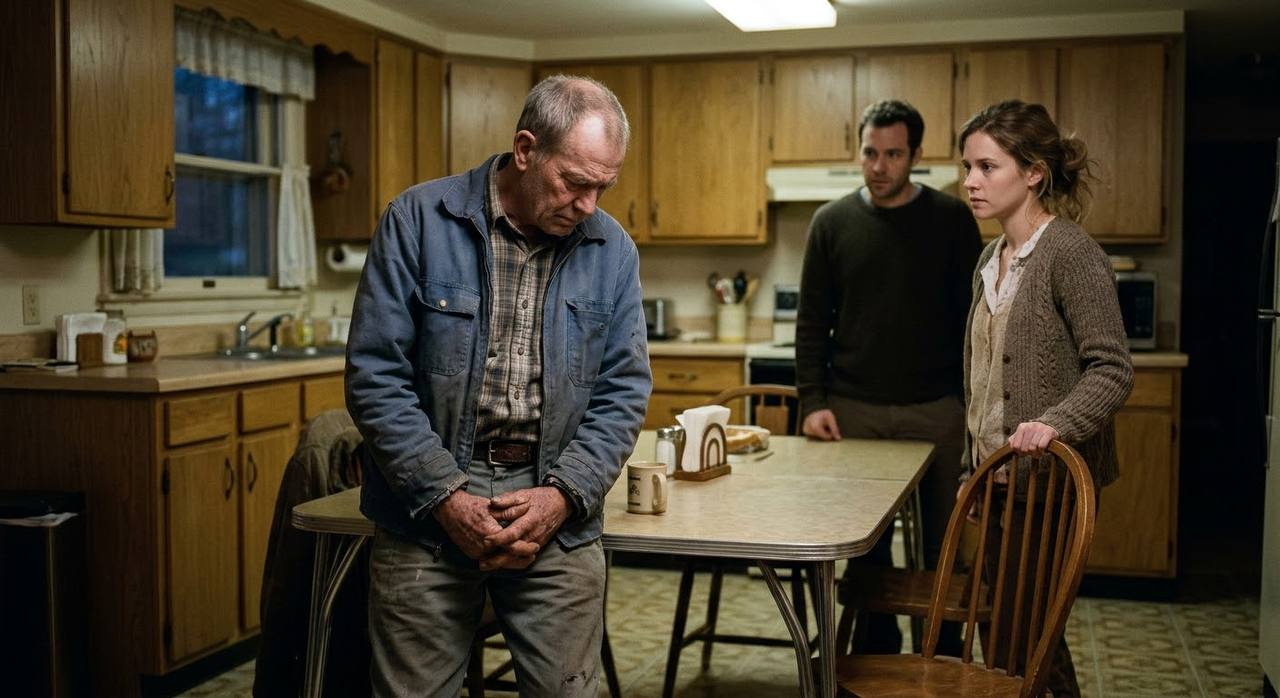
The way he had stood in my kitchen asking for a thousand dollars.
The way Jessica had humiliated him.
And the way he had looked at our house before leaving, as though he knew something terrible that I didn’t.
At every red light, I gripped the steering wheel harder.
My father had survived thirty years of dangerous construction work. He had fallen from scaffolding, broken ribs, crushed two fingers beneath a steel beam, and once spent six weeks recovering from a workplace accident.
But I had never imagined losing him to something happening quietly inside his own body.
When I finally reached Cascade Regional Hospital, I left my car in the first available parking space and hurried through the emergency entrance.
A nurse directed me to the surgical waiting area.
There, beside a row of vending machines, stood a woman in a dark blue suit holding a leather briefcase.
She looked up when I approached.
“Ethan Hayes?”
“Yes.”
“I’m Maya Sharma. I’m representing your father.”
I barely heard the introduction.
“Is he alive?”
“He’s still in surgery. The medical team is doing everything they can.”
I pressed my hands against my forehead.
“Can someone tell me what happened?”
Maya gestured toward an empty chair.
“Your father collapsed outside the county records office this morning. He was conscious when the ambulance arrived, but his condition deteriorated rapidly.”
“The records office?”
She nodded.
“He was trying to obtain one final document.”
I stared at her.
“About an adoption?”
Maya’s expression changed.
“Your father told you?”
“Only that he needed adoption records and some kind of test.”
She looked toward the operating room doors.
Then she opened her briefcase.
“Ethan, your father was very concerned about what might happen if he couldn’t explain everything himself.”
She removed a thick cream-colored envelope.
My name was written across the front.
ETHAN HAYES.
Below it, in my father’s familiar uneven handwriting, were seven words.
DO NOT LET JESSICA SEE THIS.
My chest tightened.
“Why would he write that?”
Maya didn’t answer immediately.
Instead, she handed me the envelope.
“Your father asked me to make sure you received this privately. He also asked that I explain the documents inside before you made any decisions.”
I turned the envelope over.
It had been sealed with ordinary transparent tape.
Something about that small detail nearly broke me.
My father had always used too much tape.
On birthday presents.
On packages.
On envelopes containing twenty-dollar bills when I was away at college.
I could picture him sitting at his kitchen table, pressing down the edges carefully.
Preparing for the possibility that he might not be able to tell me the truth himself.
“Can I open it?”
Maya nodded.
I tore the envelope along the top.
Inside were several folded documents and a handwritten letter.
The first page was a certified adoption decree.
I recognized my own name.
Ethan Michael Hayes.
My date of birth.
The county where I had been born.
And two names I had never seen before.
My biological mother’s name was Laura Bennett.
My biological father’s name was Daniel Whitmore.
I stared at the page.
Then I looked at Maya.
“What is this?”
She spoke gently.
“Arthur Hayes adopted you when you were eleven months old.”
The words made no sense.
I actually laughed.
A short, frightened sound.
“No. That’s impossible.”
Maya waited.
“My father is Arthur Hayes.”
“Yes.”
“He raised me.”
“Yes.”
“He told me my mother died when I was little.”
Maya nodded.
“That part is true. His wife, Margaret, died when you were three.”
I shook my head.
“No. Margaret was my mother.”
“She was the mother who raised you.”
My hands began trembling.
I looked back at the document.
Arthur Hayes.
Margaret Hayes.
Adoptive parents.
I read those words again and again.
My entire childhood seemed to shift beneath my feet.
The photographs on the mantel.
The stories about my birth.
The way my father used to say I had my mother’s smile.
Suddenly, I didn’t know what any of it meant.
“Why didn’t he tell me?”
Maya’s face softened.
“That’s something he explains in his letter.”
I unfolded the pages.
The handwriting was unmistakably my father’s.
My eyes filled before I reached the second sentence.
“Dear Ethan,
“If you’re reading this without me sitting beside you, then something happened before I could finish what I started.
“First, I need you to know that nothing in these papers changes who you are to me.
“You are my son.
“You were my son the first night I held you, and you have been my son every day since.
“I should have told you the truth years ago. I was afraid you would think our love was built on a lie.
“But I realize now that keeping the truth from you was the mistake.
“There’s more you need to know about your birth family.
“And there’s something about Jessica that frightened me enough to start looking for answers.”
I stopped reading.
My heart was pounding.
I looked at Maya.
“What does my wife have to do with my adoption?”
She opened another folder.
“Ethan, before I explain that, I need you to understand what your father discovered.”
I nodded.
Maya took out a black-and-white photograph.
It showed a young woman sitting on a hospital bed.
She had long dark hair and a tired smile.
In her arms was a newborn baby.
Me.
I knew it instantly.
Not because I recognized myself.
But because of the handwritten inscription on the back.
“For my beautiful boy, Ethan. I hope one day you understand how much I loved you. Mom.”
I felt my throat close.
“Laura Bennett was seventeen when you were born,” Maya said.
“She was unmarried, frightened, and living with relatives who didn’t support her.”
“What happened to her?”
“She placed you for adoption shortly after your birth. According to the records your father obtained, she wanted a family who could provide stability.”
I stared at the photograph.
“Did she ever try to find me?”
Maya hesitated.
“Yes.”
The single word struck me harder than anything else.
“She did?”
Maya nodded.
“She contacted the adoption agency when you were twelve. Again when you were eighteen. And once more shortly before she died.”
I couldn’t breathe.
“She died?”
“Four years ago.”
I lowered my head.
A woman I had never known had spent decades wondering about me.
And now I would never hear her voice.
Maya waited while I tried to collect myself.
Then she continued.
“Your biological father, Daniel Whitmore, was never told about the pregnancy until years later.”
I looked up.
“Is he alive?”
“Yes.”
“Where is he?”
“Portland.”
I stared at her.
Portland.
Less than two hours from where I lived.
My biological father was alive.
Nearby.
And apparently, connected to whatever secret Arthur had been investigating.
“Why did my father start looking into this now?”
Maya opened a second folder.
“Because six weeks ago, Arthur received a letter.”
She handed me a copy.
The sender was a legal firm in Portland.
The letter concerned the estate of Daniel Whitmore’s late sister, Eleanor.
According to the document, Eleanor had established a family trust years earlier.
Its terms provided for certain distributions to Daniel’s legally recognized descendants.
Recent genealogical research had suggested that Daniel might have a biological son.
Me.
I looked at Maya.
“Are you saying there’s money?”
“Potentially. But your father’s concern wasn’t the money itself.”
“What was it?”
“Someone had already contacted the trust administrator claiming to represent you.”
A cold sensation moved through my stomach.
“Who?”
Maya handed me another page.
It was a letter written on stationery bearing the name of a consulting company.
Jessica’s consulting company.
I stared at it.
The letter stated that Jessica Hayes was assisting her husband, Ethan Hayes, with a confidential family inheritance matter.
It requested information about the trust’s assets, beneficiary verification procedures, and distribution timeline.
At the bottom was a signature.
My signature.
Except I had never signed it.
I stared at the page.
“That’s not mine.”
Maya nodded.
“Your father said the same thing.”
I examined the letters.
Someone had copied the general shape of my signature.
The tall E.
The loop at the end of Hayes.
But the middle letters were wrong.
And the date was from a Tuesday when I had been in Seattle on business.
“Jessica sent this?”
“The letter came from her company email account. We have confirmation that it was received. We cannot yet establish who actually prepared or signed it.”
I felt sick.
Jessica had told me nothing about an inheritance.
Nothing about my biological family.
Nothing about an adoption.
Yet somehow she had been contacting attorneys and asking questions about money supposedly belonging to me.
“How did she even know?”
Maya folded her hands.
“That’s one of the questions your father was trying to answer.”
I looked at the letter.
Then I remembered something.
Two months earlier, Jessica had insisted that we organize our household documents.
Insurance policies.
Tax returns.
Property records.
Birth certificates.
She had spent an entire Saturday in my home office, scanning old files.
At the time, I thought she was simply trying to help.
But my birth certificate was in that office.
Along with a sealed folder Arthur had given me years earlier.
I had never opened it.
Dad had told me it contained family documents I might need someday.
I kept it in a drawer beneath my desk.
Jessica knew where it was.
My stomach tightened.
“What else did my father find?”
Maya turned another page.
“Your wife contacted a private records researcher last month. Your father learned about it because the researcher approached him to confirm information from your childhood.”
“Why would he contact Dad?”
“Because certain details in the request didn’t match the records, and the researcher wanted verification before proceeding.”
I stared at her.
“Did Jessica know Arthur wasn’t my biological father?”
“Apparently, yes.”
“Before I did?”
Maya nodded.
I leaned back in the chair.
The waiting room seemed to tilt.
My wife knew the truth about my birth.
My father knew that she knew.
And I had been living between them without understanding anything.
Suddenly, Jessica’s behavior over the last several months made terrible sense.
Her insistence that Arthur was becoming confused.
Her complaints that he interfered too much.
Her repeated suggestion that we stop visiting him.
The night she told me my father was “obsessed with controlling our marriage.”
I had dismissed those comments as ordinary family tension.
Now I wasn’t so sure.
“Was the thousand dollars for all of this?” I asked.
Maya nodded.
“He needed certified records and an independent DNA test. We were also reviewing whether the documents sent on your behalf were authentic.”
I looked toward the surgical doors.
My father had spent his retirement income helping me.
He had sold land to help me buy my house.
And now, while dealing with a medical condition he might not even have known was life-threatening, he had been searching for proof that someone was trying to use my identity.
I pressed the heels of my hands against my eyes.
“Why didn’t he just tell me?”
Maya’s voice was gentle.
“Your father was afraid you wouldn’t believe him without evidence.”
I knew why.
For two years, Jessica had repeatedly portrayed Arthur as suspicious, controlling, and forgetful.
She had turned every disagreement into proof that he wanted to interfere with our marriage.
And I had allowed it.
I had even begun visiting him less often because I was tired of the arguments afterward.
I remembered the way Dad looked at me in the backyard.
“I need proof before I tell you.”
He hadn’t been protecting himself.
He had been protecting me from an accusation he knew might destroy our relationship if he couldn’t substantiate it.
My phone vibrated.
Jessica.
“Where are you? You left without telling me.”
I stared at the screen.
Then another message appeared.
“Ethan, answer me.”
I turned the phone facedown.
Maya watched quietly.
“Your father asked you not to discuss this with her until we could preserve the relevant records,” she said. “I recommend following that advice.”
I nodded.
Then the doors at the end of the hallway opened.
A surgeon stepped into the waiting area.
“Family of Arthur Hayes?”
I stood so quickly that my chair struck the wall.
“I’m his son.”
The surgeon approached.
“I’m Dr. Collins.”
“Is my father alive?”
He took a breath.
“The surgery was successful.”
My knees nearly gave way.
I gripped the chair.
Dr. Collins continued.
“Your father had a serious aortic aneurysm that required emergency repair. He’s still in critical condition, and the next forty-eight hours will be important.”
I barely heard the rest.
Successful.
Alive.
My father was alive.
I lowered my head and began crying.
Not quietly.
Not with dignity.
I cried like the little boy Arthur had carried home after I broke my arm at six.
Like the teenager who had watched him stand in the rain repairing a neighbor’s roof because the family couldn’t afford a contractor.
Like the grown man who had almost let his wife convince him that his father was a burden.
Maya placed a hand on my shoulder.
When I finally looked up, Dr. Collins told me I would be able to see Arthur once he was settled in intensive care.
I thanked him.
Then I asked Maya to explain the rest.
She handed me one final document.
A preliminary DNA report.
Arthur had obtained a comparison using samples that both men had voluntarily provided through proper procedures.
The report established a biological parent-child relationship between me and Daniel Whitmore with overwhelming statistical confidence.
I stared at it.
“Daniel agreed to be tested?”
“Yes.”
“He knows about me?”
“He does now.”
“Does he want to meet me?”
Maya nodded.
“He does.”
I sat down again.
For thirty-eight years, I had believed my family history was simple.
My mother died when I was young.
My father raised me alone.
We didn’t have much money.
But we had each other.
Now I had an entire second history waiting beyond the one I knew.
I didn’t know whether I was ready for it.
But I knew one thing.
Whatever I learned about Daniel Whitmore, Arthur Hayes would always be my father.
That night, I sat beside Arthur’s hospital bed.
He was surrounded by monitors and tubes.
His face looked smaller against the white pillow.
His hands rested motionless on the blanket.
I had never noticed how old they looked.
The thick fingers.
The crooked knuckle from a construction accident.
The pale scar across his right palm.
Those hands had built my childhood.
They had repaired my bicycles, packed my lunches, carried me when I was sick, and signed every school permission slip.
I took his hand carefully.
“Dad.”
He didn’t move.
“It’s Ethan.”
The monitor continued its steady rhythm.
“I read your letter.”
My voice broke.
“I know.”
I swallowed.
“I know about the adoption.”
I looked down at his hand.
“And I want you to understand something.”
Tears slipped down my face.
“Nothing changes.”
I leaned closer.
“You’re my dad. You always were. You always will be.”
For a moment, I thought his fingers moved.
Then a nurse entered to check his medications.
I stepped aside.
I stayed until visiting hours ended.
When I returned home, the house was dark.
Jessica was sitting in the living room.
She stood as soon as I entered.
“Where have you been?”
“At the hospital.”
Her expression shifted.
“Hospital?”
“My father’s in intensive care.”
She covered her mouth.
“Oh my God. What happened?”
“He needed emergency surgery.”
“Is he okay?”
“He’s alive.”
She approached me.
“Why didn’t you call?”
I looked at her.
For years, I had believed I could read every expression on my wife’s face.
Now I found myself wondering what I had missed.
“Everything happened quickly.”
She reached for my hand.
I stepped away.
Her eyes narrowed.
“Ethan?”
“I need some space tonight.”
“What does that mean?”
“It means I’m exhausted.”
She looked toward my briefcase.
“Did your father say anything before surgery?”
The question came too quickly.
I went still.
“Why?”
She shrugged.
“I was just asking.”
“About what?”
“Whether he needed anything.”
I studied her.
She looked away first.
I knew then that I couldn’t confront her without understanding exactly what she had done.
So I went upstairs.
I slept in the guest room.
The next morning, I called Maya.
We discussed the possible misuse of my signature, the trust correspondence, and the need to secure my financial records.
Maya advised me to preserve evidence rather than attempt to investigate Jessica’s private accounts myself.
I changed the passwords to my personal email and financial accounts.
I contacted my bank to review account access.
I also checked my credit reports.
Nothing immediately suggested that money had been taken.
But I discovered something else.
Jessica had recently asked our financial adviser about creating a joint investment account.
She had described it as a way to manage a potential future inheritance.
I had never discussed an inheritance with her.
The adviser forwarded me his notes after confirming my identity.
One sentence stood out.
“Client’s spouse anticipates significant family distribution within six months.”
I stared at those words.
Six months.
Jessica had known about the trust for weeks.
And she had already begun planning how to use it.
That afternoon, I met Maya at her office.
We reviewed every document Arthur had gathered.
The forged signature.
The trust inquiry.
The researcher’s correspondence.
The adoption records.
Then Maya showed me something I hadn’t expected.
A copy of an email Jessica had sent to the trust administrator.
It stated:
“My husband has a complicated relationship with his adoptive father, who is elderly and increasingly confused. Please direct future beneficiary communications through me so that unnecessary family conflict can be avoided.”
I read the sentence three times.
My hands began trembling.
She wasn’t merely trying to learn about the trust.
She was trying to cut Arthur out of the conversation.
And she was using the same accusations she had repeated to me for months.
I looked at Maya.
“Can we prove she wrote this?”
“The email came from her verified business account. We have preserved the original correspondence. Whether she authorized every part of it is something a proper investigation can establish.”
I nodded slowly.
“What happens now?”
“We can notify the trust administrator that no one is authorized to act for you without proper documentation. We can also address the suspected signature forgery through the appropriate legal channels.”
I looked down at the file.
“And Jessica?”
Maya paused.
“That’s a personal decision, Ethan. But you should not confuse an unexplained document with proof of every possible motive. Give yourself time to learn the facts.”
She was right.
I wanted answers.
Not assumptions.
So I decided to ask Jessica directly.
That evening, I returned home earlier than usual.
Jessica was in the kitchen preparing dinner.
She smiled.
“You’re home.”
“We need to talk.”
Something in my voice made her turn off the stove.
“About what?”
I placed a copy of the trust inquiry on the table.
Her face changed.
It was subtle.
But unmistakable.
The color seemed to drain from her cheeks.
“Where did you get that?”
“Did you send it?”
She looked down.
“Ethan, I can explain.”
“Then explain.”
She pulled out a chair.
I remained standing.
“I found some documents in your office a few months ago.”
“What documents?”
“An old adoption file.”
I stared at her.
“You knew I was adopted?”
She nodded.
“Why didn’t you tell me?”
“I didn’t know how.”
“Jessica.”
“I was afraid it would upset you.”
I placed the second document on the table.
“Then why did you contact a trust administrator using my name?”
She stared at the forged signature.
“I was trying to help.”
“Help whom?”
“You.”
“By signing my name without permission?”
Her eyes filled.
“I thought if there was money, we should know about it.”
“We?”
“We’re married, Ethan.”
“That’s not an answer.”
She stood.
“Your father was hiding something enormous from you. Doesn’t that bother you?”
“Of course it bothers me.”
“Then why are you defending him?”
“Because he was trying to tell me the truth.”
Jessica laughed bitterly.
“After thirty-eight years?”
I felt the words strike.
But I didn’t move.
“Arthur made a mistake keeping the adoption secret,” I said. “That doesn’t give you permission to impersonate me.”
She folded her arms.
“I wasn’t impersonating you.”
I pointed to the signature.
“Then whose signature is that?”
She looked away.
Silence filled the kitchen.
Finally, she whispered, “I signed it.”
I felt something inside me collapse.
“Why?”
“Because they wouldn’t give me information otherwise.”
“So you forged my name.”
“I didn’t think of it that way.”
“How did you think of it?”
She began crying.
“I thought we could finally have some security.”
I stared at her.
“We have security.”
“Not the kind other people have.”
I looked around our kitchen.
The appliances.
The hardwood floors.
The home my father had helped me purchase.
Jessica continued.
“Your father had access to information about your biological family. If there’s money involved, why should he decide whether you receive it?”
“He wasn’t trying to keep it from me.”
“How do you know?”
“Because he was gathering evidence to give me.”
She wiped her cheeks.
“And you believe him?”
I took a breath.
“Jessica, did you tell the trust administrator that Arthur was mentally confused?”
She hesitated.
“Yes.”
“Why?”
“Because he was interfering.”
“With what?”
“Our future.”
I stared at her.
There it was.
Not an accusation.
Not a misunderstanding.
Her own explanation.
She believed my father was interfering with our future because he refused to let her control information that belonged to me.
I pulled out a chair and sat down.
“Did you know Arthur was sick?”
Her expression softened.
“No. I didn’t.”
“Did you know he needed money for legal records?”
“I knew he was investigating something.”
“Then why did you humiliate him?”
She looked down.
“I was angry.”
“At what?”
“At him.”
“Why?”
“Because he never liked me.”
I thought about that.
Arthur had never been especially warm toward Jessica.
But he had invited her to family dinners.
He had helped us move.
He had repaired our fence.
He had provided most of the down payment on our house.
He had never once insulted her in my presence.
“He helped us buy this house,” I said.
Jessica looked away.
“That doesn’t mean he gets to control us.”
“He wasn’t controlling us.”
She said nothing.
I stood.
“I need you to stay somewhere else for a while.”
Her eyes widened.
“What?”
“I need space to understand what happened.”
“Ethan, you’re choosing him over me.”
I looked at her.
The sentence sounded painfully familiar.
Three days earlier, she had said almost the same thing.
But now I understood how unfair the choice had been.
“This isn’t about choosing him over you,” I said. “It’s about what you’ve done.”
She began crying again.
“Are you ending our marriage?”
“I don’t know.”
And for once, I didn’t pretend to know.
Jessica packed a suitcase that night.
She went to stay with her sister.
I watched her car disappear down the driveway.
Then I sat alone in the kitchen.
The same kitchen where Arthur had stood asking for a thousand dollars.
I looked at the place where he had clasped his trembling hands.
And I began crying again.
Not because I regretted helping him.
Because I regretted allowing him to feel ashamed for needing me.
Two days later, Arthur opened his eyes.
I was sitting beside his bed when it happened.
His eyelids fluttered.
He looked toward the ceiling.
Then slowly turned his head.
“Ethan?”
His voice was barely audible.
I stood.
“Dad?”
He blinked.
“You’re here.”
I laughed through tears.
“Of course I’m here.”
He looked confused.
“The records…”
“Don’t worry about the records.”
“The letter…”
“I read it.”
His eyes widened.
I took his hand.
“All of it.”
He swallowed.
“I’m sorry.”
I shook my head.
“Don’t.”
“I should’ve told you.”
“Yes,” I whispered. “You should have.”
His eyes filled.
“I was afraid.”
“Afraid of what?”
“That you’d look at me differently.”
I leaned closer.
“Dad, look at me.”
He did.
“You taught me how to ride a bike. You stayed up when I was sick. You worked two jobs so I could go to college. You sold things you loved so I could have things I needed.”
His chin trembled.
“You were there every time I needed you.”
I squeezed his hand.
“Biology doesn’t erase any of that.”
He began crying.
I hadn’t seen my father cry since Margaret’s funeral.
I bent down and hugged him as carefully as I could.
For a long time, neither of us spoke.
Then he whispered something against my shoulder.
“You’re my boy.”
I closed my eyes.
“Always.”
Arthur remained in the hospital for another two weeks.
His recovery was slow.
There were difficult days.
Painful physical therapy sessions.
Long conversations with doctors.
And moments when exhaustion made him irritable.
But he improved.
Every morning, I arrived with coffee.
Every evening, I sat beside him until visiting hours ended.
Sometimes we discussed the adoption.
Sometimes we talked about ordinary things.
The weather.
Baseball.
The old truck he refused to replace.
One afternoon, he finally told me how I had become his son.
Arthur and Margaret had been married for seven years when they learned they couldn’t have biological children.
They had nearly given up hope of becoming parents.
Then an adoption agency contacted them.
A baby boy needed a home.
Arthur said Margaret cried the first time she saw my photograph.
And when they brought me home, she held me for hours.
“She wouldn’t put you down,” he said, smiling.
I laughed.
“Sounds like Mom.”
He nodded.
“She loved you more than anything.”
His expression grew sad.
“After she died, I was afraid you’d lose another parent if I told you the truth.”
I looked at him.
“So you kept it secret.”
He nodded.
“At first, I thought I’d tell you when you were older.”
“Why didn’t you?”
“Every year, it got harder. And every year, I found another excuse.”
He looked down.
“I was wrong.”
I didn’t argue.
He had been wrong.
But I could understand the fear behind his mistake without pretending it hadn’t hurt me.
Eventually, we began discussing Daniel Whitmore.
My biological father.
Arthur had already spoken with him.
Daniel had apparently been stunned to learn I existed.
He was sixty-one.
Widowed.
A retired mechanical engineer.
He had two grown daughters from his marriage.
And he wanted to meet me.
I didn’t agree immediately.
I needed time.
So did Arthur.
But six weeks after my father’s surgery, I met Daniel at a quiet restaurant outside Portland.
I went alone.
When I entered, an older man stood near the window.
He had gray hair, broad shoulders, and my eyes.
That was the first thing I noticed.
My eyes.
It was strange seeing something so familiar on a stranger’s face.
“Ethan?”
I nodded.
“Daniel?”
He smiled nervously.
“Thank you for coming.”
We shook hands.
Then sat down.
For the first twenty minutes, neither of us knew what to say.
He asked about my work.
I asked about his life.
He told me about his daughters.
About his late wife.
About growing up in Oregon.
Finally, he looked at me.
“I wish I’d known.”
I swallowed.
“About me?”
He nodded.
“I would have tried to be there.”
I believed he meant it.
But I also knew that imagining the past couldn’t change it.
We talked for nearly three hours.
He showed me photographs of Laura.
My biological mother.
She had loved gardening.
She had wanted to become a nurse.
She liked old movies and terrible jokes.
Daniel told me they had been young and frightened.
They hadn’t known how to make their relationship work.
Then Laura’s family moved away.
He never knew she was pregnant.
I listened.
Sometimes I cried.
Sometimes he did.
When we finally stood to leave, Daniel hesitated.
“I don’t want to take anyone’s place.”
I smiled sadly.
“You couldn’t.”
He nodded.
“I understand.”
“But I’d like to know you.”
His face softened.
“I’d like that too.”
We began meeting occasionally.
Slowly.
Without expectations.
I met his daughters.
I learned about relatives I had never known existed.
I received copies of childhood photographs of Laura.
And eventually, I visited her grave.
I stood there for a long time.
The headstone was simple.
LAURA BENNETT.
BELOVED DAUGHTER, SISTER, AND MOTHER.
I placed white flowers beside it.
Then I whispered, “I had a good life.”
The wind moved through the trees.
“My dad took care of me.”
I swallowed.
“I wish we could’ve met.”
There was no answer.
But somehow, saying the words helped.
The inheritance matter took longer to resolve.
The trust administrator confirmed that I was a potential beneficiary.
The documents Jessica submitted without my authorization were removed from the process.
Maya helped me provide proper identification and legal verification.
The forged signature was formally documented, and the relevant authorities were notified.
I didn’t know whether Jessica had intended to steal money.
She claimed she only wanted information.
But I knew she had lied, signed my name, and tried to control communications about my family without my consent.
That was enough to destroy the trust between us.
We began living separately.
Months later, after counseling and difficult conversations, I filed for divorce.
It wasn’t a decision I made in anger.
It was a decision I made after realizing that our marriage had become a place where honesty was optional whenever Jessica believed she knew what was best.
She apologized eventually.
A real apology.
She admitted forging my signature.
She admitted portraying Arthur as confused to make others dismiss his concerns.
She admitted that the possibility of an inheritance had made her focus more on money than on how her actions affected me.
I listened.
I thanked her for telling the truth.
But I didn’t change my decision.
Sometimes an apology arrives after trust has already suffered too much damage.
By autumn, Arthur was well enough to return to his garden.
He moved more slowly.
He needed regular medical appointments.
He couldn’t lift heavy objects.
But he was alive.
And every Sunday, I visited him.
We repaired a fence together.
Or rather, I repaired it while he supervised from a lawn chair.
He complained constantly about my technique.
I told him he was a terrible boss.
He laughed.
For the first time in years, our relationship felt simple again.
Not because we had erased the secrets.
But because we were finally talking about them.
One Sunday afternoon, while we sat beneath the apple tree in his backyard, Arthur handed me a small wooden box.
“What’s this?”
“Open it.”
Inside was a wristwatch.
Old.
Scratched.
With a worn leather strap.
I recognized it immediately.
He had worn it throughout my childhood.
“I thought you sold this,” I said.
Arthur smiled.
“Almost did.”
I turned it over.
There was a tiny engraving on the back.
TO ARTHUR — LOVE, MARGARET.
My throat tightened.
“Mom gave you this?”
“On our fifth anniversary.”
I looked at him.
“Why are you giving it to me?”
He shrugged.
“Thought it was time.”
I slipped it onto my wrist.
It was slightly loose.
Arthur watched me.
Then he said quietly, “I never regretted taking you home, Ethan.”
I looked up.
“Not once?”
“Not for a second.”
He smiled.
“Best decision Margaret and I ever made.”
I stared at the old watch.
The hands were still moving.
After all those years.
Still keeping time.
I thought about the thousand dollars he had asked to borrow.
The way he had stood in my kitchen.
The shame on his face.
The apology he had whispered when I handed him the envelope.
Then I remembered something.
“Dad?”
“Yeah?”
“That thousand dollars.”
He laughed softly.
“What about it?”
“You said you’d repay me.”
He looked embarrassed.
“I was going to.”
I shook my head.
“I don’t want it back.”
“Ethan—”
“No. Listen.”
He fell silent.
“You gave me a childhood. You gave me an education. You gave me a home. You gave me every opportunity you could afford, and plenty you couldn’t.”
My voice tightened.
“You don’t owe me a thousand dollars.”
His eyes filled.
I reached across the table.
“I owe you more than I could ever repay.”
Arthur squeezed my hand.
Then he smiled through his tears.
“That’s not how being a father works, son.”
I laughed.
“Then stop trying to pay me back.”
He nodded.
“Deal.”
We sat beneath the apple tree until the sun began to set.
For a while, neither of us spoke.
There was no need.
Months later, the trust matter was finally settled.
I received a substantial distribution, enough to improve my financial security and make some long-term investments.
But the money no longer felt like the center of the story.
In fact, the first thing I did after receiving it had nothing to do with myself.
I arranged for Arthur’s remaining medical bills to be reviewed and paid where appropriate.
Then I helped him establish a reserve for future care and emergencies.
When he found out, he was furious.
“Ethan, you shouldn’t have done that.”
I smiled.
“Why not?”
“That’s your money.”
I looked at him.
“Dad, you sold your motorcycle to help pay my tuition.”
He stared at me.
“Who told you that?”
“Mom’s sister told me years ago.”
He shook his head.
“That old thing wasn’t worth much.”
“You loved that motorcycle.”
He waved a hand.
“Didn’t need it.”
I laughed.
Then I said, “And you sold your good suit when I needed school shoes.”
His expression changed.
He looked almost offended.
“Who told you about that?”
“Aunt Linda.”
He sighed.
“That woman talks too much.”
I smiled.
“Maybe.”
Then I leaned forward.
“But I want you to understand something.”
He looked at me.
“You never made me feel like a burden. Not once.”
His eyes softened.
“And I’m not going to let you feel like one either.”
He looked away.
For a long moment, he said nothing.
Then he whispered, “Thank you, son.”
That Christmas, I invited Arthur to my house.
It was the first Christmas since my separation from Jessica.
The house felt different.
Quieter.
Less tense.
I decorated a small tree in the living room and cooked dinner myself.
Arthur arrived carrying a grocery bag.
“What’s that?” I asked.
“Pie.”
I looked inside.
A badly shaped apple pie.
The crust was uneven.
One side had collapsed.
I laughed.
“Did you make this?”
He looked offended.
“Of course.”
“Dad, you’ve never baked a pie in your life.”
“People can learn new things.”
I grinned.
“Apparently.”
We ate dinner at the same kitchen table where, one year earlier, Jessica had humiliated him.
Halfway through the meal, Arthur looked around.
“You’ve changed the place.”
I glanced toward the windows.
“Not much.”
He smiled.
“Feels different.”
I knew what he meant.
The house was still the same.
The counters.
The cabinets.
The old dining chairs.
But something important had changed.
My father no longer needed to lower his eyes when he entered.
He no longer needed to apologize for taking up space.
He was welcome.
Completely.
Without conditions.
After dinner, we sat together drinking coffee.
Arthur looked at me.
“Can I ask you something?”
“Sure.”
“Do you regret finding out?”
I thought about the adoption papers.
About Laura.
About Daniel.
About the marriage I had lost.
About the months of fear and confusion.
Then I looked at my father.
“No.”
He seemed surprised.
“Really?”
I nodded.
“I wish you’d told me sooner.”
He looked down.
“I know.”
“But I’m glad I know now.”
He smiled sadly.
“Me too.”
I took a sip of coffee.
Then I added, “And I’m glad you survived long enough to tell me yourself.”
Arthur looked toward the Christmas tree.
His eyes filled.
“So am I, son.”
Later that night, after he left, I stood alone in the kitchen.
I thought about everything that had happened since the day he asked for a thousand dollars.
My father had nearly died.
My marriage had ended.
I had discovered I was adopted.
I had met a biological father I never knew existed.
And I had learned the truth about the woman who gave birth to me.
But the most important revelation hadn’t been inside the adoption records.
It hadn’t been in the trust documents.
And it hadn’t been hidden behind the forged signature.
It had been in the letter Arthur wrote before his surgery.
I took it from the drawer where I kept it.
The paper was creased from being opened so many times.
Near the bottom, beneath his explanation about the adoption and his fears about Jessica, he had written something I now knew by heart.
“Ethan,
“I spent a lot of years worrying that one day you’d find out we weren’t related by blood and decide I wasn’t your real father.
“But I want you to know something.
“The day you came into our home, I didn’t look at you and see somebody else’s child.
“I saw my son.
“I didn’t love you because you had my eyes or my name.
“I loved you because you were you.
“And if I had the chance to live my whole life over again, knowing every hardship and every sacrifice that waited for me, I would still choose you.
“Every single time.
“Love, Dad.”
I read those words one last time.
Then I folded the letter and placed it carefully back in its envelope.
For most of my life, I believed that the greatest gift Arthur Hayes gave me was everything he sacrificed.
His time.
His money.
His youth.
His dreams.
But I eventually realized that his greatest gift was something much simpler.
He never made me feel that I had to earn my place in his life.
I was his son.
That was enough.
And when he stood in my kitchen asking for help, trembling with embarrassment, he wasn’t asking me to repay a debt.
He was simply hoping that the boy he had loved all his life would trust him one more time.
I’m grateful I did.
Because three days later, I almost lost him.
And if I had listened to Jessica, if I had turned him away because I didn’t understand his request, I would have spent the rest of my life wondering whether that one thousand dollars could have helped him finish the work he was desperately trying to complete.
Instead, I gave him the money.
He found the evidence.
And when his body failed him, he made sure the truth reached me.
That sealed envelope didn’t just reveal the truth about my birth.
It revealed the truth about my marriage.
And it reminded me that the man who raised me had spent his entire life protecting me, even when I didn’t know I needed protection.
Today, Arthur is still alive.
He still complains that I buy groceries that are too expensive.
He still insists he can fix things around my house even though his doctors have forbidden him from lifting anything heavy.
And every Sunday, when I walk through his front door, he greets me the same way he did when I was a little boy.
“There’s my son.”
I always smile.
Because now I understand exactly what those words mean.
Blood can tell you where you came from.
Documents can tell you who brought you into the world.
Money can change your circumstances.
But none of those things can measure the love of someone who chooses to show up for you, year after year, without expecting anything in return.
My father asked me for $1,000.
He ended up giving me something no amount of money could ever buy.
The truth about my life—and one more chance to tell him how much I love him.
THE END