The envelope was cream-colored, with my name written across the front.
Mary.
No last name.
Just the four letters James used to stretch into two syllables when he was teasing me.
I sat down before opening it.
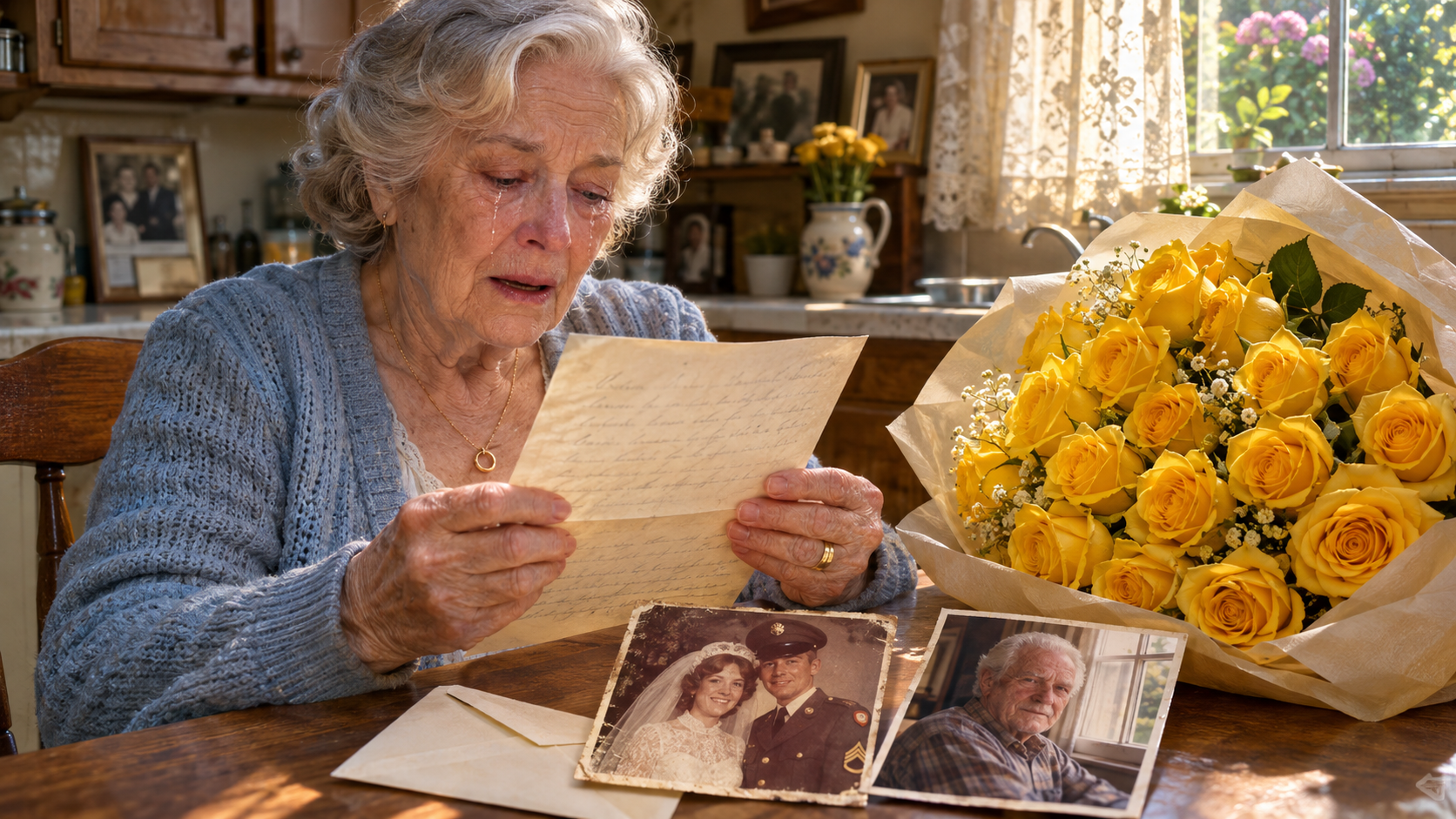
The roses lay across the kitchen table, still wrapped in paper. One of the stems had caught the lace runner my mother had made, but I couldn’t make myself reach over and untangle it.
I slid my finger under the flap.
Inside were three folded pages and a small photograph.
The first line read:
Honey, you won’t believe why I had to disappear.
I stopped breathing.
Not for long. A second, perhaps two.
But long enough that the kitchen seemed to move away from me.
I looked at the photograph.
An old man sat beside a window, a blanket over his knees. His hair was white. His shoulders were narrow. There was a scar along the left side of his neck.
His hands rested on the blanket.
I knew those hands.
Or I thought I did.
I turned the photograph over.
Written on the back, in a different hand, were the words:
James, June 2026.
I reached for my glasses.
They were already on my face.
I touched them, confused, then pressed both palms against the table until the trembling eased enough for me to read.
Mary, before you read another word, I need you to know that I asked my niece to write this exactly as I said it. My right hand won’t cooperate anymore. The words are mine, even the ones I’m ashamed of.
I have started this letter seventeen times.
Every version makes me sound better than I deserve.
I remembered that little crease between his eyebrows whenever he was trying to get something right.
A grocery list.
A letter to his mother.
The vows he had copied onto an index card and then forgotten in his jacket pocket.
I read on.
I survived the attack.
I was taken prisoner.
For a long time, I could not come home.
But there is something worse you need to know.
Later, I could have found you.
And I didn’t.
I put the pages down.
Outside, somebody’s lawn mower started.
A dog barked twice.
The refrigerator hummed behind me.
Ordinary sounds.
The kind that had filled fifty-six years.
I stood so abruptly that the chair struck the wall.
“No.”
I said it to the photograph.
Then to the letter.
Then to the empty kitchen.
“No.”
For decades, I had imagined the impossible.
James coming home with a limp.
James standing on the porch with gray at his temples.
James calling from an airport because there had been some mistake, some terrible mistake that had finally been corrected.
Eventually, I had stopped imagining his face because I couldn’t decide how old to make him.
Now there he was.
Old enough.
Alive enough.
And saying he had left me behind.
My neighbor Ruth answered on the second ring.
“Mary?”
“Can you come over?”
“What happened?”
“I need you to read something.”
She arrived wearing gardening gloves, one still holding a handful of weeds.
When she saw the roses, she smiled.
Then she saw my face.
She set the weeds on the porch rail.
I handed her the letter.
She read the first page standing up.
By the second, she sat.
By the third, she took off her glasses.
“Is there a number?”
I pointed to the bottom.
Claire Whitman. James’s niece.
A telephone number.
An address in western Pennsylvania.
And one sentence beneath it.
You do not owe him a reply. If you want answers, I will help you get them.
Ruth read that line twice.
Then she looked at me.
“What do you want to do?”
For the first time in my life, somebody was asking me that question while James was still alive.
I didn’t know the answer.
We read the letter together.
James had been injured during the attack.
He remembered dirt in his mouth, ringing in his ears, and a man pulling him by the straps of his equipment.
He had no clear memory of the first days afterward.
There had been captivity.
Transfers.
Illness.
Periods when he could not walk without help.
He gave no grand account of it. No story in which he became a hero.
Just a few plain sentences about surviving one day, then another.
He had not been among the men who returned when most American prisoners came home.
His own release and recovery had come later, through circumstances his niece had helped him document.
By the time he reached a hospital where somebody could help him send a message home, years had passed.
I held the page closer.
I wrote to you, Mary.
I wrote three letters.
I gave the first one to a man helping with correspondence. The other two went through Adrian after he answered an inquiry from my family.
Adrian.
I felt something cold move through my chest.
James’s parents had died while he was gone.
His younger sister, Helen, had moved after marrying. He had been estranged from her husband before the war, and their contact afterward was difficult and uneven.
Adrian had remained easy to find.
He had been the person everybody trusted.
The friend who had survived.
The friend who had come to my parents’ house, taken off his hat, and told me there was no hope.
According to James, Adrian had answered.
He had said I was alive.
He had said I had finally begun to recover.
Then he had said I had remarried.
I looked up at Ruth.
“I never did.”
“I know.”
“He knew I never did.”
“I know, Mary.”
Adrian had visited me for years.
He had fixed the latch on my gate.
He had carried my Christmas tree inside.
He had sat across from me on James’s birthday and accepted a slice of cake.
All that time, he had known where James was.
There was a copy of a letter inside the envelope.
I hadn’t noticed it beneath the photograph.
The handwriting looked familiar.
Adrian’s neat, narrow letters.
James,
I won’t pretend this is easy to tell you. Mary has a husband now and a baby coming. She asked me not to put her through this again. She grieved you once. Let her keep the life she has.
I read the paragraph until the words stopped behaving like language.
A husband.
A baby.
I had wanted a baby.
James and I had spoken about it during those two days after the wedding.
Not seriously. Not with names chosen and plans made.
Just lying in bed while afternoon light moved across the ceiling.
He had asked whether I thought he would be a good father.
I had told him he would have to learn not to lose his socks first.
Now a child who had never existed had been used to keep him away.
I pressed my fist against my mouth.
Ruth put a hand on my back.
She didn’t tell me to calm down.
The next part of James’s letter was worse.
Not because it explained Adrian.
Because it stopped explaining him.
I believed him because believing him gave me somewhere to put my fear.
I was badly hurt. I was ashamed of how frightened I had become. I didn’t sleep. I could not bear crowded rooms. I thought the man you married had been left behind over there.
Adrian told me you had a good life.
I told myself that staying away was the last decent thing I could do for you.
That was how I explained the first year.
It does not explain the next fifty.
I closed my eyes.
Ruth waited.
When I could read again, I did.
I could have written directly.
I could have asked someone else.
I could have stood on your street and found out for myself.
I did none of those things.
The longer I waited, the more terrible the truth became to tell.
So I kept waiting.
You deserved a husband who came looking.
You deserved, at the very least, a letter.
There was no request for forgiveness.
I noticed that.
There was no claim that he had suffered more.
No suggestion that I should understand simply because he had once been young and wounded.
He wrote that he had worked for years repairing small engines.
That he had eventually lived near his sister.
That he had never married.
That he had told people he was a widower.
That last sentence made me stand again.
“A widower?”
Ruth said nothing.
“He told people I was dead.”
I walked to the sink.
My roses reflected faintly in the dark glass above it.
For fifty-six years, I had been the widow.
In another town, under another sky, he had given himself the same permission.
I gripped the counter until my fingers hurt.
Then I returned to the table.
At the bottom of the final page, he had written:
I am ill. Claire will tell you what that means if you ask her.
I will not use it to hurry you.
Happy anniversary, Mary.
I remembered the yellow roses.
I am sorry they are late.
James.
I called Claire the next morning.
I had slept in my clothes.
The letter lay on the bedside table, weighted beneath the photograph as if it might otherwise disappear.
A woman answered.
“Hello?”
“My name is Mary.”
She went quiet.
Then, softly, “Thank you for calling.”
“Is this real?”
“Yes.”
“You understand what I’m asking?”
“Yes, ma’am.”
“Don’t call me ma’am.”
“All right. Mary.”
I sat on the edge of the bed.
“I need proof.”
“You should have it.”
She didn’t sound offended.
That helped.
She explained who she was. Helen’s daughter. James’s niece.
Her mother had died three years earlier.
Claire had begun helping James with appointments after his health declined. While organizing papers, she had found a metal box containing old letters, military correspondence, and a photograph of our wedding.
“My mother knew he’d been married,” she said. “She believed what he told her.”
“That I had died?”
“Yes.”
Claire had asked him about the woman in the photograph.
He had answered too quickly.
Then refused to discuss it.
A week later, he had asked her to bring the box back.
“He told me your name,” she said. “Your full name. Where you grew up. The street where your parents lived.”
I looked at the wallpaper beside my bed.
“And then?”
“I searched public records. Newspaper archives. I found your husband’s memorial notice.”
“My husband.”
I heard the bitterness in my own voice.
Claire let it stand.
“I found an article about your retirement from the school library,” she continued. “It mentioned that you’d never remarried.”
I had forgotten that article.
A young reporter had asked why I kept volunteering.
I had said the library had given me somewhere to go after the war took James.
The sentence had made its way into print.
Apparently, it had finally reached him.
“I want to speak to him.”
Claire took a breath.
“He’s awake. But before I get him, there are things—”
“Please.”
“All right.”
I heard movement.
A door.
A quiet exchange I couldn’t understand.
Then breathing.
Shallow.
Uneven.
“Mary?”
I pressed the phone so hard to my ear that it hurt.
His voice had changed.
Of course it had.
Fifty-six years had passed through it.
But beneath the age was something I knew.
The way he held the first part of my name.
The small catch before the second syllable.
I began crying before I spoke.
Then I became angry because he could hear it.
“Tell me what you called the crooked chair in my mother’s kitchen.”
A pause.
“The captain.”
“Why?”
“Because nobody could move it without orders.”
I shut my eyes.
He had made that joke the week before our wedding.
My mother had laughed so hard she dropped a spoon.
“James.”
“Yes.”
For a while, neither of us said anything.
Then he whispered, “I’m sorry.”
I looked down at my wedding ring.
I had stopped wearing it on my hand years earlier, after my knuckles grew thick. It hung from a chain beneath my nightdress.
“Are you married?”
“No.”
“Children?”
“No.”
“Did you ever come back to this town?”
Silence.
“James.”
“Once.”
The room seemed to tilt.
“When?”
“Eighty-two.”
I put my feet flat on the floor.
“What did you do?”
“I drove past your parents’ house.”
“I was living there.”
“I know that now.”
“Did you stop?”
“No.”
“Did you knock?”
“No.”
“Why?”
His breathing grew rough.
“I saw a little bicycle in the yard.”
I remembered it immediately.
Red.
White handles.
My sister’s daughter had left it there while staying with me for the summer.
“I thought—”
“You thought.”
“Yes.”
“You could have asked.”
“Yes.”
That answer broke something open.
Not the lie.
The smallness of what could have ended it.
A knock.
A question.
Five steps up a path.
For years, I had imagined enormous obstacles between us.
War.
Governments.
Oceans.
And there had been those things.
But then there had been a bicycle.
And a frightened man in a car who had driven away.
“I need to stop,” I said.
“All right.”
“Don’t call me unless I ask.”
“I won’t.”
“And don’t send anything else.”
“All right.”
I ended the call.
Then I sat perfectly still until Ruth arrived at ten.
She had brought breakfast.
I told her about the bicycle.
She set down the bag.
“Oh, Mary.”
I cried so hard that morning I frightened myself.
Not because I had lost him.
Because I could finally see how close he had been.
I spent the next week finding out what was true.
Claire sent documents through a secure service Ruth helped me open.
There were records of injury and recovery.
Correspondence establishing that James had returned alive.
Old addresses.
Names.
Pieces of a life that had continued without mine.
I spoke with someone qualified to help me understand the military records.
I didn’t need every detail of what had happened to him overseas.
I needed to know I wasn’t being deceived again.
The broad outline held.
James had survived.
He had been unable to return for years.
He had come home carrying injuries that followed him through the rest of his life.
Then he had made choices.
Awful choices.
Human choices.
Choices that no document could make easier for me to bear.
I put the papers in a blue folder.
On the front, I wrote his name.
Not MISSING.
Not PRESUMED DEAD.
Just James.
Adrian had died in 2009.
I remembered the funeral.
I had sent white lilies.
For three nights, I dreamed about those lilies.
Then I called his daughter, Susan.
We had not spoken in years.
She remembered me immediately.
When I explained, she said nothing for so long I thought the call had dropped.
“My father?”
“Yes.”
“I don’t understand.”
“Neither do I.”
I sent her a copy of the letter.
She called back that evening.
“That’s his handwriting.”
“I know.”
She began crying.
I hadn’t expected to comfort Adrian’s child.
I didn’t have enough strength for it.
“I’m sorry,” she said. “I don’t know what else to say.”
“You don’t have to answer for him.”
But after we hung up, I found myself furious with that kindness.
He was gone.
His daughter was innocent.
And there was nobody left who could tell me why.
There had been a time when Adrian wanted more than friendship.
I had almost forgotten.
Or perhaps I had put it somewhere I didn’t visit.
It was several years after James disappeared.
Adrian had brought groceries during a snowstorm.
After putting them away, he had stood in the kitchen and said we both deserved to move forward.
I had told him I couldn’t.
He had nodded.
He had apologized.
He had remained my friend.
Now that memory changed shape.
I wanted to believe jealousy explained everything.
It would have made a clean story.
A cruel man.
A stolen letter.
A life ruined by one deliberate act.
But I couldn’t know everything that had been in Adrian’s mind.
I knew only what he had done.
He had lied.
He had continued visiting me.
He had let me grieve beside him.
Whatever he had wanted, he had accepted my trust while keeping the truth.
That was enough to judge.
On the eighth day, I asked Claire about James’s illness.
She answered plainly.
He was receiving hospice care.
His heart and lungs were failing.
There wasn’t an exact timetable.
“He has good mornings,” she said. “Afternoons are harder.”
“Can he travel?”
“No.”
I looked around my kitchen.
The roses had begun to bend at the edges.
I had trimmed them twice.
Changed the water.
Saved the wrapping.
“I’m not promising anything,” I said.
“I understand.”
“If I come, I need my own place to stay.”
“Yes.”
“And I don’t want everybody waiting for some reunion.”
“There won’t be everybody.”
Her voice softened.
“It’s mostly been him and me.”
I thought about James sitting beside that window.
I hated that the thought hurt.
I hated that I could still care.
Then I remembered caring had never been my mistake.
The silence had been his.
Ruth drove me.
I could have flown.
I could have taken a train.
But I needed the miles.
I needed fields and service stations and places to stop without explaining why.
We left on a Monday.
I packed a small suitcase.
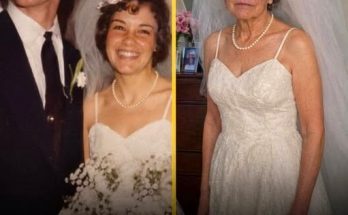
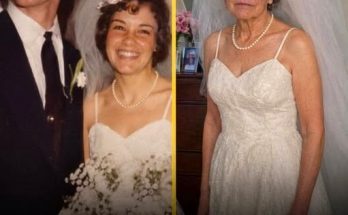
At the last minute, I added our wedding photograph.
Not the framed one.
The small duplicate my father had taken on his old camera.
James was looking at me instead of the lens.
I had spent fifty-six years loving the young man in that picture.
I didn’t know whether I could bear meeting the old man who had lived beyond it.
At a rest stop, Ruth asked if I wanted to turn around.
“No.”
“You can.”
“I know.”
She handed me a cup of coffee.
For the rest of the drive, she talked about road construction, her granddaughter, and a terrible sandwich.
I loved her for every ordinary word.
Claire met us outside a modest brick house.
She was in her fifties, with tired eyes and James’s sister’s dark hair.
She didn’t try to hug me.
“Thank you for coming.”
“I haven’t decided how long I’m staying.”
“That’s all right.”
Inside, the house smelled of laundry soap and toast.
No hospital smell.
That surprised me.
A walker stood beside a doorway.
There were books on a low shelf and a half-finished crossword on the table.
Claire led me toward the back room.
Then she stopped.
“He’s by the window.”
I could see part of his chair.
One hand.
The edge of a blue sweater.
Ruth touched my elbow.
“I’ll be right here.”
I took three steps.
Then two more.
James turned his head.
For a moment, I saw the young man.
Not because he looked young.
Because he looked frightened.
“Hello, Mary.”
I had prepared questions.
Angry ones.
Careful ones.
Questions I had written in my notebook so emotion wouldn’t steal them.
But when I saw him, the first thing I said was:
“You got old.”
His mouth moved.
Something between a smile and a sob.
“So did I,” I added.
“Yes.”
I sat in the chair across from him.
There was oxygen tubing beneath his nose.
A thin wedding band hung from a chain around his neck.
I looked at it.
“Yours?”
“Yes.”
“You kept it?”
“Yes.”
I almost asked what right he had.
Instead, I took my own ring from beneath my blouse.
His eyes filled.
I put it back.
“I’m not here because of this.”
“I know.”
“I’m here because I need you to answer me.”
He nodded.
“All right.”
We talked for twenty minutes.
Then he needed to rest.
I had expected his weakness to make me kinder.
Instead, it made me angry at the clock.
I had been denied answers for half a century.
Now I had to wait while he slept.
I went outside and stood beside Ruth’s car.
“I don’t know how to do this.”
“You don’t have to do it well.”
“I want to shout.”
“Then shout.”
“I want him to know what it cost.”
“Tell him.”
“I don’t want to hurt a dying man.”
Ruth leaned against the car.
“He can be dying and still hear the truth.”
I looked toward the house.
Through the window, I could see Claire adjusting the curtain.
I had spent years imagining what I would say if James came home.
None of those speeches included asking whether he had the strength to listen.
The next morning, I read him my list.
The first question was whether he had ever checked public records.
“No.”
Whether he had asked his sister to find me.
“No.”
Whether he had kept Adrian’s letter because he believed it or because he needed to.
James looked down.
“Both.”
I waited.
“At first, I believed it.”
“And later?”
“Later, I was afraid you’d ask what you’re asking now.”
The answer was so small I almost missed it.
“You let the shame grow.”
“Yes.”
“And I paid for it.”
“Yes.”
I looked at the window.
A bird landed on the feeder outside.
“I didn’t remarry.”
“I know.”
“No. You know the fact.”
I turned back.
“You don’t know the birthdays. Or the Christmas mornings. Or what it was like when your mother died and I stood at her grave thinking you should have been there.”
His eyes closed.
“You should have been there.”
“Yes,” he whispered.
I told him about my father’s final illness.
About the way he kept asking whether there had been news.
About my mother saving every newspaper article concerning missing servicemen.
I told him about the men I had turned away.
Not because he owed me a husband.
Because I wanted him to understand that waiting had been an active part of my life.
It had shaped choices.
Homes.
Jobs.
Whole seasons.
“I learned how to live,” I said. “I wasn’t miserable every day.”
He looked up.
“I had friends. Work I loved. Children who came into the library and grew up and brought their own children.”
“I’m glad.”
“Don’t be relieved too quickly.”
He swallowed.
“I’m not.”
“I had a life. But I had it with a question in the room.”
For a long time, he said nothing.
Then he whispered:
“I gave you the question because I couldn’t bear the answer.”
On the third day, he told me more about coming home.
Not the details people put in films.
The ordinary failures.
A crowded grocery aisle.
A slammed door.
Being unable to sleep beside an open window.
Not knowing how to explain his injuries without seeing pity settle over someone’s face.
He had been offered help.
Some he accepted.
Some he refused.
For years, he drank too much.
Later, he stopped.
He built a quiet life repairing machines because machines stayed still while you worked out what was wrong.
I listened.
Sometimes I could see the frightened young man he had been.
Sometimes all I could see was the calendar.
Both were true.
At one point, he said, “I thought you deserved somebody whole.”
I leaned forward.
“You didn’t ask me.”
“No.”
“You made yourself noble in a story where I didn’t get a voice.”
His face crumpled.
“Yes.”
I sat back.
He didn’t try to defend it.
That mattered.
It did not erase anything.
We stayed five days.
On the fourth, I brought our photograph.
Claire left us alone.
James held it close.
“Your mother hated that cake,” he said.
I stared at him.
“She thought the icing looked yellow.”
“It did look yellow.”
“You told her it was cream.”
“She’d been awake since five.”
He laughed.
The sound caught halfway and became a cough.
I waited until it passed.
Then I laughed, too.
For ten minutes, we remembered things nobody else could remember exactly.
My father forgetting where he had put the rings.
James stepping on the hem of my dress.
The neighbor’s dog escaping into the yard during the photographs.
I had expected tenderness to feel like surrender.
It didn’t.
It felt like finding something that had survived under rubble.
I could pick it up.
I didn’t have to pretend the rubble wasn’t there.
Before leaving, I asked about the opening line.
“Honey, you won’t believe why I had to disappear.”
He looked ashamed.
“I hated that after Claire mailed it.”
“Why did you say it?”
“Because I wanted you to keep reading.”
I nodded.
“And because part of me was still trying to make it sound like I had no choice.”
“Yes.”
“The first years, you didn’t.”
“No.”
“After that, you did.”
He looked directly at me.
“Yes.”
I let the silence settle.
Then I said, “If you write another letter, start there.”
He nodded.
Claire brought an envelope to my hotel the next morning.
The first line read:
Mary, I came home alive and failed to come home to you.
I read the rest standing beside the bed.
This time, I didn’t have to fight my way through an excuse to reach him.
I returned home without making promises.
We spoke on Tuesdays.
Sometimes for ten minutes.
Sometimes for three.
Once, he was too tired, and Claire called to tell me.
I went to the library anyway.
I shelved returns.
Helped a boy find a book about volcanoes.
Drank coffee with the volunteers.
At home, I put James’s photograph beside the old one.
Not in its place.
Beside it.
He asked about my life.
At first, his questions were clumsy.
Then they improved.
What books was I reading?
Had Ruth’s granddaughter found an apartment?
Did the maple tree outside my kitchen still drop seeds into the gutter?
He remembered that tree.
It had been small when he left.
I told him it shaded half the yard now.
He was quiet.
Then he said, “I would have liked to see that.”
I looked out at the leaves.
“Yes,” I said. “You would.”
Susan found another letter among Adrian’s papers.
She sent it with a note saying she was sorry.
It was from James.
One of the letters that had never reached me.
The paper was thin.
The writing uneven.
Mary, if you have moved on, I will understand. But please tell me yourself. I need to know that you are safe. I need to know whether there is any part of our life left to come home to.
I sat with it all afternoon.
Then I called James.
He remembered writing it.
“Did Adrian answer?”
“Yes.”
“What did he say?”
“That you didn’t want direct contact.”
I looked at the paper.
“Did you believe him?”
James took a breath.
“I let myself.”
We had reached a point where I could hear the difference.
Not because the answer hurt less.
Because he had stopped handing me words meant to make it hurt less.
I visited again in October.
This time, Ruth stayed home.
Claire met me at the station.
James had grown weaker.
He could no longer move from the bed to the chair without help.
When he saw me, he tried to sit straighter.
“Don’t,” I said.
He settled.
I sat beside him and took out the book I had brought.
A collection of short stories.
He had once loved being read to, though he would never have admitted it around his friends.
I read until his eyes closed.
Then I kept reading.
Not because I was pretending to be his wife again.
Not because fifty-six years had been repaired.
Because I was there.
Because he was listening.
Because, after everything, that was what I chose to do with the hour.
That evening, he asked whether I could forgive him.
I looked down at our hands.
They were resting near each other on the blanket.
“I don’t know how much of this can be finished.”
“I understand.”
“I’m less angry some days.”
He nodded.
“And then I remember something.”
“Yes.”
“I don’t want you waiting for me to say the right thing.”
He turned his face toward me.
“I’m grateful you came.”
I took his hand.
It felt unfamiliar.
Thin skin.
Cold fingers.
The wedding photograph had been wrong about one thing.
I didn’t know these hands anymore.
But I could learn what they felt like now.
We sat that way until Claire came with his medicine.
James died in November.
Claire called before dawn.
I had been home for eleven days.
“He was peaceful,” she said.
I sat up.
For fifty-six years, I had lived with a death that might not have happened.
Now there was no uncertainty.
I asked what time.
She told me.
I wrote it down.
Then I asked whether she had someone with her.
Her husband was there.
Her son was on his way.
After we hung up, I went into the kitchen and turned on the light.
There were no flowers.
No envelope.
No impossible message waiting to undo what I had just heard.
I put water in the kettle.
Then I called Ruth.
“He’s gone.”
She arrived before it boiled.
The funeral was small.
Claire asked whether I wanted to sit with the family.
I did.
I didn’t explain myself to anyone.
There was a photograph of James beside his tools.
Another of him with his sister.
Claire had included our wedding picture, too.
I looked at all three.
They belonged to the same man.
That had been the hardest thing to accept.
The boy who loved me.
The soldier who survived.
The man who stayed away.
I couldn’t keep one and discard the others.
When it was my turn to speak, I stood without a paper.
“James was my husband for two days before the war took him away,” I said.
My voice shook.
“For many years, I believed that was all the time we had been given.”
I looked at Claire.
“This summer, we were given a little more.”
I stopped there.
I didn’t owe the room the rest.
In winter, I took the chain from around my neck.
I held my wedding ring in my palm.
For years, removing it would have felt like betrayal.
Now it felt like finishing a task I had carried long past the point when I understood it.
I placed it in a small wooden box.
Beside it, I put James’s ring, which Claire had sent me.
They touched.
Then I closed the lid.
I kept the letters.
All of them.
The cruel one.
The lost one.
The first one full of fear.
The second one that finally told the truth.
They were part of my life now.
But they no longer sat on the kitchen table.
There was room there for other things.
A crossword.
A seed catalog.
Lunch with Ruth.
On what would have been our fifty-seventh anniversary, I bought six yellow roses.
Not the biggest bouquet I could find.
Six was enough.
I put them in the blue vase by the window.
Then I went to the library.
The children’s summer program had begun, and somebody had ordered far too much glitter.
By noon, it was on my sleeves, in my shoes, and somehow inside my handbag.
A little girl asked why I was smiling.
“I was thinking about a friend.”
“Is your friend funny?”
“Sometimes.”
“Are they nice?”
I considered that.
“They were complicated.”
She nodded solemnly, as if she understood perfectly.
Then she asked for help cutting out a paper sun.
I helped.
That evening, I sat in my kitchen while the roses caught the last light.
For the first time since 1970, I wasn’t waiting for James to come home.
I knew where his story ended.
And when the telephone rang, I let myself wonder who else might be calling.