THE BEST SEATS
The paper in Emily’s hand was a photocopy.
The original was at home in Olivia’s yellow folder, behind the adoption decree and a photograph of Emily at fourteen, wearing a winter hat indoors and laughing at something she could no longer remember. At the top of the copy, in type small enough that nobody in the arena could read it, was the name of Memorial Hospital.
A crease ran between her parents’ signatures.
Emily had seen that crease more often than she had seen either of them in the past fifteen years.
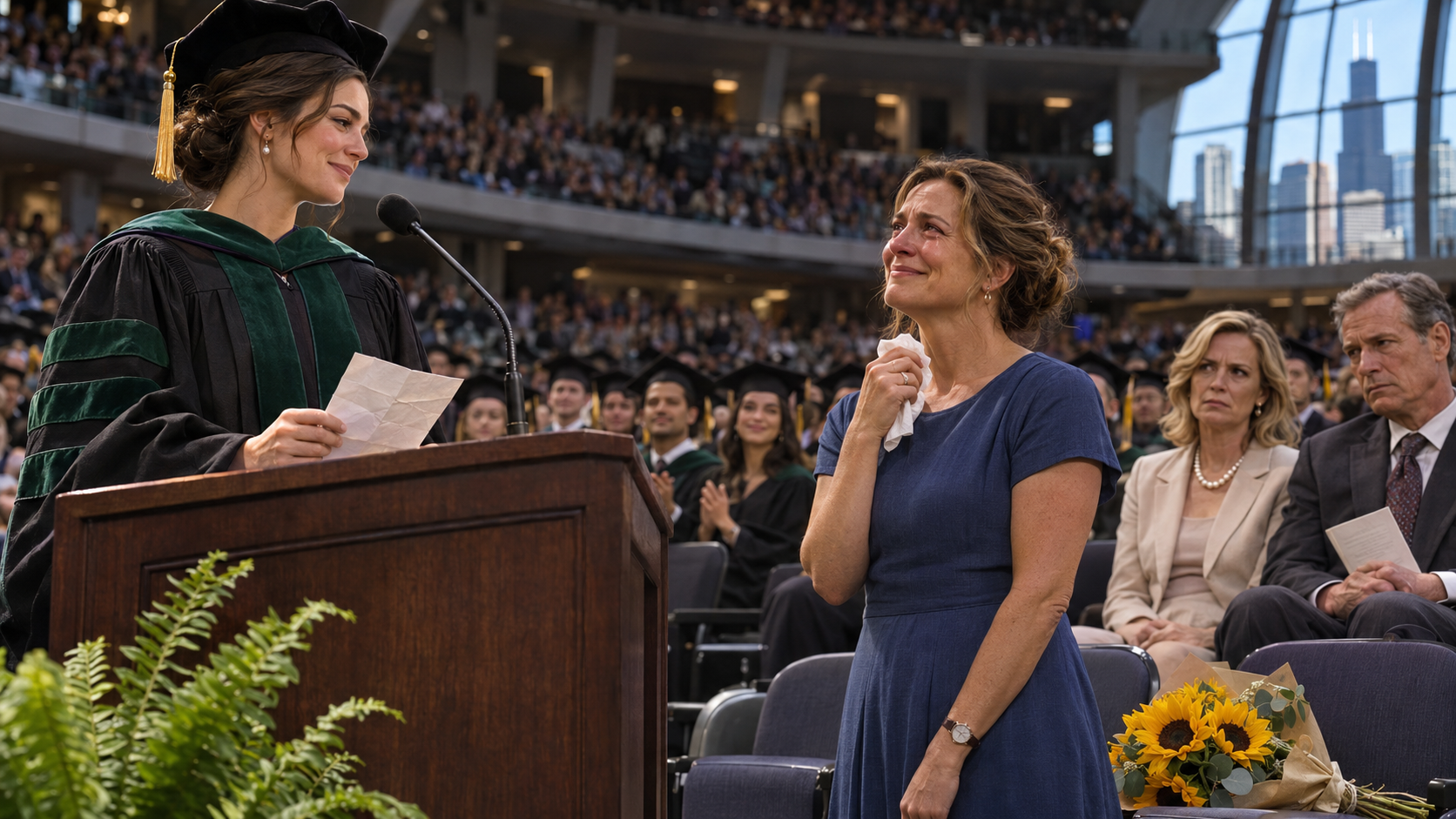
The dean moved aside. The applause lasted long enough for Emily to set her water down, adjust the microphone, and find Olivia in the first row.
Olivia had put the sunflowers on the empty seat between herself and the Mitchells. One bloom had tipped forward against the program in her lap. She straightened it, then looked up just as Emily caught her eye.
At thirteen, Emily had learned to watch Olivia’s face before anyone came into the room to deliver news. Olivia never gave anything away. She would meet Emily’s eyes and wait for the person whose job it was to speak.
She did exactly that now.
Emily unfolded the paper.
“I practiced my speech last night at my kitchen table,” she said. “I made it all the way through without stopping, which was a relief. Then I realized I’d left out the person I was writing it for.”
Richard sat up. Beside him, Karen folded her hands together.
“I was writing it for a thirteen-year-old girl in a hospital bed. I thought I should try again.”
There was still a little movement in the upper rows. A man carrying a baby slipped into an aisle seat. Somebody dropped a program. Emily waited for the noise to settle.
“When I was thirteen, I had acute lymphoblastic leukemia. I remember the doctor saying the full name, and I remember being glad there was a word in it I recognized. I’d heard ‘acute’ in geometry. For a second I could think about angles instead of what was happening to me.”
A few people laughed softly. Emily could see her classmates in their gowns, a dark block broken by faces she knew better than she knew her own neighbors.
“Then my father asked how much it would cost.”
Richard’s smile stiffened.
“Dr. Sullivan began to explain what help was available. My father said my younger sister had fifty thousand dollars put away for college. He said she had a future, and he wasn’t going to spend her money on an uncertain bet.”
Karen’s hands came apart. She reached for the program on her lap, then seemed to forget what she wanted it for.
“I want to tell you what I understood at thirteen. I understood that my sister was worth planning for. I understood that I might die. And because those two things were said in the same conversation, I decided one of them explained the other.”
Emily rested two fingers on the photocopy. A breath came out of the microphone when she moved too close to it. She took a step back.
“I was wrong. My sister deserved every opportunity she had. I deserved to be cared for while I was sick. A child should never have to choose between those two things, and neither should a parent.”
She had kept that sentence through seven drafts. In one, she had left Brianna out altogether. In another, she had written three furious paragraphs about the ballet shoes that appeared every September in a fresh cardboard box. Then she remembered how Brianna used to leave the shoes in the hallway after class because her toes hurt too much to bend down and take them to her room. Emily sometimes carried them upstairs for her.
Brianna had been a child in that house, too.
“Before my parents left the hospital, they signed the paperwork for my temporary placement. I have a copy here. I brought it because my father has spent fifteen years saying they had no choice. I wanted to remember the difference between having very difficult choices and having none.”
Richard bent toward Karen. He spoke behind one hand, his eyes on the stage. She kept looking at Emily.
Emily laid the paper flat on the podium. She had imagined holding it up. She had imagined the camera closing in on the signatures and the whole arena turning to look at the front row. Standing there, she realized the names would be impossible to read from ten feet away. Holding it high would give the cameras something to film and take her eyes away from the people she had come to speak to.
“After they left, I kept looking at the door. I remember thinking my mother would come back when she realized we hadn’t said goodbye. I had a whole argument ready for her. I was going to promise I wouldn’t ask for anything expensive ever again.”
Karen pressed her lips together. Her chin shook once, and she brought the program up close to her chest.
“At three in the morning, a nurse named Olivia Hart came in to change my IV. I asked her whether my parents would come back. She said she didn’t know. Then she pulled up a chair and told me that for the rest of that night I’d have somebody with me.”
From the front row, Olivia mouthed something. Emily knew the sentence by the way her lips moved.
Get a drink of water.
Emily did.
“I don’t know how many people have sat in those chairs,” she continued. “They’re surprisingly uncomfortable considering how long the people who buy them expect you to sit there. I offered Olivia part of the bed. She told me I’d kick her.”
Another little ripple of laughter, this one closer to the stage. Olivia shook her head.
“She was right. I did kick her, a couple of years later, on a pullout couch in a motel when she took me to see Lake Michigan in the winter. She still brings it up.”
“You nearly broke my shin,” Olivia said.
Only the nearest rows could hear her. Emily laughed into the microphone. For several seconds there was just that, the sound of her laughing with her mother.
“Olivia was the first adult who let me be angry about what happened. She was also the first person to tell me that being frightened by the cost of care was something we could talk about without whispering. There were forms on our kitchen table for years. Sometimes there was money at the end of the month and sometimes there wasn’t. She’d tell me what she knew, which was usually less than I wanted to hear. Then she’d make a call and find out the next thing.”
Olivia looked down at the sunflowers. There was a little plastic card stuck in the bouquet, the kind the florist gives you for a note. It was blank. She had set out to buy flowers, seen the sunflowers, and decided she had said more than enough to Emily that morning.
“I found out after college that she mortgaged her house. I found out what happened to the gold earrings I remembered from the first Christmas we spent together. She sold them. They had belonged to her grandmother, and she loved them. She worked shifts that began before I got up and ended after I’d gone to sleep.”
Richard folded his program along a line that ran through Emily’s name. He stood. The man beside him drew in his knees to make room.
For an instant Emily thought Richard would leave. He looked at the aisle, then at Karen. She had both feet planted on the floor.
“Sit down,” Karen said.
Richard sat.
Emily let herself look straight at them then.
“Two weeks ago, my biological parents asked the university for VIP seats. I called my mother and asked what I should do. She said, ‘Give them the best seats.’”
This time there was no small movement in the upper rows. Emily could hear a ventilation fan cycling above the stage. In front of her, Richard turned his folded program over once and then put it down.
“So I did. I wanted them to hear the part of my life they missed. There’s too much of it to fit in a speech.”
Emily glanced down at the photocopy.
“There’s a grocery store where Olivia taught me how to choose peaches without squeezing them. There’s a high school auditorium where she was still in scrubs when she stood up for my name. There’s a Tuesday in my first year of medical school when I called her and said I had made a terrible mistake, and she asked whether I’d eaten dinner. I thought that was a stupid question. I hadn’t eaten dinner.”
Olivia was crying now. She found a tissue in the sleeve of her dress and pressed it under one eye.
“And there’s a yellow folder. The first time I saw it, Olivia asked me whether I wanted her to adopt me. I had to ask her why. She told me every child deserved to be chosen by somebody. It took me a long time to understand that she’d meant me on the days I was rude and scared and miserable, too.”
Emily slid the approved speech out from beneath the photocopy. The last page had a paragraph she wanted to keep. She found it by the blue ink with which she had crossed out the word despite.
“I know there are parents in this room who have sat in hospital parking lots trying to decide which bill to pay. I’ve met some of them during my training. I’ve seen them come back upstairs carrying a vending-machine sandwich and ask a question they were too embarrassed to ask during rounds. The question is usually some version of ‘How do I keep doing this?’”
A woman in the third row took a man’s hand.
“I’m going into pediatrics. I want to take care of children with cancer, and I want to learn how to help their families ask that question before they run out of money or leave the room. I’ve been fortunate to train with people who already do that work. I hope I’ll call them often enough to get on their nerves.”
One of Emily’s professors laughed loudly enough that several students turned around. He had already answered a call from her on a Sunday while cleaning his gutters. Now, as then, he looked rather pleased to be bothered.
Emily put the pages together.
“I have one favor to ask before I go. Olivia Hart, would you stand up?”
Olivia pointed at herself, and Emily nodded. She remembered seeing Olivia do the very same thing at a grocery store raffle. She had won a ham that day. They were both vegetarians at the time, and Olivia had taken it home anyway because she knew a neighbor who cooked Sunday dinner for eleven people.
Olivia shifted the flowers onto her own seat and got to her feet.
“This is my mother,” Emily said.
The first clap came from somewhere in the graduating class. Emily could never say whose it was. By the time Olivia turned to find it, most of the class was standing. Then the dean stepped forward to applaud, and people along the arena floor got up in little uneven groups.
Olivia looked at Emily. With everybody on their feet around her, she pressed a tissue to her mouth, lowered it, and said, “You did it, honey.”
Emily heard her.
The microphones might have caught it. She never checked.
Afterward, there were names to call, hoods to straighten, and photographs to take. Emily hadn’t planned for how difficult it would be to go back to sitting in a row and standing when told. Her legs shook the first time she got up. A classmate put a hand under her elbow and kept it there until her feet felt steady again.
When she walked across the stage for her diploma, she heard Olivia whistle.
Olivia had sworn she didn’t know how.
Emily laughed and nearly missed the dean’s hand.
By the time the last graduate crossed the stage, she had developed a headache behind her left eye. Her phone had eleven missed calls and so many new messages that the notifications had started to bunch together. She turned it off. Somebody in an usher’s vest pointed her toward the graduates’ exit, but she took the side stairs instead, looking for the blue dress.
She found Olivia near a service door with the sunflowers laid across her forearm. Publicly praised or privately irritated, Olivia had the same way of waiting. She put her weight on one leg and rubbed the heel of the other shoe up and down the back of her calf.
“Are those shoes already hurting you?” Emily asked.
“I think they were built for the display.”
“You have sneakers in your bag.”
“I have slippers in my bag. They have ducks on them.”
“Then put the ducks on.”
Olivia handed her the flowers and took her by both shoulders. For a moment she examined Emily’s face as if she might find the whole speech written out there and could read it at her own speed.
“You could’ve warned me you were going to make me stand,” she said.
“You would’ve worn different shoes.”
“I would’ve brought a second tissue.”
Emily hugged her. Olivia’s arms tightened hard around her ribs. A sunflower scraped the side of Emily’s neck. She had grown enough since thirteen to rest her chin on Olivia’s shoulder without lifting her heels, and sometimes it still startled her that she could do it.
“I kept seeing you in the bed,” Olivia said.
Emily closed her eyes.
“I kept seeing you in the chair.”
They stood like that while a catering cart rattled past on a bad wheel. The woman pushing it asked whether they needed a minute before she opened the door. Olivia said yes. The woman put both hands on the cart and waited.
Then, from the far end of the corridor, Emily heard her mother’s old voice say her old name.
“Emily Mitchell.”
She lifted her head.
Karen had taken her pearls off. They were wrapped twice around her right hand, and a small red patch marked the place where the clasp had rubbed her neck. Richard was at her shoulder. He still held the folded program.
“Can I call you Emily?” Karen asked.
“You can. It’s still my first name.”
Richard stepped past Karen. “You invited us to humiliate us in front of a room full of people.”
“I invited you to hear what I had to say.”
“You had us down there like exhibits. Your mother practically had a coronary.”
Karen flinched at the word mother. Emily saw it happen. Richard was looking at Olivia and missed it.
“Could we use the room in there?” Emily asked the woman with the catering cart.
The woman glanced at Richard. Then she set her brake and opened the service door onto a room with a sink, an ice machine, and a table covered with folded linens.
“I’ll leave the door open,” she said.
Emily thanked her. Olivia started to follow. Emily touched her wrist.
“Will you stay where I can see you?”
Olivia leaned back against the wall directly across from the door. “Right here.”
Inside, Richard put the program on the table. He seemed surprised when Emily set her own papers down beside it. The hospital form had slipped slightly sideways, and he could see the first letter of his signature without having to move anything.
“Where did you get that?” he asked.
“It’s part of my records.”
“Did she give it to you?”
“I asked for my records. I was twenty-two. She sat with me while I read them.”
“You were sick. There was a lot happening. People put things in front of you and say sign here.”
“What did they tell you would happen once you’d signed?”
“They said somebody would take care of you.”
“Did you ask who?”
Richard looked at Karen. Karen was unwinding the necklace from her hand. One end caught in her sleeve. She freed it slowly and laid it beside the program.
“Did you ask who?” Emily said again.
“Your doctor was right there.”
“Did you know where I was a month later?”
Richard didn’t answer. The ice machine let out a low rumble, dropped a load into its bin, and fell quiet.
Karen gripped the edge of the table. “I knew you were still at Memorial. I called the desk.”
Emily turned to her. “When?”
“I waited a week. Maybe eight days. The person who picked up asked if I wanted to be put through to the room.”
Emily watched one of Karen’s fingers straighten on the tabletop.
“What did you say?”
“I hung up.”
In the hospital, Emily had listened to a phone in the hallway ring through entire evenings. On her own bedside phone, she had memorized how far the cord would stretch so she could reach the bathroom door without hanging up on the one friend from school who still called. She tried to picture the phone ringing that eighth day. Fifteen years had left her with the cord and no memory of the day itself.
“Why did you call?”
“I wanted to know if you were alive.”
Karen had a particular way of saying hard things without moving her mouth much. Emily recognized it from childhood. She had heard the same voice come through a bathroom door the year Karen’s own mother died.
“Why did you hang up?”
“Because I knew you’d ask me to come back.”
Emily pulled out a chair and sat. She had stood up in front of thousands of people without wanting to retreat. It was the look of relief on Karen’s face, after finally getting that one sentence out, that made Emily need a moment.
“I would have,” she said.
Karen nodded. Her nose had begun to run. She reached toward her neck for a necklace that was already on the table.
“I was afraid,” Karen said.
“So was I.”
“I know.”
“You know now,” Emily said. “Then you had to walk past the door to find out.”
Richard made an impatient sound. “There’s no end to this if we do it like this. Every day, every call. We did what we thought we had to do. What do you want, a check?”
Emily looked over at him. “I want you to stop saying you had to.”
He picked up the program and put it down again.
“Are we supposed to tell people we threw our child away?”
“What have you been telling people?”
“That you were placed where you could get the best care.”
“Did you tell them I asked you to stay?”
It was the first time in the conversation that Richard looked surprised by a question.
“You were half asleep,” he said.
Emily was fourteen years old again for the time it took him to say that. She had spent months wondering whether he had heard her. Her mouth had been dry. Karen had been close to the door. Emily had said please twice while Richard stood with his hand on the back of the visitor’s chair.
“You heard me,” she said.
The anger went out of Richard’s face. What replaced it was harder for Emily to look at. He seemed tired, and for an instant she could see the father who used to put his palm against the roof of the car when she got in so she wouldn’t hit her head. She had needed that man a thousand times before she stopped expecting him.
He rubbed his thumb over the folded edge of the program. “Yes.”
Emily put both hands flat on her thighs. She had brought the paper because she wanted a fact that Richard couldn’t talk around. The fact she had wanted most had been in his head the entire time.
“Thank you for answering,” she said.
He waited. She could see him expecting something more. She understood the impulse. He had offered one sentence after fifteen years, and perhaps from his side of the table, one sentence felt like a great distance to have traveled.
From her side, it was an answer to a question.
Karen sat down. “When you were little, all you wanted was to be held. You’d pick up both arms before you could even stand properly. I’ve thought about that so many times.”
Emily could imagine it. She had a memory of standing on a kitchen chair while Karen combed a knot out of her hair. Karen always held the hair between the knot and Emily’s scalp so the pulling wouldn’t hurt. Twice in her life, a hairdresser had done the same thing and made her want to cry.
“Why did you want VIP seats?” Emily asked.
Karen looked blank for a second. “Because you were graduating.”
“Why those seats?”
After a while, Karen said, “I wanted people to see that I was your mother.”
Outside the room, Olivia looked down the corridor, giving them what privacy the open door allowed. Two graduates walked past her barefoot, their shoes dangling by the straps. Olivia moved the flowers out of their way.
“I wish you had asked to see me,” Emily said.
Karen gathered her pearls back into her palm. “Could I ask now?”
“You can write to me. I’ll decide if I’m ready to answer.”
Richard gave a short laugh. “She gets an address, and what do I get?”
“The same address if you want it.”
He studied her, perhaps looking for the trick in that. Emily took a spare program from a stack beside the sink and wrote a post office box number on the back. She’d opened it after the university’s email. At the time, she had felt faintly ridiculous spending part of her lunch break trying keys in a metal door to prepare for a letter she didn’t expect. Now she was glad she could offer an address without giving either of them a place to knock.
She tore the paper in half and copied the address for Richard.
Karen took hers. Richard left his on the folded linens.
Emily put the hospital form back in her jacket. When she stood up, Richard glanced toward the open doorway.
“She was paid to be there,” he said.
Emily followed his gaze to Olivia.
“For the first few hours,” she said.
She left him with his address on the table.
Olivia had made a lunch reservation at a place that promised nice photographs. Neither of them wanted to go. They called to release the table and ate grilled cheese at a diner where the server brought two ice waters, asked whether they’d come from graduation, and went to get ketchup before Emily could answer.
Olivia changed into the duck slippers under the table.
“Did you really call that motel a vacation in front of all those people?” she asked.
“You told me it was one.”
“We booked it because a pipe burst.”
“I knew the pipe burst. I thought the lake was an extra.”
Olivia dipped a fry in ketchup. “You were very good at making an extra out of whatever we had.”
The next time the server came by, Emily asked if somebody could take their picture. Olivia reached to smooth Emily’s gown. Emily pulled it open far enough to show the splash of tomato soup on her shirt. They laughed at exactly the wrong moment. The server took one photograph, looked at it, and took another.
In the first, Emily was turned halfway toward Olivia. One of her eyes was almost closed. Olivia was looking at Emily with her mouth open, as if she’d been caught starting to tell a story she had told many times before.
Emily asked the server to keep both.
They were eating the last of the fries when Emily turned on her phone. She swiped past a handful of calls and came to a message from a number she didn’t know.
It’s Brianna. Mom gave me your number. She says you told everybody about my college money. I haven’t watched the speech yet. I keep trying to figure out what you might have said about me. I think I’m going to get it wrong if I keep guessing.
There was a second message, sent twenty minutes after the first.
They told me you didn’t want to come home.
Emily read that one twice.
Brianna had been ten when Emily went into the hospital. At the time, Emily had imagined her sitting at the kitchen counter, eating cereal and receiving regular reports on the sister who had disappeared. She had never imagined what those reports might say.
Olivia took the check when it came. Emily set her phone down and reached for it at the same time. They held opposite ends until Olivia slipped it free.
“You can buy me coffee tomorrow,” Olivia said.
Emily let her pay. She watched Olivia count out bills with the same concentration she had brought to Emily’s fractions homework and thought of all the times she’d seen that particular look on a face. Richard, working out what his daughter would cost. Olivia, making sure the person who had filled their water glasses got a good tip. For years Emily had wished she could stop remembering the first thing. Now she knew there was room to keep noticing the second.
Outside, she and Olivia stood beside the car while the air cooled the sweat under the collar of Emily’s gown. The sunflowers lay on the back seat. Emily typed her sister’s name before she knew what else she would write.
Brianna, I wanted to come home for a long time. I asked for you, too.
She read it in case she had accidentally written something cruel. Then she sent it.
In the passenger seat, Olivia took off the duck slippers and put her bare feet on the rubber mat. Emily climbed in and set both hands on the wheel.
“Ready to go home?” she asked.
“Oh, yes,” Olivia said, and closed her eyes.
Emily waited for a family to cross the parking lot. A little girl in a white dress was holding the hem up so she wouldn’t step on it. When her father saw, he bent to pick her up. She went willingly, her small pink shoes hanging down on either side of his arm.
Then the way was clear, and Emily drove them home.
END OF NEXT PART
FINAL PART — THE CHAIR BY THE BED
The morning after graduation, Emily went downstairs in her socks and found Olivia washing a vase that had been standing upside down on the top shelf of the pantry since Christmas.
“Those stems need more room,” Olivia said.
Emily found the scissors in the drawer with the rubber bands. She cut the sunflower stems one at a time while Olivia held them over the sink. Three were the same height when she finished, and Olivia told her to take another inch off one. Emily did and saw that it looked better.
It was a little after nine when Brianna called.
Emily thought about letting it ring so she could make coffee first. Then she remembered the message the previous afternoon and picked up.
“Hi,” she said.
Brianna said, “I’m sorry she gave me your number.”
Emily looked out at the patio. One of the chairs had tipped over in the wind, and a squirrel was standing on its side as if that were where a chair belonged.
“I’m glad you used it.”
There was a small noise at the other end. Then Brianna said, “I watched the speech.”
“All right.”
“I watched it three times. The first time I kept waiting for you to say my name. The second time I actually listened. The third time I wanted to see her face when you asked her to stand.”
“Olivia’s?”
“Yes. I like that dress.”
“She says it’s a terrible dress to sit in. It’s nice to stand in, apparently.”
Brianna laughed. Emily had forgotten the little hiccup at the end of her laugh. She hadn’t realized she was waiting to hear it until it came.
“Did you really ask for me?” Brianna said.
“Yes. I thought you might visit on a Saturday. I didn’t know what they’d told you.”
“They said you were angry with me because I got to be at home. Then Dad said I had to give you time.” Brianna paused. “I was ten. I thought he meant a week.”
“So did I,” Emily said.
Olivia set a cup of coffee on the counter within reach, then took her own mug and went outside to set the chair upright.
“Would you want to meet somewhere?” Brianna asked. “I thought about coming yesterday, but I didn’t know about it until Mom told me where they were. That whole conversation was awful. I could tell she wanted me to say you were awful, too.”
“What did you say?”
“I asked why she had gone.”
Emily traced the rim of the mug with one finger.
“Did she answer?”
“She said someday I’d understand when I had children. I was sitting in my car with my daughter asleep behind me when she said it.” Brianna let out a long breath. “I understood a lot, actually.”
They agreed to meet the following Sunday in the park where Karen had once taken them to eat ice cream after ballet. Emily chose it before remembering the ballet classes. If the conversation went badly, they could go for a walk in opposite directions. If it went well, there would be a place to get coffee.
Before they hung up, Brianna asked whether Emily wanted her to bring anything.
“Just yourself this time,” Emily said.
“I have a photograph I think you’d like.”
“Bring that, then.”
For most of the next week, Emily’s phone had to be put facedown if she wanted to get any work done. The university had posted the ceremony, and a clip of the speech was being shared with titles that assigned her a feeling before she had time to open the link. A producer offered to fly her somewhere for an interview. A woman she had never met described her as brave in a message that began with the woman’s own story and ended with a question about visiting a grandchild.
Emily wanted to answer the woman. She wanted to answer a lot of people. By Tuesday evening, she had discovered she could use up an entire day on strangers’ grief and still have every feeling of her own waiting when the house went quiet.
She answered three messages. One was from an old school friend who had called her at Memorial and remembered exactly how much it had cost to speak to her from an Oregon vacation. One was from her new residency program, confirming her schedule. The third was from the catering worker, who had located Emily through the university and wanted to know if the sunflowers had made it home without getting crushed.
Emily sent her a photo of the vase.
On Sunday, Brianna was already on the bench when Emily arrived. At first Emily recognized only the way she sat, both hands tucked under her thighs. Then Brianna stood up, and Emily made out Karen’s nose in a face that belonged to somebody she would have passed on the street.
They each lifted a hand and lowered it again. Brianna was the one who asked if they could hug.
Emily said yes.
Brianna’s shoulders were broader than Emily remembered. She smelled faintly of sunscreen. When they let go, she sat down and immediately put her hands under her legs again.
“I practiced saying hello in the car,” she said. “That was about as far as I got.”
“Hello worked.”
Brianna pulled a little envelope out of her bag. It was the kind that used to come with prints from a drugstore. The photograph inside had been bent across one corner.
Two girls stood at the edge of a park fountain. Brianna was wearing a pink skirt, one white sock up and the other down. Emily was behind her in a yellow T-shirt with a wet patch across the front. She had reached forward to pull Brianna back by the waistband.
“I fell in right after this,” Brianna said.
“You jumped.”
“I thought you’d catch me.”
“I was already holding you. You slipped right out of my hands. I was standing there with the waistband stretched this far.”
Brianna smiled. “Dad said you pushed me.”
“Did you tell him I didn’t?”
“I told him I could swim. That was the part I cared about.”
Emily turned the picture over. Karen had written Girls at the fountain in a small neat hand. There was no date. Emily could remember the heat on her bare arms and the slap of Brianna’s wet shoes on the walk home.
“Can I keep it?”
Brianna nodded. “I brought a copy for me.”
They spent the next ten minutes talking about the fountain, and about a shop nearby that used to sell penny candy from jars. When the conversation stopped, Emily realized that she had forgotten, for a few minutes, how long they had been apart.
“I spent some of that money,” Brianna said when they were both quiet. “There was enough to cover most of my tuition. I went to a state school and worked. They were proud of how I’d handled it. I was proud of it, too.”
“You should be.”
“I feel sick when I think about going to the bank with Dad to get the first check. He bought us breakfast afterward. We talked about a girl in my dorm who couldn’t get her parents to help with anything. He said you do everything you can for your kids.”
Emily watched a man walk a dog past them. The dog stopped to sniff the end of the bench, looked up at Brianna, and kept going.
“I’ve been angry about that account,” Emily said. “I think I’ll always have trouble hearing the number. I meant what I said onstage, though. It was fine for you to go to college. You were never the person I needed to answer for it.”
“I wondered if I should offer you something. All I have right now is a mortgage and six dollars from a tooth fairy who had to break a twenty.”
Emily smiled. “Keep the six dollars.”
Brianna smiled too, and rubbed the side of her nose. “My daughter’s name is Nora. She’s five. She’s learning to keep a secret, except she thinks it still counts if she puts her hand over your ear and tells you in a loud whisper.”
“Did you tell her where you were going?”
“I told her I was going to meet my sister. She asked whether you’d moved away because grown-ups move away.”
“What did you say?”
“I said I didn’t know how to tell it yet. She offered to draw me a picture of a sister so I’d have something to look at while I waited.”
Brianna opened her bag again. There was a sheet folded into quarters, a tall purple person drawn at the center. The purple person was holding hands with someone the same size, in green. Above them was a sun rendered in a furious orange scribble.
“That’s you,” Brianna said, touching the purple one. “Apparently you have great boots.”
Emily studied the square purple feet. “I hope I get to meet her.”
Brianna folded the picture more carefully than was necessary. “Whenever you’re ready.”
They walked around the fountain. There was a shallow spot where the concrete had worn smooth on top. Brianna put her hand on the edge, and Emily laid hers down a few inches away.
“I used to come here and pretend I’d run into you,” Brianna said. “After I was old enough to drive. I could’ve looked harder. I don’t want to act like there were no phones or computers when we were twenty.”
“What stopped you?”
“I was afraid you’d tell me it was all true. That you didn’t want me.” Brianna looked down at her hand. “Then it got easier to put it off a few more weeks.”
Emily understood that in a way that made her chest ache. Sometimes the thing a person had been told as a child was easier to carry than any answer they could uncover as an adult. She could have looked for Brianna sooner as well. For a while she had worried that the sister she remembered would answer the phone as Richard’s daughter and repeat what he had said about her from the foot of the bed.
“If we go for coffee,” Emily asked, “do we have time to be late for whatever we’re doing next?”
“I told my husband I could be all afternoon.”
They bought coffee, then turned back into the park to drink it. Brianna showed Emily a picture of Nora in a bike helmet and another in which she was crouched in the grass beside a dead bee. Emily showed Brianna Olivia’s duck slippers. They had a long way to go before either would think of calling the other about something ordinary. Emily had missed enough ordinary things to be willing to start small.
When she got home, she put the fountain picture on the refrigerator under a souvenir magnet from the motel at Lake Michigan.
It was the first picture of Brianna she’d had in the house.
Two envelopes arrived at the post office box before Emily started residency.
The first contained a thick stack of paper. Karen had typed most of it, then written an opening by hand that began, I hope someday you can understand the position we were in.
Emily read it in her car with the engine off. The sun had heated the steering wheel until it felt uncomfortable under her wrists. She opened the windows and kept reading.
Karen described the conversation in the hospital. She remembered Richard naming the amount in Brianna’s account. She described looking at Emily’s arm and thinking an IV should look smaller on a child. She remembered being angry that the social worker had asked her to step back into the hallway, because she thought the other parents could tell what she was doing. She had written several lines about Richard’s certainty and her own fear of standing up to him.
Near the bottom of the last page, she had included a memory that made Emily stop.
I had your hairbrush in my bag when we went to the hospital. The pink one with the broken handle. I meant to leave it with you. I found it when we got home. I kept thinking I could go back in the morning and put it by your bed. I put it in your dresser instead.
Emily had looked for that brush for days. Olivia had found her a different one, though it hadn’t mattered for much longer. At thirteen Emily had imagined the brush sitting on her dresser and Karen walking past the room without wanting to go in. She could take one detail out of that picture now. Karen had stepped into the room. She had opened a drawer.
Emily went home, got the yellow folder, and put Karen’s letter on top of the photocopy from graduation. She moved it once so the two pages wouldn’t quite line up.
The second envelope contained a note from Richard. It was two sentences long.
I’m sorry you suffered as much as you did. Karen has taken this harder than you realize.
Emily read it once. She thought about writing back to explain how many times she had been asked to consider Karen’s feelings before her own. She thought she could probably find the exact right sentence. Then she remembered the paper he had left on the folded linens. He had asked his wife for the address after all.
She put his note in the folder, too. She closed it and went down to help Olivia make dinner.
“Do you want to talk about the letters?” Olivia asked.
“I think I want to talk about what you’re doing to that onion.”
“I’m cutting it.”
“Some of those pieces would hold a door open.”
Olivia handed her the knife.
They made enough soup for four meals. After dinner, Emily washed the pot while Olivia wrapped bread for the freezer, and at ten that night Emily realized she had gone several hours without thinking about either letter. She had once imagined that finding the words to answer her parents would be a kind of finish line. That night, she left them in the folder and took a long time choosing which shirt to wear for the first day of the job she’d been working toward for years.
The badge she was issued for residency was a little crooked in its plastic sleeve.
EMILY HART, MD
PEDIATRICS
She sent a picture of it to Olivia. Olivia called her instead of texting back.
“Are they letting you do things?” she asked.
“Yes.”
“Things you feel like you know how to do?”
“Some of them.”
“The people who already work there know you’re new. Remember that.”
Olivia said it in the same tone she had used on the first day Emily took the bus by herself. Emily had gotten on in the wrong direction that day and ridden six stops before noticing she was passing the same tire store she could see from their house.
“I’ll remember,” she said.
The first weeks left Emily feeling capable in brief intervals. She could persuade a furious toddler to let her listen to his heart by listening to his stuffed frog first. She could still forget the code for a door she went through twelve times a day. She learned the quickest way to get food into herself during a shift and how many different things a parent might hear in the same sentence.
Her first rotation on the oncology service came later in the year. On the second day she met a twelve-year-old girl named May who had cut all the characters out of a cereal box and was arranging them along her windowsill. A rabbit kept falling backward. Emily propped it up with a folded piece of cardboard. May told her it had been doing that all morning.
“Do you want to see him standing up straight?” Emily asked.
“He looks like he can see outside now.”
The next time Emily came to the room, May’s father, Luis, had three cups of untouched coffee on the tray. He was wearing a work shirt with his name printed over the pocket. The letters had faded to a pinkish gray.
“What happens if I can’t come every day?” he asked.
May had gone to sleep. Emily watched the slow rise under her blanket.
“What would make it hard to come?”
His eyes went to the door. He spoke softly enough that Emily had to pull the visitor’s chair closer to hear.
“I drive deliveries. I’ve used up what I have. My boss says I can work nights if I say yes by tomorrow.” He rubbed a thumb over a spot along the edge of the tray. “She asked me this morning if she was gonna have to stop coming here because I wasn’t at work.”
Emily had spent years thinking about the child hearing the conversation. Now she sat with a father who would have taken any combination of hours, traffic, and unpaid sleep if someone could make the two halves of his day fit.
“What did you tell her?” she asked.
“I told her to quit worrying about it.”
“Is that what you want her to know?”
He looked at May’s sleeping face. “I want her to know I’m coming back tomorrow.”
“You can tell her that when she wakes up. I can come with you to talk to the social worker about the work schedule. Do you have a few minutes now?”
“Yes,” he said, still watching May. Then he looked back at Emily. “Would it be here? In the room?”
“We can ask her where she wants to talk.”
He checked the clock. His shoulders dropped a little.
“Okay. I can do that.”
The hospital social worker already knew two things about his employer that neither Luis nor Emily had thought to ask about. By the end of the day, Luis had written a list of questions on the back of a parking receipt and made a call to his sister. The night shifts remained a possibility. On Thursday, his sister sat with May and beat her at cards twice. Luis came in Friday morning with a bag of fruit and read out the label on every pear to find the one May insisted he had bought for her the week before.
Emily saw him do it. He kept taking pears out of the bag as if there might be a sixth in there if he reached deep enough.
That evening she called Olivia on her walk to the garage.
“Did I ever ask you about money when I was sick?” she asked.
“Of course.”
“What did you say?”
“Probably something unhelpful the first time.” Olivia stopped to think. “I remember having to tell you the red letters on an envelope meant somebody expected us to call them. You’d decided it meant somebody was coming to take away the furniture.”
Emily remembered the envelope. She had started sitting on the couch after school even when she could still do homework at the kitchen table. She wanted the fabric to wear in the shape of her. She had thought that would be a good reason for someone to let them keep it.
“Did you get scared?” she asked.
“Many times.”
“Of the bills?”
“Of those. And I was scared you’d wake up hurting and I’d be too tired to hear you. I used to lie down in my clothes because I was worried about how long it would take me to get dressed if you needed me.”
“You could’ve come in your pajamas.”
“You say that now. You had some very firm opinions about what I wore in public at the time.”
Emily laughed. Cars passed at the far end of the garage. There was a persistent drip from a pipe overhead. She leaned against a clean part of the wall and let Olivia tell her about the night she’d come home to find Emily asleep on their couch, one shoe still on and the TV playing static. Emily couldn’t remember the night. She could picture exactly how Olivia would have eased that shoe off.
The first time Nora came over, she brought a toy stethoscope and a paper bag containing two smooth rocks, a broken hair clip, and a single sock.
“I packed for a long visit,” she told Emily.
Brianna stayed in the doorway with one hand on Nora’s shoulder. Emily recognized the hesitation. It was the same feeling that had made her ask Olivia to stay where she could see her at the arena. She opened the door wider.
Olivia had dough chilling in the refrigerator. Nora asked if she could help roll it out. Olivia put a step stool beside the counter and let her choose which rolling pin to use. She picked the short one that had belonged to Olivia’s grandmother and rolled the center of the dough thin as paper while the edges stayed an inch thick.
Emily opened her mouth to tell her to stop.
Olivia caught her eye and lifted one eyebrow.
They made six usable cookies and a seventh that was mostly seams. Nora put twice as much sugar on the seventh as on the others and announced that it was for herself. While they baked, she pulled Emily into the living room and asked why there was a sock in her bag.
“I thought you knew,” Emily said.
Nora looked seriously at the sock. “It could’ve fallen in.”
They gave it a place of honor on the arm of the couch. Nora said she had to listen to Emily’s heart next, then pressed the toy stethoscope to the outside of Emily’s sweater.
“What do you hear?”
“It’s fast,” Nora said. “Do you need a cookie?”
“Probably.”
Nora went back to the kitchen to check.
Brianna sat down on the arm of the couch beside the sock. She watched Nora ask Olivia how much longer the cookies would take, then ask the same question using a different set of words.
“Dad wanted me to show him the video of her riding her bike,” Brianna said.
“Did you?”
“Yes. Then he said you never wrote back and asked if I thought you might listen to me.”
Emily ran one finger under a snag in her sweater. “What did you say?”
“I said he could ask you the next time he wrote.”
Emily looked up.
“He can use his own envelope,” Brianna said.
From the kitchen came a soft bang, then the two distinct sounds of Olivia asking whether Nora had been burned and Nora replying, with outrage, that a spatula had fallen on the floor.
“I appreciate that,” Emily said.
Brianna leaned over and put her head on Emily’s shoulder for a few seconds. They could hear Olivia washing the spatula. By the time the oven timer rang, Nora had decided each adult could have one cookie and she would have the other four, a proposal she made with complete confidence. Emily dealt them evenly onto plates. Nora studied the result, gave half of hers to Olivia, and asked whether the two of them could make another batch the following Sunday.
They did.
The following spring, another letter arrived from Karen. It was shorter than the first one. She described the morning after the diagnosis, when she had woken up before Richard and made coffee. She had gone into Emily’s room and sat on the bed for a few minutes. She’d written that she knew where the car keys were, had enough gas in the tank, and could have made it back to Memorial before the shift changed.
I’ve spent a long time saying everything happened so fast. The next morning was slow. I had time. I chose to go downstairs when your father woke up. I am sorry I left you there, Emily. You asked me to stay, too. I heard you.
Emily cried in the post office parking lot. With her feet still on the ground outside the open car door, she let her head drop and watched dark spots appear on her pants where the tears fell. Two people got into the car beside her, backed out of their space, and drove away. When she could see well enough, she got up to close the door and sat there for another five minutes.
She met Karen for coffee a month later.
They chose a place halfway between their neighborhoods that neither of them knew. Karen arrived early and sat at a table by the window. She stood when Emily came in. There was a coffee in front of her and a second cup waiting across from it.
“I bought you a plain one,” she said. “I realized I don’t know what you like.”
“Plain is fine.”
Emily tasted it. There was a faint burnt smell to it. She took another sip. Karen watched her hands until Emily set the cup down.
“Thank you for the second letter,” Emily said.
Karen nodded. She was wearing a blouse with loose cuffs, and she folded them up out of the way. Emily could remember being small and holding a hair tie while Karen rolled one of those sleeves to wash dishes. She had always liked having something to hand her when she was ready.
“I’ve wanted to say I’m sorry to your face,” Karen said. “I’m sorry I left. I’m sorry I hung up when I called. I’m sorry I wanted to sit there at your graduation and be seen without asking what I’d done to deserve it.”
Emily had expected another if or but to come. Karen looked down at her coffee and let the sentence stand.
“Did you really think I owed you that moment?” Emily asked.
Karen opened her mouth too quickly. She stopped, closed it, and thought.
“Yes,” she said. “When I said it, yes.”
“Why?”
“I thought being the person who gave birth to you should mean something.” Karen drew one finger through a circle of water on the table. “I wanted to get to the part where you were well and tell myself what happened before was over. If I could sit there and smile for a photograph with you, maybe I could look at it and believe that.”
Emily had watched people leave the arena with pictures taken in front of the blue commencement banner. Some had posed with both parents. Others had walked back to the cars in twos and threes, their gowns over their arms. She pictured a photograph with Karen. In the imagined picture, Karen had the expression from the front row, waiting to be noticed. Emily had the headache behind her left eye.
“I didn’t want that photograph,” Emily said.
“I know.”
“I’d like to tell you what I would have wanted at thirteen.”
Karen wrapped her hands around her cup. She took a breath and nodded.
“I would have wanted you to come back with my brush. I would have wanted you to sit there even if you thought Dad was going to be angry. When I asked what was going to happen to me, I wanted you to say we’d find out together.”
Karen wiped her eyes with one of the paper napkins. It left a white fleck at the corner of her mouth. Emily pushed a clean napkin toward her.
“Thank you,” Karen said.
For a while they drank their coffee. A child near the counter dropped a cardboard sleeve on the floor and bent to pick it up. The door opened and let in the cool air from outside. The cafe stayed busy around them.
“Do you want to know how Richard is?” Karen asked.
“Some other time.”
“All right.”
“Does he still tell people you placed me where I’d get the best care?”
Karen weighed that before answering. “He said it at dinner once after the ceremony. I told him that if people ask me, I’ll say we signed the papers and left. I can’t make him say it.”
Emily nodded. She could live with knowing Karen had corrected him once. She could pay attention to what happened next without having to invent it.
Karen reached into her bag. “I brought something. I didn’t know whether I ought to give it to you. You can leave it here if you want.”
The brush she set on the table had lost several bristles. The cracked handle was as Emily remembered it. As a child, she’d peeled a corner off the pink plastic with one fingernail without telling Karen she had done it.
“You kept it?”
“Through two moves. I thought I’d throw it out every time I packed it.” Karen drew her hands back from the table. “I ought to have brought it to the hospital.”
Emily picked it up. In the crease of the handle, there was still a thin gray line that had resisted every attempt she used to make to clean it with a wet washcloth.
“Can I take it home?” she asked.
“Yes.” Karen swallowed. “I’d like you to.”
They’d been there forty-five minutes when Emily checked the time. She had arranged plans with Brianna and Nora that afternoon. She told Karen she had to go, and Karen didn’t ask her to stay another five minutes or tell her it had taken a year to get these forty-five.
At the door, Karen asked if she could write again.
“Yes,” Emily said. “Sometimes it takes me a while to answer.”
“I know where to send it.”
Karen stepped aside to let a woman through with a stroller. By the time Emily turned back, she was still standing by the door, holding it open. Emily lifted a hand and went to her car.
She put the brush in the yellow folder when she got home. It made a little ridge under the cardboard. Olivia saw it sitting on the table and asked if Emily wanted her to have a look at what was inside.
“It’s the one I told you about,” Emily said.
Olivia opened the folder. She picked up the brush and turned it over. Then she ran a finger gently across the bristles.
“You said it was pinker,” she said.
“It used to be.”
“I went looking for one like it in the gift shop. The lady finally asked me what I was doing.”
Emily pictured Olivia after a long night shift, standing between packets of gum and stuffed animals, searching for a pink hairbrush she had never seen.
“You did?”
“You were asking for it. I thought you might let me help get a knot out if I had the right brush.”
Olivia set it back inside the folder. Emily left it open for the rest of the afternoon. Sometimes, on her way through the kitchen, she stopped and looked at it. She had missed that brush out of all proportion to what it could do, the same way she had missed a bedroom and a set of stairs and the sound of a sister dropping shoes in the hallway. She could remember those things now with the brush right there on the table. When it was time to start dinner, she moved the folder to the sideboard and asked Olivia to take the onions.
Richard’s next letter came halfway through Emily’s second year of residency.
He told her he had found the program from graduation in the glove compartment. He had taken it inside and flattened it under a book. The crease still went through her name.
He didn’t mention Karen.
I keep thinking about you asking if I heard you. I said yes. I could have said more. I did hear you, and I decided to leave the room anyway.
On the back of the page there was one more line.
I don’t know what to do with that.
Emily set the letter aside for several days. She had seen enough of how her parents behaved to know what she wanted to make room for. A letter from Karen every month or two felt possible. Lunch with both of them felt like spending the whole meal waiting for Richard to explain her life to her. She had become used to the pleasant discovery that she could decide what happened between those two points.
Finally she wrote back.
I spent years thinking you hadn’t heard me. I’m glad you’ve told me what happened. I’m going to leave it there for now. If somebody asks you about it, please give them the same answer you gave me.
She signed it Emily Hart. At the mailbox, she noticed the envelope had caught under the metal lip. She opened the door again and pushed it all the way through. Then she went home to pick up Olivia for dinner.
It was the week of their adoption anniversary. Olivia grilled peaches for dessert because years earlier she had bought a paper sack of them on the way home from court. Half had been overripe. They’d eaten them over the sink with the juice running down their wrists, both too happy and too exhausted to find plates.
Brianna brought Nora that evening. Nora wanted to know how long it had taken Emily to learn to write her new last name. Emily found a piece of paper and demonstrated the large uneven H she had practiced in the margins of a notebook.
“It’s easy,” Nora said.
“It got easier.”
“Did it feel different to be called it?”
Emily leaned back from the table. Olivia was scraping the grill with a metal brush, little flecks of burned peach falling onto a plate.
“The first person I told was the woman who answered the phone at the hospital,” Emily said. “She said, ‘Okay, Emily Hart. Tell your mom I sent those papers.’ She had meant Olivia for months by then, even when my last name was still Mitchell.”
“Were you happy?”
“Yes.” Emily drew the H once more, smaller this time. “I wanted to hear it again.”
Nora took the paper and wrote EMILY HART in careful block letters. Below it she wrote AUNT EMILY. She had to squeeze the Y into the far corner because she had left too much space between the other letters.
Emily stuck it on the refrigerator next to the fountain photograph.
When Brianna saw where she’d put it, she came to stand closer. “Mom says she still has the one of you and me with the candy jars. Do you want me to ask for it?”
“I can ask her,” Emily said.
Brianna nodded. “Okay.”
They ate the peaches outside. It got dark sooner than anybody expected. Olivia put on the patio light, which attracted so many moths that Nora started counting them instead of finishing her dessert. She got to eleven and then decided three of them were counting twice.
Emily sat with her arms on the warm edge of the table and listened to her sister argue a moth’s case.
Emily’s training took her through more rooms than she could ever have imagined at thirteen. On the good days she got to look at somebody and tell them an ordinary, welcome fact. You can sleep at home tonight. You can eat breakfast. Your sister can visit. On harder days she learned that a family sometimes needed her to sit quietly after she had answered the last question.
When she finished residency, she accepted a pediatric hematology and oncology fellowship at Memorial. She and Olivia went there before her first day to see how much of the old hospital they could still recognize.
The entrance had been moved, and the place where Richard used to park was now a sidewalk. Olivia recognized the vending machine alcove by the width of the opening. Emily recognized nothing until they turned a corner near the old ward and came to a window with a broad ledge. The window looked across a roof and down into the opening where ambulances pulled in.
“I spent a whole afternoon here,” Emily said.
“Several afternoons.”
“I could see the drivers get out and go around the back. I thought if somebody kept coming in, that was good. They were getting here.”
Olivia rested her hands on the ledge. “You used to ask me to leave the curtain open in your room, too.”
“I thought I might see somebody I knew.”
They stood at the window and watched a man in a reflective vest carry a lunch cooler to an ambulance. He set it in front, closed his door, and drove out slowly enough for a woman with a walker to cross the driveway ahead of him.
“What did you do after your shift that first morning?” Emily asked.
“I sent a text to the person I was supposed to meet for breakfast. I got coffee and came back upstairs.”
“Were you already thinking about taking me home?”
“I was thinking you’d been asleep for about twenty minutes and I didn’t want anybody coming in with a mop to wake you up.” Olivia looked at her. “Taking you home came later. I had some figuring out to do first.”
Emily could see the first chair, clean and hard at the edges, the little dot in Olivia’s scrub sleeve where a pen had leaked. She remembered holding that sleeve with two fingers because she didn’t know Olivia well enough to reach for her hand again.
“Do you ever wish you could tell that girl how things turn out?” Olivia asked.
“Sometimes. She’d have questions about the parts in between.”
“She could ask them.”
“She’d ask whether you go away, too.”
Olivia looked out the window for a few more seconds.
“I needed to go home and sleep sometimes,” she said. “I could tell her what time I’d be back.”
Emily put her hand on Olivia’s where it rested on the ledge. They had another few minutes before the parking meter ran out. Both knew it. They stayed for those minutes.
A few months into her fellowship, late on a cold evening, Emily passed a room where a girl was sitting upright with one bare foot on the floor. Her other foot still wore a sneaker. She was twelve, had been admitted that afternoon, and had spent most of the evening with her aunt beside her. The aunt had just gone downstairs to move the car and arrange for someone to pick up the girl’s little brother.
When Emily stopped at the door, the girl said, “I was just checking if the hallway was still there.”
“It is.”
“Are we allowed out?”
“We should ask your nurse how far you can go tonight. Do you need something?”
The girl looked at the sneaker. “She said she was coming back. It’s been fifteen minutes longer than she said.”
Emily checked with the nurse. The aunt had called from the parking garage. The boy’s ride had gotten turned around. She was waiting where he could see her from the elevator and would be back once he had gone home.
Emily returned to the room and told the girl where her aunt was.
“Can we call her here?” the girl asked.
They called. The aunt picked up, let her nephew say goodnight, and told the girl she could pick up her bag and start upstairs as soon as his ride arrived. After they hung up, the girl put her bare foot back under the blanket. She left the sneaker on the floor.
“How long can you stay?” she asked.
Emily had finished the tasks she needed to hand off. Her coat was hanging over the back of a chair near the staff room. Olivia had called at dinner to say that there was soup in the refrigerator, and Emily had told her she’d heat it up when she got home.
“I have time to wait with you,” she said.
The chair by the bed was pressed against the wall. Emily drew it closer. One leg caught on a curl in the edge of the floor mat, and she bent down to straighten it. When she was seated, the girl asked whether the light in the hallway could stay on. Emily opened the door a little wider so the girl could see the bright strip of floor outside.
“Could you tell me something that happened to you today?” the girl said.
Emily told her that on the way to work she’d seen a man walking a dog in four red booties. The dog had tolerated three of them and spent the length of a block trying to remove the fourth. The girl wanted to know whether the dog had managed it. Emily said she’d gone into the hospital before seeing the end. The girl decided the dog had probably taken off one bootie and then looked confused about why its foot was cold.
They discussed names for the dog. The girl named it Ron, after her uncle, who also complained about his shoes. Emily moved the sneaker away from the edge of the bed so the girl would have a place to stand when she next wanted to check on the hallway.
Her phone vibrated once. She took it out to see a photograph Olivia had sent. Four sunflowers stood in the vase on the kitchen table. The stems were different heights. Beside the vase was a bowl turned upside down over a plate to keep Emily’s piece of bread from drying out.
She typed, I’ll be a little late. Leave the light on?
Olivia sent back, Already on.
Emily put away the phone. The girl had turned on her side and was watching the doorway. Her eyelids dropped. A set of footsteps stopped outside, went on, and faded.
The girl opened her eyes.
“Was that her?”
“Somebody going to the next room.”
“Will you tell me when it’s her?”
“I will.”
A few minutes later a woman came around the corner with a striped canvas bag banging against her knee. She saw the open door and slowed down. Emily recognized the aunt from earlier and leaned toward the bed.
“Here she is,” Emily said.
The girl held out her hand before her aunt had set down the bag.
Emily stayed while the aunt took off her coat and got herself settled. Then she picked up the sneaker from the floor and put it where the girl could see it beside the other one.
In the hall she sent Olivia one more message.
On my way.
She went back for her coat. Outside the hospital the temperature had dropped. Emily buttoned up to her throat and walked to the garage, thinking about how she would warm the bread without making it hard.
When she pulled into the driveway, the kitchen light was on. Olivia was at the table, reading a book she’d propped open against the vase. She looked up through the window as Emily came up the walk. By the time Emily got her key out, Olivia had opened the door.
“You’re cold,” she said, touching Emily’s sleeve.
“A little.”
“Come sit. I’ll heat the soup.”
Emily took off her coat and sat. Olivia went to the stove, then came back to lift the bowl off the bread. She put a hand briefly on Emily’s shoulder on her way past.
Emily reached up and held it there for a moment.
END