PART 2 — THE NOTE ON THE TABLE
“And you need to call an ambulance,” Officer Harris said.
His partner stared at him.
“For who?”
Harris pointed toward the kitchen.
“The mother.”
They stepped farther inside.
The house was small, poorly heated, and almost completely dark despite the afternoon sunlight outside.
A blanket covered the living-room couch.
An empty baby bottle lay on the floor.
Beside it was another bottle, completely dry.
Then they saw her.
The children’s mother was lying on the kitchen floor beside the table.
She was alive.
Barely.
Harris immediately radioed for medical assistance.
“Female, approximately late twenties. Unresponsive but breathing. Possible dehydration or medical emergency.”
His partner searched the room for anything that could explain what had happened.
Then he noticed the table.
A handwritten note sat beneath a glass.
The handwriting was shaky.
The first line read:
If my daughter brings the babies to the hospital, please believe her.
The officer stopped breathing for a moment.
He continued reading.
I have been sick for weeks. I thought I could recover after giving birth, but I keep getting weaker. I don’t have family nearby. Their father left before the twins were born.
His partner moved closer.
“What else?”
Harris lowered his voice.
“She knew this was coming.”
The note continued.
My oldest daughter is only seven. She should never have had to do this. But if I become unable to care for them, she knows where the hospital is. I told her to take the babies there if they stopped crying. Please don’t blame her. She saved them.
At the bottom was one final sentence.
Please don’t let anyone separate my children from each other.
Harris folded the note carefully.
Then he looked toward the hallway.
Three tiny footprints were visible in the dust.
One set belonged to the little girl.
The others were far too small to be footprints at all.
They were marks left by the wheelbarrow.
“She pushed them all the way,” his partner whispered.
Harris nodded.
“She’s seven.”
At the hospital, nobody knew any of this yet.
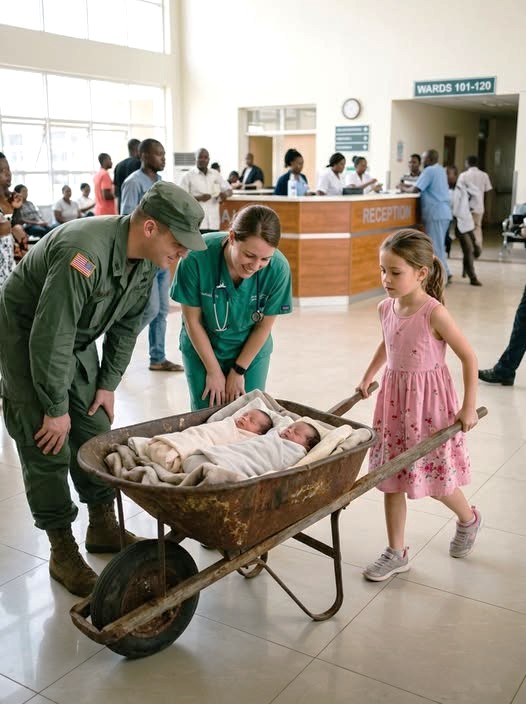
The seven-year-old sat beneath a heated blanket while a social worker examined her hands.
The blisters were severe.
Her feet were worse.
She had walked for hours.
But every few minutes, she looked toward the neonatal unit.
“Are they awake?”
The nurse checked.
“Not yet.”
The girl’s lower lip trembled.
“But they’re going to be okay?”
“We’re doing everything we can.”
The girl nodded.
Then she asked quietly:
“Did you find my mommy?”
The social worker froze.
“Why do you think we’re looking for her?”
“Because she told me to tell you where she was.”
The room went silent.
“She knew she might not wake up,” the girl whispered.
The social worker sat beside her.
“What else did she tell you?”
The child stared at her hands.
“She said there was something in the house.”
“What kind of something?”
“My mommy said if she couldn’t come with us, I had to tell the police about the blue box.”
The social worker exchanged a glance with the nurse.
“What blue box?”
The girl looked toward the hospital doors.
“The one under her bed.”
At 4:12 p.m., officers returned to the house.
The mother had been transported to the hospital.
Harris went upstairs.
There was only one bedroom.
A narrow bed.
A small dresser.
A crib pushed against the wall.
And beneath the bed, exactly where the girl had described it, was a blue metal box.
It was locked.
Harris found a key taped beneath the dresser.
Inside were medical records.
Birth certificates.
Photographs.
A bank statement.
And several envelopes.
The first envelope contained the twins’ hospital records.
The second contained the mother’s insurance information.
The third had a name written across it.
For whoever finds this.
Harris opened it.
His face changed.
“What?”
His partner stepped closer.
Harris handed him the letter.
The first paragraph explained that the mother had been afraid of someone.
Not a stranger.
The twins’ father.
She claimed he had threatened to take the children if she ever left him.
Then came the sentence that made both officers stop.
He doesn’t know the twins survived.
Harris looked up.
“What does that mean?”
His partner pointed to another document.
A temporary birth registration.
Only one father was listed.
Then Harris found a photograph.
The mother was standing beside a man neither officer recognized.
In her arms was a newborn baby.
But there was something strange about the photograph.
A hospital bracelet was visible around the baby’s wrist.
The name printed on it wasn’t the mother’s surname.
It belonged to someone else.
Harris opened the final envelope.
Inside was a court document.
His eyes moved across the page.
Then he whispered:
“This isn’t just a custody case.”
His partner frowned.
“What is it?”
Harris turned the document around.
At the top was a restraining order.
The protected parties were the mother and her children.
The respondent was the twins’ father.
And beneath his name was a photograph.
The same man from the mother’s picture.
Harris stared at it.
Then his radio crackled.
“Unit Twelve, we have an update from the hospital.”
Harris grabbed the radio.
“Go ahead.”
“The mother is conscious.”
Harris exhaled.
“Can she speak?”
A pause.
Then the dispatcher said:
“She asked for her daughter.”
Harris closed the blue box.
“Tell the hospital we’re coming.”
He took one final look at the photograph.
The man in it wasn’t simply the twins’ father.
He was someone the officers already knew.
Someone who had been reported missing eighteen months earlier.
And according to the mother’s letter…
he had been looking for the children the entire time.