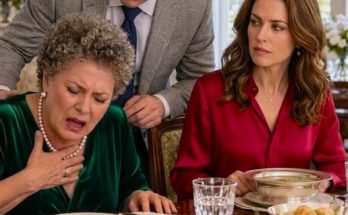
Margaret looked smaller the next time I saw her.
Not weaker.
There was a difference.
Her certainty remained intact, but the environment around it had changed.
At family gatherings, Margaret's authority had been supported by invisible agreements.
People waited for her to choose seats.
They asked her before changing plans.
If she disliked a subject, conversation moved.
If she became offended, everyone else adjusted.
In court, none of those agreements existed.
She was required to answer questions she would once have dismissed as disrespectful.
That made her look smaller because the room did not expand around her personality.
I sat where I had been instructed and watched her take her place.
Daniel was present too, but the distance between them had become unmistakable.
They did not speak.
Margaret did not look at him.
Robert sat separately.
Claire arrived without any member of the family.
That image stayed with me.
Five people who once occupied the same dining table now sat in different parts of a room because each person's version of loyalty had finally reached its limit.
The legal discussion began with familiar evidence.
Hospital records.
Statements.
The recording.
Phone logs.
Prior inconsistencies.
Then Margaret's explanation was examined more directly.
She no longer denied that she intended to frighten me.
That concession had become necessary.
Too much evidence existed.
Instead, she argued about purpose.
She had not intended serious injury.
She had intended correction.
The word entered the room so calmly that for a moment I wondered whether I had heard it correctly.
Correction.
My attorney asked what behavior required correction.
Margaret's answer was almost astonishing in its simplicity.
I had been undermining my husband.
She said I challenged Daniel in front of relatives.
I questioned family decisions.
I had discussed moving farther away.
I had encouraged Daniel to establish boundaries with his parents.
I had become increasingly disrespectful during pregnancy.
Listening to the list felt like hearing ordinary marital decisions translated into crimes.
I had disagreed.
I had wanted privacy.
I had wanted distance from a mother-in-law who entered our life whenever she pleased.
I had asked my husband to behave like my partner rather than his mother's representative.
Those were the offenses.
Margaret continued.
She believed Daniel had become weak.
She believed I was separating him from his family.
She believed the baby would grow up without proper respect for grandparents if the pattern continued.
The more she spoke, the clearer everything became.
This was not an explanation invented after the assault.
It was the worldview that made the assault possible.
Someone asked what authority Margaret believed she had to correct an adult daughter-in-law physically.
Her answer shifted.
She said she did not mean correction in the way the question suggested.
Then she said families sometimes intervene when marriages become unstable.
Then she said I had been hysterical.
Then she said the cane was meant mostly to strike the bench.
The familiar progression appeared again.
Meaning changed whenever consequences approached.
But one earlier statement had already been recorded.
Daniel had said Margaret wanted me to remember not to disrespect the family.
Peter had said Margaret feared I would tell outsiders they had hurt me.
Claire had heard me asking to be released.
The medical evidence showed injuries.
The audio preserved impacts.
Margaret could adjust individual words.
She could not make the entire structure disappear.
The questions moved to preparation.
Had she discussed the bench before I arrived?
Margaret denied planning to injure me.
That was not the question.
Had she discussed the bench?
She said she might have mentioned making me sit there until I calmed down.
Daniel had described something more explicit.
Had the cane been available beforehand?
It was always on the property, she said.
Had she brought it closer?
She could not remember.
Had she contacted Robert before my arrival?
The phone records said yes.
Margaret claimed the call concerned an unrelated family matter.
Daniel said otherwise.
Had she contacted Peter during the incident?
Yes.
Why?
Because the situation had become difficult.
What did she tell him?
She could not remember exact words.
Peter remembered.
That was the problem with records and independent witnesses.
Margaret had built her authority on other people's uncertainty.
Now other people had preserved details she wanted blurred.
I expected to feel satisfaction.
Instead, I felt grief.
There had been opportunities for her to become human inside the story.
She could have said she was horrified by what she did.
She could have admitted anger became cruelty.
She could have acknowledged that I was pregnant and frightened and trusted her family enough to enter their property.
She did none of those things.
Every answer remained centered on intention, reputation, authority, or interpretation.
She wanted the room to understand her.
She showed little interest in understanding what she had done to me.
At one point, the chili powder was discussed.
Margaret said it was an old household remedy.
That claim made several people in the room look up.
A remedy for what?
She struggled.
She suggested it had been intended to discourage me from scratching damaged skin.
The explanation was so detached from reality that I briefly stopped feeling afraid of her.
The hospital documentation described the condition of my skin.
Daniel had already said Margaret wanted me to remember the lesson.
My own statement about the burning sensation had been given before I knew how much the dashcam captured.
Margaret's new explanation did not fit any of it.
Her attorney intervened.
The discussion moved on.
But I kept thinking about the phrase household remedy.
That was what the family did.
Rename harm until it became ordinary.
Control became concern.
Silence became privacy.
Fear became respect.
Punishment became correction.
Concealment became protecting the family.
A painful act became a remedy.
Language had always been one of Margaret's weapons.
The evidence forced the words back toward their actual meanings.
During a recess, Claire approached Elena and asked whether she could speak with me.
I agreed to a minute.
She stopped several feet away.
"She did this with Anna too."
I knew immediately who she meant.
"Called it correction?"
"Not that word."
Claire looked exhausted.
"She said Daniel needed a woman who understood how to calm him instead of provoke him."
I stared at her.
"Why didn't you tell investigators that before?"
"I remembered it while she was talking."
"Tell them."
"I will."
That was all.
Claire walked away.
The conversation lasted less than a minute.
But it reinforced something Anna's statement had already suggested.
Margaret did not merely defend Daniel after violence.
She integrated his violence into a theory about women's behavior.
If a woman managed him properly, there was peace.
If he became angry, the woman had failed.
That belief protected Daniel from learning self-control because responsibility always traveled outward.
It also protected Margaret's image of her son.
He was not dangerous.
Other people mishandled him.
I wondered how much of Daniel's adult personality had been built inside that explanation.
Then I stopped myself.
Understanding origin did not erase responsibility.
Daniel was not a child on the day he held me down.
Whatever Margaret taught him, he had made adult choices.
He knew enough to lie afterward.
He knew enough to fear the recording.
He knew enough to stop me from reaching the road.
Knowledge and responsibility belonged together.
When proceedings resumed, Daniel's cooperation became relevant.
His newer account contradicted Margaret directly on several points.
She turned toward him for the first time that day.
The look was familiar.
I had seen it directed at me countless times.
It meant: Correct yourself.
Daniel did not.
His face was pale.
But he maintained what he had said.
Margaret had discussed frightening me beforehand.
She had mentioned the bench.
She had wanted Robert available.
She had worried about what I might tell outsiders.
Daniel still minimized his own intentions.
He still insisted he did not expect the severity.
But saving himself required exposing planning.
Margaret listened without expression.
Then came the question that changed the atmosphere.
If Daniel knew his mother intended to frighten me, why had he encouraged me to come to the property?
He looked at me.
I wished he had not.
"I thought she'd apologize afterward."
The answer was so absurdly revealing that the room seemed to stop.
Not that nothing would happen.
Not that he thought his mother was joking.
Not that he misunderstood the plan.
He expected harm followed by apology.
That was his model of resolution.
Fear first.
Apology afterward.
Return to normal.
I understood our marriage differently in that instant.
Daniel had apologized many times.
I had treated apologies as evidence that the frightening behavior was not his true self.
Perhaps he saw apology differently.
Not as transformation.
As reset.
A mechanism allowing the relationship to continue without requiring the behavior to change.
The realization hurt.
How many times had I mistaken a reset for repair?
Afterward, outside the courtroom, I sat with Elena.
"I used to think he was good at apologizing."
She waited.
"I think that's why I stayed through things I shouldn't have."
"An apology can matter."
"I know."
"But?"
"But if the same thing keeps happening, maybe the apology is just part of the pattern."
I said it slowly.
Not because Elena needed the explanation.
Because I did.
Daniel had expected Margaret to apologize after terrifying me.
He believed I would accept it because I had accepted versions of that structure before.
That was why he had not warned me.
He assumed the family could hurt me and then manage my reaction.
The injuries became inconvenient only because they were severe enough to bring outsiders in.
The dashcam became dangerous because it prevented the reset.
The police made privacy impossible.
The hospital documented what an apology could not erase.
Margaret left the building before I did.
I watched through a window as she crossed toward a waiting car.
Robert followed several steps behind.
She stopped suddenly and turned on him.
Even through the glass, I could see the force of her gestures.
Robert answered once.
Margaret walked away.
The family was no longer protecting one another smoothly.
Their old structure had become a liability.
That evening, Daniel sent no message.
Neither did Margaret.
The silence felt different this time.
Not like preparation.
Like distance.
I slept for nearly six uninterrupted hours.
It was the longest I had managed since the hospital.
The next morning, Elena called.
There was another development.
Claire's statement about Anna had led investigators to review older information more carefully.
Something had surfaced.
Not another dramatic assault.
Not another photograph.
A police contact.
Years earlier, officers had been called to a location where Daniel and Anna were arguing.
No charges had resulted.
The report was brief.
Anna had declined to pursue the matter.
Daniel's family had always described that relationship as ending because Anna was unstable.
The old report did not prove everything.
But it established that outsiders had been brought into one of their conflicts before.
Margaret's claim that Daniel had no history beyond ordinary relationship arguments was now harder to maintain.
I asked the question that immediately occurred to me.
"Why didn't Anna pursue it?"
Elena paused.
"That is Anna's story to explain if she chooses."
She was right.
I did not ask again.
Later, however, I received another short email from Anna.
She had apparently learned the old report had been located.
She told me why she had walked away.
Margaret came to see her after the police contact.
She did not threaten her openly.
She cried.
She talked about Daniel's career.
Robert's health.
Claire's future.
The humiliation the family would suffer.
She made Anna feel as though asking for protection would injure five innocent people.
Anna withdrew.
Then she left Daniel.
I sat with the email open for a long time.
Margaret had nearly done the same thing to me.
The difference was not that I was stronger than Anna.
The difference was evidence, timing, people who intervened, and the fact that I had reached help before the family could bring me back inside and perform their reset.
Thomas had not simply captured sound.
He interrupted a family ritual older than my marriage.
Harm.
Silence.
Apology.
Return.
This time, the cycle had broken before the apology could erase the event.
And Margaret, forced to explain herself without the protection of that cycle, had finally revealed the belief beneath everything.
She thought marriage had made me part of the family.
And being part of the family, in her mind, meant the family had the right to correct me.
Click Here to continue read next: PART11: Daniel’s Last Attempt to Separate Himself From His Mother Failed When His Own Words Revealed Why He Had Helped Keep Me Behind the Gate
The Hospital Room Changed the Moment a Stranger Mentioned What His Dashcam Had Captured Outside Our Family’s Closed Gate
Part 10 of 12