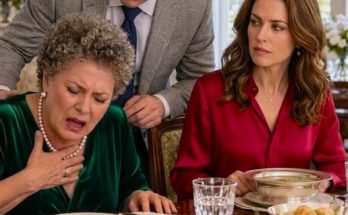
The final outcome did not feel like the ending of a story.
There was no sudden silence in which every wound disappeared.
No perfect sentence restored the months I had lost to fear.
No decision could return me to the morning before I entered Daniel's parents' property and tell me not to go.
The legal consequences came through formal language.
Responsibility was assigned according to conduct and evidence.
Margaret faced the most serious consequences for planning and carrying out the punishment that injured me.
Daniel faced consequences for knowingly participating, restraining me, silencing me, preventing my escape, and lying about what happened afterward.
Robert's actions surrounding the gate and concealment were treated according to his own role rather than simply folded into Margaret's.
Claire's cooperation, her eventual truthful statements, and the more limited nature of her conduct distinguished her position from the others.
Peter's involvement remained separate because he had not been present, though his testimony became important in proving what Margaret and Robert knew and when they knew it.
The exact legal distinctions mattered.
But sitting there, I discovered they did not produce the emotional explosion I once expected.
I did not feel victorious when Margaret's consequences were confirmed.
I looked at her and saw an older woman whose entire concept of family had collapsed around the rules she used to preserve it.
That did not make me pity her enough to excuse anything.
It simply made the outcome feel real rather than theatrical.
Margaret had believed authority protected her.
It had not.
She had believed family loyalty would prevent witnesses from speaking.
It had not.
She had believed my status as Daniel's wife gave her a right to correct me.
It did not.
Most of all, she believed the wall around her property created a boundary around consequences.
It did not.
Robert looked down when his role was addressed.
I remembered all the times I once described him as kind.
He had rarely been openly cruel to me.
That had been enough for me to call him kind because Margaret and Daniel occupied so much more emotional space.
I understood the mistake now.
Kindness is not simply the absence of aggression.
Sometimes kindness requires inconvenience.
Intervention.
Risk.
Opening a gate when the people you love want it closed.
Robert had been given that choice.
He failed it.
Claire cried.
Her consequences did not erase her cooperation, and her cooperation did not erase the moment she closed the gate.
We never became friends afterward.
I think people expected that possibility.
Two women escaping the same family structure.
Shared understanding.
Reconciliation.
Life was less tidy.
I appreciated that Claire eventually told the truth.
I appreciated that she gave investigators information about Anna.
I believed her when she said she would not close the gate again.
But I still remembered crawling toward an opening and seeing it disappear.
Some relationships do not need to be restored in order for people to change.
Claire and I learned to exist with that.
Peter remained the strangest figure to me.
He had been outside the property and yet connected to the event by a phone call.
He represented how far the family's rule of silence extended.
Margaret did not need someone physically present to recruit him into managing the crisis.
All she had to say was that I might tell outsiders.
That was enough to activate the family instinct.
Contain.
Call Robert.
Keep things private.
Peter's later honesty helped expose that system.
I hoped he understood why calling Robert had not been enough.
Anna remained mostly outside my life.
That was how she wanted it.
She cooperated where necessary and then stepped back.
We exchanged only a few messages.
I never asked her to become a symbol of my experience.
She had her own life.
Her own years.
Her own reasons for keeping that photograph.
But I thought about her often.
Years earlier, she had photographed bruises because she feared other people's certainty might eventually overpower her own memory.
That image survived longer than the bruises.
Longer than the relationship.
Longer than Margaret's effort to convince her that speaking would destroy Daniel's future.
When investigators found her, she no longer needed the photograph to prove to herself what happened.
But she still had it.
The family had counted on memory fading.
Evidence had waited.
Daniel was the hardest person to look at when the outcome became final.
He had changed physically over the months.
His face seemed thinner.
His posture had lost some of its old certainty.
I knew he had begun counseling.
I knew he had eventually cooperated.
I knew he had admitted things that harmed his own position.
All of that was true.
Another truth remained beside it.
He had known.
Not every detail.
Not every injury that would result.
But enough.
He knew Margaret intended to frighten me before I arrived.
He knew physical punishment was possible.
He allowed me to come.
He helped restrain me.
He silenced me when my cries might reach outsiders.
He stopped me from reaching the road because, in his own words, if I got outside, it was over.
Then he went to the hospital and tried to explain my body before I could speak.
Those choices ended our marriage long before any legal document did.
The formal separation that followed merely gave paperwork to something already true.
Daniel sometimes asked through proper channels about the pregnancy and later about matters connected to the child.
Those issues had to be handled carefully and legally.
I did not make decisions from anger.
I also did not confuse biological connection with automatic access to me.
Boundaries that once felt cruel began to feel ordinary.
Necessary.
Adult.
The baby's arrival changed my sense of time.
For months, my life had been measured by what happened behind the gate.
Before the assault.
After the assault.
Before the recording.
After the recording.
Before court.
After court.
Then suddenly time was measured in feedings.
Sleep.
Tiny breaths.
Appointments.
A hand curling around my finger.
The first night I held my baby without hospital staff nearby, I cried quietly.
Not from fear.
Not entirely from happiness either.
Grief remained mixed into everything beautiful.
I had once imagined Daniel in that room.
I had imagined him tired and smiling.
I had imagined calling Margaret with news.
I had imagined Robert visiting.
Claire bringing something unnecessary for the baby.
That future had felt guaranteed.
It was gone.
For a while, I thought healing required me to become grateful that it was gone.
I stopped demanding that of myself.
I could mourn the future I wanted while knowing the real people inside that imagined future were unsafe.
Grief did not mean I had chosen incorrectly.
It meant I had loved something that never became what I hoped.
My physical scars faded further.
One remained more noticeable than the others.
For months, I avoided looking at it.
Then one morning, while getting dressed, I noticed it without reacting.
That moment meant more to me than I expected.
The scar had become part of my body rather than a doorway back into the yard.
Recovery happened like that.
Quietly.
A sound stopped frightening me.
A night passed without a nightmare.
I used chili while cooking and realized only afterward.
I saw a wooden garden bench at a store and kept walking.
I drove past a metal gate without checking whether it was open.
Small freedoms.
No witnesses.
No legal documents.
Still real.
Thomas contacted me once after everything settled.
His message was simple.
He wanted to know whether I was doing all right.
I told him I was.
Not perfect.
All right.
I thanked him again for preserving the recording.
He answered that he still wished he had understood sooner.
I told him what I had wanted to tell him in the hospital but had not yet understood clearly enough.
"You acted when you knew."
That was the difference.
Thomas heard something he could not identify.
Then he realized a woman was in danger.
He did not decide it was a family matter.
He did not worry first about embarrassing anyone.
He did not wait for certainty about every detail.
He helped.
The nurse had done the same.
When I asked Daniel to leave my hospital room, she did not hold a family meeting to decide whether my boundary was fair.
She acted.
The doctor saw injuries that did not fit the explanation and kept asking questions.
The officer heard conflicting stories and preserved evidence.
Elena never demanded that I make every decision at once.
Each person did something small enough to seem ordinary.
Together, those actions changed my life.
For a long time, I told myself the dashcam saved me.
It was easy to believe.
The recording was dramatic.
A machine outside a closed gate captured sounds the people inside believed would disappear.
It caught voices.
Impacts.
Robert.
Claire.
My own cries.
It contradicted Daniel's first story before his family had time to make that story permanent.
Without it, the investigation might have been harder.
Perhaps much harder.
I never minimized its importance.
But eventually I understood that saying the recording saved me gave too much power to accident.
Thomas happened to be there.
The camera happened to be running.
The microphone happened to capture enough.
Those were fortunate circumstances.
They were not the whole reason I escaped.
The recording could have existed and still meant nothing if Thomas deleted it.
It could have existed and meant less if the doctor accepted Daniel's explanation without examining me carefully.
It could have existed and remained unused if I allowed Daniel to stay in the room and answer every question.
It could have existed while I returned home and agreed that involving police would destroy the family.
Evidence needs people willing to act on what it shows.
That included me.
I resisted saying that for a long time because I did not want survival turned into another burden placed on injured people.
I had needed help.
I had been vulnerable.
I had not rescued myself alone.
But I had made choices too.
I asked Daniel to leave the hospital room.
I asked Thomas to preserve the original recording.
I agreed to speak with police.
I described the bench.
The cane.
The sock.
The powder.
The gate.
I kept Daniel's messages.
I refused the private explanations.
I did not return to the house.
I let uncertainty remain rather than accepting a familiar lie because it offered quicker peace.
Those choices belonged to me.
Months after the final proceedings, I drove near the road where Daniel's parents lived.
I had not planned to.
Construction diverted traffic.
By the time I recognized the area, turning around would have required more effort than continuing.
My hands tightened around the steering wheel.
For a few seconds, the old fear returned.
Then the property appeared.
The wall.
The entrance.
The gate.
It looked smaller from the road than it had in my memory.
That surprised me.
During nightmares, the gate towered.
It became an impossible barrier separating me from the entire world.
In daylight, from inside a moving car, it was simply metal attached to hinges.
I slowed slightly.
Not enough to stop.
I could not see the bench from the road.
I did not want to.
I looked at the opening where Thomas's truck had once been parked.
There was another vehicle there now.
A stranger's.
Ordinary traffic.
Ordinary afternoon.
For years, Daniel's family had treated that boundary as sacred.
What happened inside belonged inside.
Marriage belonged inside.
Discipline belonged inside.
Arguments belonged inside.
Injuries could be explained inside.
Apologies could erase things inside.
Outsiders were dangerous because outsiders used different words.
Restraint.
Assault.
Evidence.
Help.
Choice.
Responsibility.
I drove past.
My body remained tense for another block.
Then my hands loosened.
I did not turn around.
Later that evening, I held my child near a window while rain tapped softly against the glass.
There was no dramatic revelation.
No promise that pain had made me stronger.
I disliked that kind of story now.
Pain had hurt me.
Other people's choices had hurt me.
Healing came from safety, time, truth, support, boundaries, and the slow return of trust in my own judgment.
My child shifted against me.
I looked down.
One day, there would be questions.
About family.
About Daniel.
About why certain people were absent.
I did not yet know every answer I would give.
But I knew what I would never teach.
I would never teach that love requires silence.
I would never teach that respect means surrendering the right to safety.
I would never teach that protecting a family's reputation is more important than protecting the people inside it.
And if my child ever came to me and said someone had hurt them, I would not begin by asking what they had done to provoke it.
I would open the gate.
That thought stayed with me.
Claire had once said she spent her whole life closing gates.
I understood what she meant now.
Families build invisible gates everywhere.
Around secrets.
Around shame.
Around authority.
Around the behavior everyone knows about but nobody wants named.
The metal gate at Margaret's property had been only the most literal one.
The real gate was the rule that I should protect the people hurting me because they were family.
That gate had taken longer to open.
But once it opened, I never stepped behind it again.
The recording still existed somewhere in an evidence file.
I did not keep a copy where I could easily play it.
I did not need to hear it anymore.
There had been a time when I listened because I needed proof that my memory was real.
Eventually I no longer needed a machine to tell me that.
I remembered.
Not perfectly.
Not every second.
Trauma does not organize itself for convenient retelling.
But I knew the important truth.
Daniel knew I was trying to escape.
Margaret knew she was punishing me.
Robert knew outsiders were approaching.
Claire knew closing the gate kept me inside.
Peter knew enough to understand the family feared exposure.
And I knew I wanted help.
None of their later explanations could change those facts.
Sometimes I wondered what would have happened if Thomas had never parked there.
The question had no useful answer.
Maybe I would still have escaped.
Maybe the case would have depended more heavily on medical evidence.
Maybe Daniel's family would have coordinated their stories successfully enough to make everything harder.
Maybe I would have doubted myself longer.
I stopped building alternate lives around accidents that could not be changed.
Thomas had been there.
The camera had been running.
The recording existed.
The nurse listened.
The doctor documented.
The police investigated.
Claire eventually spoke.
Anna kept her photograph.
Peter confirmed the call.
Daniel admitted what he knew.
Margaret revealed what she believed.
And I left.
That was the story.
Not a miraculous recording.
A chain of people deciding, at different moments, whether truth was worth the discomfort it created.
Daniel's family had spent years choosing comfort.
When the consequences finally arrived, they called me the person who destroyed them.
I no longer carried that accusation.
I had not destroyed their family.
I had stopped protecting the structure that allowed them to hurt people without consequences.
There was a difference.
A large one.
I kissed the top of my baby's head and watched rain move down the window.
Outside, headlights passed along the wet street.
Doors opened.
Doors closed.
People went home.
For the first time in years, home did not mean a place where I had to calculate another person's anger before speaking.
It meant somewhere my voice could exist without permission.
The recording had helped prove what happened to me.
But the final truth was simpler.
The thing that saved my life was not that a camera had heard me.
It was that, once the gate opened, I finally believed I deserved to be heard.
The End
Read more original stories on Feel Every Story.
The Hospital Room Changed the Moment a Stranger Mentioned What His Dashcam Had Captured Outside Our Family’s Closed Gate
Part 12 of 12