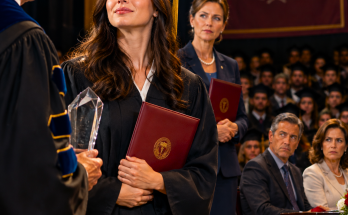
The word failure landed between the plates before anyone touched dessert.
My father had said it without raising his voice. That made it worse. He sat at the head of the table with one hand around his water glass, looking at me as if he were discussing a disappointing investment rather than his daughter.
“You had ability,” he said. “That’s what makes this so hard to understand. You had every opportunity, and somehow you still managed to waste it.”
My mother kept cutting her chicken into smaller pieces.
Across from me, Marcus glanced at his phone.
Emma was already scrolling through pictures from a party she had attended the night before. Nobody looked at me.
I folded my napkin once, then again.
“What exactly did I waste?”
My father sighed.
“That attitude is part of the problem.”
I almost smiled.
Not because anything was funny.
Because I had heard that sentence so many times that I could have supplied the rest of the conversation myself.
He would mention my unfinished career. My small apartment. The coffee shop where I worked between laboratory shifts. The fact that Marcus had a better-paying job and Emma had already moved into a fashionable neighborhood. Then he would say I was too intelligent to be living the way I did.
What he never mentioned were the twelve-hour shifts.
The research papers I read on buses.
The nights I slept four hours before going back to the lab.
The applications I completed at two in the morning because that was the only quiet time I had.
None of those things looked impressive from the outside.
A coffee-shop apron did.
My father pushed his chair back slightly.
“Marcus bought a house,” he said. “Emma has a real career. You’re nearly finished with college and still acting as if you’re trying to figure out what you want.”
“I know what I want.”
“Then why can’t anyone see it?”
The question stayed there.
I looked at him.
“I think that’s the problem.”
His forehead tightened.
“What does that mean?”
“It means you only believe something is real after somebody else approves it.”
Marcus finally looked up.
“Can we not do this tonight?”
My father ignored him.
“You're nearly an adult, Sarah. At some point, you have to accept reality.”
I thought about the acceptance letter sitting in the bottom drawer of my desk at home.
I had not told them.
Not yet.
The envelope had arrived six weeks earlier.
Harvard Medical School.
I had read the letter so many times that the folds were beginning to soften. The admission was real. The scholarship was real. The research placement was real.
But every time I imagined bringing it home, I remembered what had happened the last time I had tried to tell my father about something important.
Ninth grade.
A science fair.
A ribbon.
His response had been, “That’s nice. Just don’t let it distract you from subjects that actually matter.”
So I had learned something early.
In my family, accomplishments mattered only when they fit the version of success someone else had already chosen.
My father leaned forward.
“You're not a failure, Sarah.”
I waited.
Then he finished the sentence.
“But you're making failure look like a lifestyle.”
My mother finally looked at me.
“Your father is only worried.”
“I know.”
She frowned.
“You always say that.”
“Because it’s easier than saying anything else.”
The room went quiet.
Emma lowered her phone.
Marcus shifted in his chair.
For a moment, I thought my father might apologize.
Instead, he picked up his fork.
“Enough. Eat.”
I didn't.
I watched the steam disappear from my plate.
The acceptance letter was still waiting at home.
So was the decision I had been avoiding.
I had been planning to tell them after graduation.
I had imagined my father smiling.
I had imagined my mother crying.
I had imagined Marcus making some sarcastic joke and Emma demanding to see the letter.
But sitting at that table, I realized I had been imagining a family I didn't actually have.
After dinner, my mother followed me into the kitchen.
She stood beside the sink while I rinsed my plate.
“He shouldn't have said that.”
I turned off the faucet.
“You didn't stop him.”
She looked down.
“You know how your father is.”
“That doesn't answer me.”
She rubbed the edge of a dish towel between her fingers.
“He wants you to be settled.”
“I am settled.”
“You work two jobs.”
“One is at the café. The other is at the lab.”
“You know what I mean.”
“Yes.”
She watched me for a moment.
“Are you happy?”
The question caught me off guard.
I looked toward the dark window over the sink.
“I don't know.”
That was the honest answer.
I wasn't happy every day.
Some mornings I woke with my stomach tied in knots. Some nights I cried in the bathroom because an experiment had failed for the third time. There were weeks when I had to decide whether groceries or transportation came first.
But there were also moments when something worked.
A result appeared on a screen.
A professor stopped beside my desk and asked what I thought.
A complicated problem finally made sense.
Those moments were enough to keep me going.
My mother touched my arm.
“You could come home more often.”
“I come when I can.”
“You could tell us more about what you're doing.”
“I tried.”
She looked away.
I knew she remembered.
She had simply chosen not to.
That was becoming a pattern in our family.
The things they did not want to hear somehow became things they had never been told.
I left twenty minutes later.
The drive home was quiet.
Rain had started, thin and steady, turning the road into a dark ribbon beneath the headlights.
When I reached my apartment, I climbed the stairs with my shoes still damp.
My refrigerator contained half a carton of eggs, mustard, and a container of rice.
I laughed under my breath.
Then I opened the bottom drawer of my desk.
The Harvard envelope was exactly where I had left it.
I touched the embossed seal.
Six weeks.
I had spent six weeks waiting for courage.
Maybe courage wasn't coming.
Maybe I had to stop waiting for it.
I opened my laptop.
There were three emails waiting from Professor Liang.
The first asked about my latest research results.
The second reminded me about an upcoming presentation.
The third contained only one sentence.
“You should be proud of yourself.”
I stared at it longer than I expected.
Professor Liang was different from my family.
He noticed when I skipped lunch.
He noticed when I stayed late.
He noticed when I stopped talking.
Once, after I had failed an exam and spent twenty minutes pretending I wasn't upset, he had simply placed a sandwich beside my notebook.
“You can be disappointed,” he had said. “Just don't confuse disappointment with evidence.”
I remembered those words now.
I pulled the Harvard letter from the drawer.
Then I took out a blank sheet of paper.
At the top, I wrote three words.
I am going.
I stared at them.
For the first time that evening, my shoulders relaxed.
The next morning, I arrived at the laboratory before sunrise.
The building smelled faintly of disinfectant and burnt coffee.
Professor Liang was already there.
He looked over his glasses when I walked in.
“You're early.”
“I didn't sleep.”
“That usually means one of two things.”
“What are they?”
“You discovered something or someone upset you.”
I put my bag down.
“My father called me a failure.”
Professor Liang's expression changed.
Not dramatically.
Just enough.
“And what did you call yourself?”
I looked at him.
“I didn't.”
“Good.”
He returned to his computer.
I stood there, surprised.
“That's all?”
“No.”
He turned toward me.
“People who love us can still be wrong about us.”
I swallowed.
“Even parents?”
“Especially when they confuse their expectations with your identity.”
I sat down.
For the next three hours, I worked.
No speeches.
No dramatic promises.
Just work.
At noon, Professor Liang stopped beside my desk.
“You've been accepted.”
My hands froze.
“How do you know?”
“Because Dr. Porter called me.”
I stared at him.
He smiled.
“Congratulations, Sarah.”
The room seemed suddenly too quiet.
“You knew?”
“I knew before you did.”
“That isn't possible.”
He laughed.
“I've watched you for four years. You are remarkably intelligent, but you are terrible at recognizing your own progress.”
I looked down at the keyboard.
“I'm scared.”
“Of Harvard?”
“No.”
He waited.
“Of telling my family.”
Professor Liang pulled up a chair.
“Then don't tell them today.”
I looked at him.
“Why?”
“Because this is your achievement. You don't owe anyone an announcement before you're ready to own it yourself.”
I nodded slowly.
That evening, I went back to my apartment and packed one small box.
Books.
Not clothes.
Not photographs.
Books.
The things I had carried from one cramped room to another for years.
At the bottom of the box, I placed a faded blue ribbon from eighth grade.
First place.
Regional science fair.
I hadn't looked at it in years.
I didn't remember why I had kept it.
Maybe because some part of me still remembered the girl who had earned it before she learned to doubt herself.
I closed the box.
Then my phone rang.
My father's name appeared on the screen.
I nearly let it go to voicemail.
Instead, I answered.
“Sarah.”
“Yes?”
“You're coming to graduation tomorrow, right?”
“Of course.”
“Your mother wants pictures.”
I smiled faintly.
“I'll be there.”
There was a pause.
Then he said, “Try to look presentable. Marcus is bringing his camera.”
“I'll try.”
Another pause.
“Your father loves you,” he added.
I looked at the sealed Harvard letter on my desk.
“I know.”
After we hung up, I sat in the dark.
Tomorrow, they would watch me walk across a stage.
Tomorrow, I would finally tell them.
And tomorrow, whether they understood it or not, the life they had decided I was failing at would begin somewhere else.
Click here to continue reading: PART 2: The Graduation Ceremony Was Supposed to Be About a Diploma Until One Crimson Folder Changed What Everyone Thought They Knew About Her
The Night Her Father Said She Had Wasted Her Potential, Sarah Quietly Decided She Would Stop Asking Them to See It
Part 1 of 20