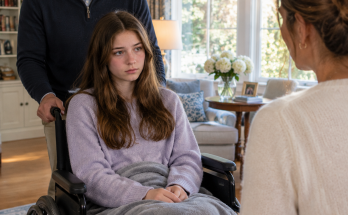
The first week after the hearing should have felt like the end of something. Instead, it became the beginning of the part nobody in our family had anticipated.
The prosecutor's office continued reviewing the financial records. The doctors were asked for additional statements. Chloe's old medical files were compared against pharmacy records, appointment notes, and the information Marcus had provided over the years. Every new document seemed to answer one question while creating two more.
Chloe tried not to follow the investigation too closely.
"I don't want every morning to begin with Dad," she told Rachel one afternoon.
Rachel understood.
So they made a rule. At breakfast, they talked about ordinary things. The weather. Grocery lists. A television show. Chloe's plans for school. The things that had once seemed too insignificant to matter suddenly mattered enormously.
But ordinary life was harder than it looked.
Chloe still woke whenever she heard footsteps outside her bedroom. She still startled when a phone rang unexpectedly. She sometimes stopped halfway through a sentence because she was checking whether someone was listening.
One evening, I found her standing in the kitchen with the refrigerator door open.
"You okay?"
She nodded.
Then she closed the refrigerator.
"I forgot what I wanted."
"That happens to everyone."
She looked at me.
"Not like this."
I understood what she meant.
For years, forgetting something had been treated as proof that something was wrong with her. A hesitation became confusion. A tired afternoon became evidence of weakness. A quiet response became another reason for Marcus to speak on her behalf.
Now she was learning that ordinary human mistakes did not need an explanation.
The investigation uncovered another discrepancy a few weeks later.
A therapy center had billed for sessions Chloe had supposedly attended.
Chloe had never been there.
When the investigator asked her about it, she remembered something.
"Dad took me there once."
"Do you remember why?"
"He wanted a photograph."
The investigator looked up.
"A photograph?"
"He had me sit in the chair. The therapist wasn't there yet."
"What happened?"
"He took pictures."
The photographs were later found in a folder.
Marcus had used them to support fundraising material.
Chloe stared at the images when they were shown to her.
"I hated that chair."
"Why?"
"Because every time someone took a picture, Dad told me not to move."
I felt my hands curl into fists.
Rachel looked away.
The financial records became more troubling.
Money raised for medical expenses had been mixed with household accounts. Some payments could be explained. Others could not. There were transfers to credit cards, restaurant charges, travel expenses, and purchases unrelated to Chloe's care.
Marcus's attorney argued that maintaining a household for a disabled child naturally involved many expenses.
The investigators did not accept that explanation without documentation.
Meanwhile, the church that had organized the first fundraiser requested a complete accounting.
People began sending emails.
Some were angry.
Some were embarrassed.
Some asked whether Marcus had ever actually needed the money.
Rachel refused to read them.
"I don't want Chloe seeing any of it," she said.
I agreed.
But Chloe eventually saw enough.
She found an old photograph online.
It showed Marcus standing behind her wheelchair at a fundraiser.
She was fourteen.
He was smiling.
She stared at it for a long time.
"I remember that day."
"What do you remember?"
"He told me not to smile."
I looked at her.
"He said crying made people donate more."
The sentence sat between us.
Chloe did not cry.
That frightened me more than tears would have.
She simply looked at the photograph and said, "I thought he was joking."
Rachel sat beside her.
"You were a child."
Chloe nodded.
"I know."
Her therapist later explained that understanding something intellectually and accepting it emotionally were not the same thing.
Chloe knew Marcus had manipulated her.
She was still grieving the father she had believed she had.
That grief did not disappear simply because the evidence was clear.
There were nights when she defended him.
"He wasn't always bad."
Nobody argued.
"He taught me how to ride a bike."
Nobody corrected her.
"He used to make pancakes."
Rachel squeezed her hand.
"Those memories can still be real."
Chloe looked surprised.
"I can remember good things?"
"Of course."
That seemed to help.
The investigation eventually returned to the medication.
The doctor who had treated Chloe years earlier was contacted.
He had retired, but his archived records remained.
His notes contained something important.
He had recommended reducing one medication after Chloe's symptoms improved.
Marcus had not followed the recommendation.
Instead, another physician had been contacted.
That doctor had relied heavily on information provided by Marcus.
The pattern was becoming unmistakable.
Marcus had not created Chloe's original illness.
He had taken something real and preserved it long after the crisis had passed.
He had turned recovery into dependency.
One afternoon, the detective called me.
"We found another recording."
My stomach tightened.
"Where?"
"In the old house."
The police had recovered a small device hidden behind a cabinet.
It contained conversations from years earlier.
Most were mundane.
Then Marcus's voice appeared.
"I need you to understand something, Chloe."
A younger Chloe answered.
"I do."
"If people think you're getting better, the help stops."
Silence.
"Do you understand?"
"Yes."
"Then don't walk where anyone can see."
The recording ended.
I sat very still.
The detective did not say anything.
Neither did I.
That sentence explained more than a dozen medical reports.
Chloe eventually listened to it.
Her face became pale.
"I forgot that."
Rachel reached for her.
"I wish I had forgotten."
Chloe shook her head.
"No."
She took a breath.
"I need to remember."
The next morning, Chloe made a decision.
She wanted to return to the school she had attended before her illness.
Not to enroll immediately.
Just to walk through the building.
Rachel drove her.
I went too.
The hallway smelled exactly as old schools always do: floor cleaner, paper, dust, and something faintly metallic from the radiators.
A teacher recognized her.
Her eyes widened.
"Chloe?"
Chloe smiled.
"Hi."
The teacher covered her mouth.
"You came back."
"Just visiting."
They talked for several minutes.
The teacher remembered Chloe as a quiet student who liked science.
"I thought you couldn't walk," she finally said.
Chloe answered honestly.
"So did everyone."
The teacher's expression changed.
"I'm sorry."
Chloe shook her head.
"Don't be."
They walked away.
Outside, Chloe stopped beneath a tree.
"I used to think everyone abandoned me."
Rachel looked at her.
"Some people were kept away."
Chloe nodded.
"I know that now."
Then she looked toward the school.
"I want to come back."
It was the first future plan she had made without asking whether it was permitted.
She enrolled in a program that allowed her to complete missed coursework at her own pace.
Her first assignment took her three hours.
Not because she could not understand it.
Because she kept rereading every answer.
Her teacher finally wrote a note at the top.
You don't need permission to be wrong.
Chloe laughed when she saw it.
"She sounds like Mom."
Rachel smiled.
"Maybe that's why you like her."
The investigation continued.
Marcus's lawyers requested another review.
The prosecutor agreed.
Nobody wanted the case to depend on emotion.
Every claim needed evidence.
Every contradiction needed documentation.
Every financial transfer needed an explanation.
That process was slow.
It was frustrating.
But it also gave Chloe something Marcus had never allowed her.
Time.
Time for people to ask her questions.
Time for her to answer.
Time for the truth to exist without being rushed into a convenient shape.
Then, nearly six months after the first hospital visit, the prosecutor called again.
"We found something significant."
I looked at Rachel.
"What?"
"There was another account."
Rachel went still.
"What kind?"
"An account controlled by Marcus."
"How much?"
The prosecutor hesitated.
"Enough to change the financial portion of the case."
That evening, Chloe sat at the kitchen table doing homework.
She looked up when I entered.
"What happened?"
I sat down.
"The investigation found another account."
She studied my face.
"Is it bad?"
"It's important."
She lowered her pencil.
"Then we'll deal with it."
I smiled.
The old Chloe would have waited for someone else to tell her what happened next.
This Chloe opened her notebook.
"Can I finish this first?"
I laughed.
"Yes."
She returned to her homework.
And for the first time, the investigation felt like it belonged in the background where it should have been.
Her life was finally becoming the main story.
Click here to continue reading: PART 6: The Hidden Account Changed the Case, but Chloe Was More Concerned With the Ordinary Future She Had Once Been Told She Could Never Have
The House Went Quiet the Moment They Left, and I Finally Saw the Girl My Husband Had Spent Years Teaching Everyone to Fear for Her
Part 5 of 9