Marcus appeared at the end of the hallway with Helen beside him.
He looked exactly as he always had in public: pressed shirt, dark jacket, controlled expression. If I had seen him that morning without knowing what I knew now, I might have thought he was a worried father.
But I had watched Chloe stand.
I had heard her speak.
I had seen the medication report.
I had read Rachel's letters.
The old version of Marcus could no longer exist in my mind.
Security stopped them before they reached the elevators.
Marcus saw me.
"Sarah."
His voice was low.
"Come here."
I stayed where I was.
Helen pointed at me.
"You've made a terrible mistake."
Rachel stepped in front of Chloe.
Marcus's eyes moved toward his daughter.
For one second, his expression softened.
Then Chloe moved behind her mother.
That small movement changed his face.
"Chloe," he said.
She did not answer.
"Sweetheart, your father is here."
Chloe stared at the floor.
Marcus looked at me.
"What have you told them?"
"Nothing they didn't already learn from her."
"She's confused."
The detective stepped forward.
"Mr. Hale, we'll speak downstairs."
Marcus ignored him.
"Sarah, you know how sick she is."
I looked at him.
"I saw her walk."
He shook his head.
"That doesn't mean anything."
"She spoke."
"She's capable of occasional speech."
"You told me she could barely communicate."
"She has good days."
I felt something inside me harden.
"You never mentioned good days."
Marcus's jaw tightened.
Helen interrupted.
"Rachel has been filling her head with this."
Rachel looked at her.
"Where were you when she needed you?"
Helen's face flushed.
"You don't understand."
"I understand enough."
The detective asked Marcus to come with him.
Marcus finally turned away.
But before he left, he looked directly at Chloe.
His expression was no longer gentle.
It was a warning.
She saw it.
I saw it.
So did the detective.
Marcus spent several hours answering questions.
He maintained that Chloe had a serious neurological condition.
He said her ability to walk had been inconsistent.
He said her mother had been emotionally unstable.
He said the medications were prescribed.
He said I had misunderstood the situation.
Then the detective asked about the recordings.
Marcus stopped talking.
That was the first crack.
The search warrant came the following morning.
I was not present when officers entered the house, but Rachel called me afterward.
"They found files."
"What kind?"
"Medical records. Donation information. Notes."
My stomach tightened.
"What notes?"
"About people."
Later, I saw copies.
There were names of visitors and short descriptions beside them.
Easy to convince.
Suspicious.
Useful.
Too emotional.
Not worth discussing with.
Beside my name was a sentence.
Trusting. Emotional. Manageable.
I stared at it.
For years I had thought Marcus trusted me.
He had simply categorized me.
Rachel saw my face.
"He did the same thing to me."
"What did he write about you?"
She hesitated.
"Unstable. Persistent. Difficult to control."
I looked away.
There was no comfort in knowing I had company.
The police also found donation records.
Some money had been used for legitimate expenses.
Much of it was harder to explain.
Payments had been made to accounts connected to Marcus.
There were lists of fundraising events.
There were draft speeches.
There were photographs prepared for social media.
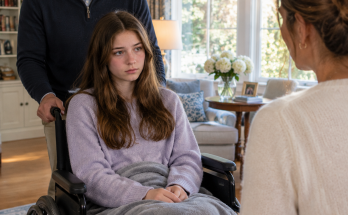
Chloe was always seated in the wheelchair.
Marcus was always standing behind her.
The detective showed one of the photos to Chloe.
She stared at it.
"That was the day I walked in the bathroom."
I looked at her.
"You walked then?"
"Yes."
"Why didn't you tell anyone?"
She gave me a tired look.
"Because he was outside the door."
That answer was enough.
The investigation widened.
The charity board froze the remaining funds.
The church requested records.
People who had donated began asking questions.
Marcus's carefully built reputation began to crack.
He called me from an unknown number.
I answered once.
"Sarah."
I said nothing.
"You need to understand what you're doing."
"I understand that Chloe can walk."
"She is sick."
"Then why are you afraid of independent testing?"
Silence.
He changed tactics.
"You have no idea what Rachel has done."
"I've seen her letters."
"She abandoned Chloe."
"No."
I said it quietly.
"She didn't."
Marcus's breathing changed.
"You think you know my family after a few days?"
"I know enough."
"You'll regret this."
I ended the call.
My hands shook afterward.
Not because I believed him.
Because I finally understood how much of my marriage had been built around fear I had mistaken for concern.
I filed for divorce that week.
Marcus's attorney contacted me before the paperwork was complete.
He suggested that I was under emotional pressure.
He suggested I had been manipulated.
He suggested I should reconsider.
I replied through my lawyer.
I would not reconsider.
Meanwhile, Chloe began staying with Rachel.
The first evening there, she stood in the kitchen without knowing what to do.
Rachel asked whether she wanted tea.
Chloe said yes.
Rachel handed her a mug.
Chloe held it with both hands.
"I forgot you used this one."
Rachel smiled through tears.
"You remember?"
"I remember everything."
That was the hardest thing for Rachel to hear.
Chloe remembered.
Not only the bad things.
The small things too.
The way her mother used to braid her hair.
The song she played while cleaning.
The blue mug.
The smell of cinnamon toast.
The yellow blanket Chloe had slept with as a child.
Marcus had not erased her memories.
He had simply controlled which ones she was allowed to share.
A few days later, Chloe walked outside.
No wheelchair.
No camera.
No one standing behind her.
She stepped onto the sidewalk and stopped.
"What's wrong?" Rachel asked.
"Nothing."
Chloe looked up at the sky.
"I forgot the sun felt like this."
Rachel began crying.
Chloe smiled.
Then she laughed.
It was a small laugh at first.
Then a real one.
I watched from the doorway.
For the first time, I understood that freedom did not always look dramatic.
Sometimes it looked like a girl standing in a patch of sunlight because nobody was there to tell her she couldn't.
But the legal side of the case was becoming darker.
The prosecutor reviewed the recordings.
One was especially damaging.
Marcus's voice was unmistakable.
"You want to see your mother?"
A younger Chloe answered.
"Yes."
"Then stop causing trouble."
"I didn't."
"You argue too much."
"I just want Mom."
"Then act grateful."
There was a long silence.
Marcus continued.
"Sick girls don't make demands."
Chloe's voice became very small.
"Okay."
I had to stop listening.
Rachel could not.
She listened until the end.
When it finished, she covered her face.
The prosecutor asked Chloe whether she wanted to testify.
She thought about it for two days.
Then she said yes.
"I want them to hear me."
Her decision changed everything.
Marcus's attorney tried to argue that Chloe's testimony was unreliable.
The doctors disagreed.
The medical evidence did not prove every accusation by itself, but it established enough contradictions that the old story could no longer simply be accepted.
Records had been altered or selectively presented.
Medication had been administered under Marcus's direction.
Medical decisions had been made without Rachel's involvement.
And the recordings provided something the paperwork could not.
His voice.
His own words.
The case moved toward court.
Marcus continued sending messages.
Some were apologetic.
Some were angry.
Some sounded almost affectionate.
One said:
I did everything for you.
Chloe read it.
Then she deleted nothing.
"Keep it," she said.
"Why?"
"Because he needs to understand that I remember."
The hearing date was set.
Helen came to Rachel's apartment once.
She stood outside in the rain holding a bag.
Rachel answered the intercom.
"It's me."
Rachel did not respond.
"I brought Chloe's things."
Silence.
"Please."
Chloe stood beside her mother.
Helen's voice cracked.
"She's still my granddaughter."
Chloe reached toward the intercom.
Rachel looked at her.
"Are you sure?"
Chloe nodded.
She pressed the button.
"I know."
Helen began crying.
"I love you."
Chloe closed her eyes.
Then she said, "You helped him."
Helen stopped speaking.
Chloe released the button.
That night, she asked me something.
"Do you think he'll ever admit it?"
I thought about Marcus.
About the photographs.
The speeches.
The money.
The wheelchair.
"No."
Chloe looked down.
"Neither do I."
Then she smiled faintly.
"But I don't need him to."
The morning of the hearing arrived cold and clear.
Rachel helped Chloe choose a blue dress.
Chloe stood in front of the mirror.
"I look different."
"You look like yourself."
Chloe touched her hair.
"I don't remember what that looked like."
Rachel hugged her.
At the courthouse, Marcus was already there.
He wore the same navy suit he had used for charity events.
He looked at Chloe.
She looked back.
Neither spoke.
Then the clerk called her name.
Chloe stood.
She did not reach for a wheelchair.
She did not look at Marcus.
She walked toward the courtroom.
Every step was ordinary.
That was what made it powerful.
Marcus had spent years telling the world those steps were impossible.
Now the entire room watched her take them.
Click here to continue reading: PART 4: In Court, Chloe Finally Told the Story No One Had Allowed Her to Finish, and Marcus Heard His Own Voice Become Evidence Against Him
The House Went Quiet the Moment They Left, and I Finally Saw the Girl My Husband Had Spent Years Teaching Everyone to Fear for Her
Part 3 of 5