The old house was sold, but the new owners had not moved in yet.
The attorney contacted Rachel.
A few personal items belonging to Chloe had been discovered in a storage room.
Rachel asked whether Chloe wanted them.
Chloe said yes.
We went together.
The house looked unfamiliar.
The hedges had grown.
The paint was faded.
A cardboard sign hung near the front door.
FOR SALE.
Chloe stood on the sidewalk.
"You don't have to go inside."
"I know."
She looked at the door.
"I want to."
The lock clicked.
The door opened.
The smell was different.
Someone had cleaned the place.
The rooms were mostly empty.
Without furniture, the house seemed smaller.
Chloe walked slowly through the living room.
"This is where I stood."
Rachel looked at her.
"When?"
"The first day."
She touched the wall.
"I thought my legs would give out."
They didn't.
She smiled.
"Neither did I."
They continued toward the study.
The camera was gone.
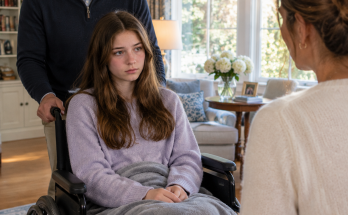
The wheelchair was gone.
The closet was empty.
Chloe opened the wooden panel.
Nothing remained.
She crouched.
"This is where I kept the pouch."
Rachel watched her.
"Do you want to take a picture?"
"No."
Chloe stood.
"I don't need one."
They moved upstairs.
Her old room had been cleared.
There was a small mark on the wall where her bed had once stood.
Chloe touched it.
"I used to count these marks."
"Why?"
"To make time pass."
She looked around.
"I thought I would live here forever."
Rachel put an arm around her.
"You don't have to think about that anymore."
"I know."
They reached the hallway.
Chloe stopped beneath the place where Marcus had installed the camera.
She looked up.
"Do you remember the red light?"
"Yes."
"I used to watch it."
"Why?"
"Because I knew when it blinked, he was watching."
She stood there for several seconds.
Then she laughed softly.
"What?"
Rachel asked.
"I can't believe I used to think a little light was stronger than me."
She walked away.
That was the last time Chloe entered the house.
Outside, she found a box of belongings.
Inside were old school notebooks, childhood photographs, and a stuffed animal she had forgotten.
She held it.
"Oh."
Rachel smiled.
"You remember?"
"Yes."
Chloe hugged the toy.
"I thought Dad threw this away."
Rachel's expression changed.
"He probably didn't."
They took the box home.
That evening, Chloe sorted through the photographs.
There were pictures of birthdays.
School plays.
Family trips.
Marcus appeared in many.
So did Rachel.
Some pictures were painful.
Others were not.
Chloe kept them.
She did not tear them up.
She did not pretend the good moments had never happened.
She simply stopped allowing the bad ones to erase everything else.
Among the photographs was one she had never seen.
Rachel was holding Chloe at age six.
Marcus stood beside them.
All three were smiling.
Chloe stared at it.
"I want this one."
Rachel nodded.
"Keep it."
"I will."
She placed it in a frame.
That surprised me.
"You're keeping a picture with him in it?"
"Yes."
"Why?"
"Because he was there."
She looked at the photograph.
"And because that little girl shouldn't lose her mother just because her father later hurt us."
Rachel began crying.
Chloe reached for her hand.
"Mom."
"I know."
"You don't have to cry."
"I'm trying."
Chloe laughed.
"You're terrible at that."
Rachel wiped her eyes.
The next morning, Chloe put the framed picture on a shelf.
Beside it, she placed a photograph of herself in her red shoes.
Past and present.
Not competing.
Both true.
Her apartment felt different after that.
Not heavier.
Lighter.
She had stopped dividing her memories into acceptable and forbidden.
She could remember.
She could choose.
She could continue.
Her scholarship year ended with a presentation.
She spoke about personal autonomy.
The professor asked whether she wanted to include her own experience.
She did.
But she kept Marcus out of the center.
The presentation focused on a simple principle.
Ask the person.
Listen to the answer.
Then listen again when circumstances change.
People's abilities change.
Needs change.
Preferences change.
Fear changes.
Healing changes.
No caregiver, parent, spouse, doctor, or institution should assume that yesterday's answer must remain today's answer.
After the presentation, several students approached Chloe.
One wanted to discuss disability rights.
Another asked about writing.
A third simply said, "Thank you."
Chloe smiled.
"You're welcome."
Walking home afterward, she realized something.
She had spent years thinking her story ended when she finally walked.
It hadn't.
Walking had only opened the door.
Everything afterward had required choices.
She had chosen Rachel.
She had chosen school.
She had chosen work.
She had chosen boundaries.
She had chosen what memories to keep.
She had chosen not to let Marcus's actions become the explanation for every decision she made.
That was harder than exposing him.
It was also more important.
One evening, she received a message from her father.
It was short.
I hope you're well.
She stared at it.
Rachel was nearby.
"What is it?"
"Nothing."
Rachel looked at her.
Chloe turned the phone around.
Rachel read the message.
"What will you do?"
Chloe thought.
"Nothing."
She archived it.
She did not block him.
She did not answer.
She did not need to.
The silence was a choice.
Later that week, Marcus's attorney sent another notice confirming that no further action was pending.
The final administrative matter was closed.
Rachel read it.
Then she put it in a drawer.
Chloe smiled.
"That's where paperwork belongs."
"Exactly."
There was no celebration.
No toast.
No dramatic moment.
They made dinner.
Afterward, Chloe washed the dishes.
Rachel dried them.
Music played quietly.
For years, ordinary household sounds had existed beneath the pressure of surveillance.
Now those same sounds meant something else.
Safety.
One night, Chloe asked me to walk with her.
We went around the block.
The air was cool.
She talked about school.
About work.
About a professor she liked.
About a customer who kept returning books without reading them.
She laughed.
Then she said, "Do you know what I like most?"
"What?"
"Nobody knows where I'm going tomorrow."
I smiled.
"Not even you?"
"Especially not me."
We continued walking.
That sentence stayed with me.
For years, Marcus had controlled Chloe by telling everyone what her future would be.
She would always need care.
She would never walk.
She would barely communicate.
She would remain dependent.
He had described her future as though it belonged to him.
Now Chloe did not know exactly what her future would hold.
And she loved that uncertainty.
Because uncertainty meant possibility.
At the corner, she stopped.
"I think I'm going to apply for another program."
"What kind?"
"Something bigger."
"What does that mean?"
"I don't know yet."
She smiled.
"But I'm going to find out."
She walked ahead.
I followed.
Neither of us looked back.
Click here to continue reading: PART 12: Chloe Had Spent Years Being Told Her Future Was Already Written, but on the Last Evening She Chose Something Marcus Could Never Take From Her
The House Went Quiet the Moment They Left, and I Finally Saw the Girl My Husband Had Spent Years Teaching Everyone to Fear for Her
Part 11 of 12