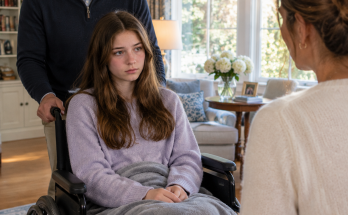
Two years after the day Chloe walked into the hospital, she graduated from her program.
Rachel sat in the front row.
I sat beside her.
The bookstore manager came too.
Chloe had insisted that he attend.
"He gave me my first normal job."
He smiled.
"You were good at it."
"I still am."
"Fair."
When Chloe's name was called, she walked across the stage.
There was no wheelchair.
No medical explanation.
No dramatic announcement.
Just her name.
She accepted the certificate.
Rachel cried.
Again.
Chloe saw her from the stage and laughed.
Afterward, they took photographs.
Chloe wore a simple dress.
Her red shoes were hidden beneath the hem.
Rachel noticed.
"You wore them."
"Of course."
"They're falling apart."
"I repaired them."
"You've repaired them three times."
"They've been through a lot."
Chloe smiled.
"So have I."
They celebrated at a small restaurant.
There were no speeches about Marcus.
Nobody mentioned the court case.
Nobody talked about the money.
They talked about Chloe's plans.
She had accepted a position with a community organization that worked with families navigating medical and disability services.
She would help people understand records, ask questions, and make sure patients were included in decisions about their own lives.
"Are you sure?" Rachel asked.
"Yes."
"Because it might bring difficult things back."
"It might."
Rachel looked worried.
Chloe reached across the table.
"But it also lets me do something useful with what happened."
Rachel nodded.
That was enough.
The following month, Chloe moved into a slightly larger apartment.
She kept the framed photograph of herself and Rachel from childhood.
She kept the red shoes.
She kept the scholarship certificate.
She kept the small notebook containing the questions she had written during the investigation.
What happened?
Who says it happened?
What proves it?
What is missing?
She added another question beneath them.
What does the person involved say?
That became the principle she carried into her work.
Her first case involved an elderly man whose relatives made most of his decisions without asking him.
Chloe sat beside him.
"What do you want?"
He looked surprised.
Nobody had asked him directly.
He took a long time to answer.
"I want to go home."
Chloe listened.
Then she helped him explain that wish to the people responsible for his care.
She did not promise an easy solution.
She did not speak for him.
She made room for him to speak.
That was the work.
Sometimes it was frustrating.
Sometimes families resisted.
Sometimes doctors were impatient.
Sometimes paperwork became an obstacle.
But Chloe kept asking questions.
She kept listening.
She kept records.
She never assumed that one person's description was the whole truth.
At home, she still had difficult days.
She sometimes woke from dreams about the old house.
Sometimes she found herself checking a doorway twice.
Sometimes a particular tone of voice could make her stomach tighten.
Healing had never turned her into someone untouched by the past.
It had simply taught her that the past did not have to command the present.
One evening, she sat on her balcony with a cup of tea.
The city below was noisy.
Cars passed.
Someone laughed in the street.
A dog barked.
She looked at her hands.
Then at the red shoes near the door.
Her phone rang.
Rachel.
"Are you busy?"
"Drinking tea."
"Can I come over?"
"Of course."
Rachel arrived carrying groceries.
"I brought too much."
"You always do."
"I know."
They cooked together.
After dinner, Rachel asked whether Chloe had heard anything from Marcus.
"No."
"Good."
Chloe nodded.
"I don't think about him much anymore."
Rachel looked relieved.
"Really?"
"Really."
There was a pause.
"Sometimes I do."
Rachel waited.
"But when I think about him, I don't think about what he did first."
"What do you think about?"
Chloe looked toward the window.
"I think about the fact that he's just a person."
Rachel frowned slightly.
"What does that mean?"
"It means he isn't the center of my story anymore."
Rachel smiled.
"I like that."
"So do I."
They finished washing the dishes.
Before leaving, Rachel hugged Chloe.
"Call me tomorrow."
"I will."
"Don't forget."
"I won't."
The door closed.
Chloe returned to the balcony.
She opened her notebook.
On the first page were the questions she had written years earlier.
What happened?
Who says it happened?
What proves it?
What is missing?
She turned to a blank page.
Then she wrote:
What do I want now?
She thought about the question.
She wrote slowly.
A career I care about.
A home that feels like mine.
People I trust.
Room to change.
Room to make mistakes.
Room to say no.
Room to say yes.
She stopped.
Then added one final line.
A life I chose myself.
She closed the notebook.
Outside, the city lights flickered.
For a moment, she remembered the red light of the camera in the old hallway.
The tiny blinking point that had once seemed impossible to escape.
She remembered the wheelchair.
The locked routines.
The medications.
The photographs.
The fundraisers.
The lies about Rachel.
The hospital.
The courtroom.
The first walk.
The first job.
The first apartment.
The scholarship.
The red shoes.
Everything was connected.
But not everything needed to remain connected.
She could remember the past without carrying it into every room.
She could acknowledge what Marcus had done without giving him control over what came next.
She could love parts of her childhood without defending him.
She could miss the father she thought she had without inviting the man he became back into her life.
Most importantly, she could stop proving herself.
She no longer needed anyone to watch her walk.
That realization came quietly.
There was no audience.
No photograph.
No medical professional.
No courtroom.
Nobody waiting to decide whether her movement counted.
She stood from the chair on her balcony.
She walked inside.
She closed the notebook.
Then she turned off the kitchen light.
That was all.
The story people once told about Chloe had been simple.
She was the girl who could not walk.
The girl who could barely communicate.
The girl who would supposedly require care for the rest of her life.
That story had been repeated so many times that people stopped asking whether it was true.
But Chloe had always known something different.
Her body was not the only thing that mattered.
Her voice mattered.
Her choices mattered.
Her memory mattered.
Her right to answer for herself mattered.
And when she finally found people willing to listen, the truth did not arrive as one dramatic revelation.
It came in pieces.
A whispered word.
A step.
A medical test.
A recording.
A torn letter.
A financial record.
A photograph.
A question.
Then another.
The evidence mattered.
The consequences mattered.
What Marcus had done mattered.
But eventually, something else mattered more.
What Chloe chose to do with the life that remained.
She chose her mother.
She chose school.
She chose work.
She chose to help people who were struggling to be heard.
She chose boundaries without apology.
She chose memories without allowing them to dictate her future.
She chose uncertainty over a future someone else had written for her.
And she chose not to become trapped in the story of the man who had trapped her.
Years earlier, Marcus had told her that nobody would believe a sick girl over her father.
He had been wrong.
Not because everyone suddenly became wise.
Not because the truth had been obvious from the beginning.
He was wrong because Chloe eventually found the courage to speak, and eventually there were people willing to listen.
But the most important thing she learned afterward was even simpler.
Being believed was not the same as being free.
Freedom came when she no longer needed anyone else to confirm who she was.
That night, Chloe went to bed in her own apartment.
She left her phone on the table.
She left the bedroom door open.
Then, after a moment, she changed her mind and closed it.
She smiled to herself.
Nobody had told her to.
Nobody was watching.
She simply wanted the room quiet.
And in the darkness, with no camera blinking overhead and no voice telling her what tomorrow would look like, Chloe finally understood the thing she had been denied for so many years.
Her future was not a sentence someone else could write.
It belonged to her.
The End
Read more original stories on Feel Every Story.
The House Went Quiet the Moment They Left, and I Finally Saw the Girl My Husband Had Spent Years Teaching Everyone to Fear for Her
Part 12 of 12