Chloe did not write about Marcus for several weeks.
She wrote about everything else.
A bookstore customer who returned the same novel three times because he liked the ending.
A professor who drank coffee during every lecture.
The strange quiet of the city before sunrise.
The way Rachel always bought too many vegetables.
Small things.
Safe things.
Then one night she opened the unfinished document.
The sentence was still there.
A person can be trapped without chains.
She stared at it.
Then she added another line.
Sometimes the hardest prison to recognize is the one everyone else calls protection.
She wrote for an hour.
Then two.
When she finally stopped, she had seven pages.
She did not send them anywhere.
The next morning, she showed them to me.
"Is this too much?"
I read the pages carefully.
"No."
"Does it sound angry?"
"Sometimes."
"Is that bad?"
"No."
She leaned back.
"I don't want to make myself sound like a victim."
"You don't."
"I don't want to make him into a monster either."
"You don't have to make him into anything."
She looked at me.
"That's what I'm trying to learn."
The essay became part of a class project.
Her professor encouraged her to revise it.
"Keep the facts clear," he said. "Separate what you know from what you believe."
Chloe appreciated that.
She had spent years living inside someone else's conclusions.
Now she wanted every sentence to earn its place.
She checked dates.
She compared memories with documents.
She removed details she could not verify.
She kept others because they were supported by records.
When she was uncertain, she wrote that she was uncertain.
It was difficult.
Truth was rarely as tidy as the stories people preferred.
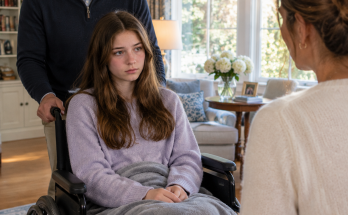
One section described the wheelchair.
She wrote about how she had once believed it was part of her identity.
Then she explained what it had actually become.
A prop.
Not in every moment.
Not in every medical appointment.
But often enough.
She stopped writing.
The word made her uncomfortable.
She changed it.
A tool.
That felt more accurate.
The wheelchair itself had never betrayed her.
The person controlling the meaning of it had.
She continued.
When the essay was finished, her professor asked whether she wanted to submit it to a student publication.
Chloe hesitated.
"People might recognize me."
"They might."
"Then they'll recognize him too."
"Probably."
She thought about it.
Then she said yes.
The article was published under her full name.
It did not contain accusations beyond what could be documented.
It did not identify Marcus in every section.
It focused on voice, consent, medical autonomy, and the danger of allowing one person to become the permanent interpreter of another person's life.
Readers responded.
Some shared similar experiences.
Some wrote about elderly relatives whose care had been controlled by family members.
Some wrote about disabled children who were spoken over.
Others simply said the article made them think differently.
Chloe read very few responses.
"I don't want to become addicted to strangers' opinions," she said.
That was wise.
But one message mattered.
It came from a young woman whose brother had a disability.
She wrote that she had begun asking him questions directly instead of automatically asking their parents.
Chloe saved the message.
"That's enough," she said.
The article also reached the hospital.
The nurse who had first helped Chloe contacted her.
She said the piece had been shared among staff.
"People are talking about it."
"About me?"
"About listening."
Chloe smiled.
"Good."
Her life continued.
The legal matter involving Marcus was finally closed.
There were no more hearings.
No more requests for documents.
No more calls from investigators.
The final notice arrived by mail.
Rachel opened it.
She read it.
Then she handed it to Chloe.
Chloe read it once.
"That's it."
Rachel nodded.
"That's it."
Chloe folded the paper.
"Can we celebrate?"
Rachel laughed.
"How?"
"Chinese food."
They ordered too much.
I joined them.
We ate at the apartment table until there was barely room for the plates.
Rachel raised her glass.
"To Chloe."
Chloe groaned.
"Mom."
"Fine. To surviving."
"No."
Rachel stopped.
Chloe smiled.
"To living."
Rachel lifted her glass.
"To living."
We drank.
After dinner, Chloe opened the window.
The evening air smelled like rain.
She stood there quietly.
"Do you miss anything?" I asked.
"About before?"
"Yes."
She thought.
"I miss who I thought Dad was."
That answer hurt.
"But I don't miss the life."
She turned around.
"I used to think those were the same thing."
"They aren't."
"No."
She closed the window.
Then she asked whether I had ever spoken to Marcus.
"Not since the divorce."
"Good."
"Why?"
"I don't want to hear about him."
I nodded.
That was her boundary.
I respected it.
The next semester, Chloe took a course on disability advocacy.
She discovered that many families faced situations where a person's needs were interpreted by caregivers, doctors, or institutions.
She became interested.
Not because she wanted to become the spokesperson for every difficult case.
Because she understood how important it was to preserve the person's own voice.
Her professor encouraged her to volunteer at a local support center.
She started one afternoon a week.
At first, she mostly listened.
That suited her.
She knew the value of being heard without interruption.
One woman told her about an adult son whose relatives made every decision for him.
"What should I do?" the woman asked.
Chloe did not give an immediate answer.
She asked, "What does he want?"
The woman stared at her.
"I don't know."
"Then maybe that's the first thing to find out."
The woman nodded.
Chloe came home that evening thoughtful.
"Sometimes the answer is just a question."
"That's what you've learned."
She smiled.
"Maybe."
Her work at the center remained small.
She did not call herself an advocate.
She did not want a title.
She simply helped where she could.
Meanwhile, her relationship with Rachel continued to change.
They still had disagreements.
One weekend, Rachel bought a large piece of furniture without asking Chloe.
"Where is that going?"
"In your apartment."
"I don't want it."
"But it's beautiful."
"It's huge."
Rachel looked at it.
"It is."
"I told you I don't want it."
Rachel crossed her arms.
"Fine."
"Mom."
"What?"
"You're mad."
"I'm not mad."
"You are."
Rachel sighed.
"Maybe."
Chloe smiled.
"That's okay."
Rachel laughed.
They moved the furniture back.
That small disagreement mattered more than either realized.
Chloe was learning that saying no did not destroy relationships.
Rachel was learning that respecting Chloe did not mean protecting her from every discomfort.
Their relationship became healthier because neither needed to control the other.
One evening, Chloe asked me whether I thought she should change her last name.
I asked why.
"Sometimes seeing Dad's name bothers me."
"What would changing it mean to you?"
"I don't know."
"Then you don't have to decide."
She smiled.
"That's becoming your favorite answer."
"Because you keep asking questions that don't need immediate answers."
She laughed.
A year after the first hospital visit, Chloe returned to the park where she had once taken her first long walk.
She wore the same red shoes.
They were slightly worn.
She had repaired one of the soles.
Rachel took a picture.
"Do you want to see it?"
"No."
"Why not?"
"I don't need proof."
Rachel lowered the phone.
Chloe smiled.
"I know I walked here."
They continued through the park.
At the far end was a bench overlooking a small pond.
They sat.
The water reflected the gray sky.
Rachel asked, "Are you happy?"
Chloe thought carefully.
"Sometimes."
Rachel smiled.
"That's honest."
"I'm also tired sometimes."
"That's normal."
"I get angry."
"Normal."
"I get scared."
"Normal."
Chloe nodded.
"I think normal is underrated."
They laughed.
The sun appeared briefly through the clouds.
Chloe looked at the water.
"I don't want my life to be about what happened."
"Then it won't be."
"But I don't want to pretend it didn't happen either."
"You don't have to."
She leaned against Rachel's shoulder.
For the first time, the past did not feel like an open wound.
It felt like a scar.
Still part of her.
No longer bleeding.
Click here to continue reading: PART 11: When Chloe Returned to the Old House for the Last Time, She Expected Memories to Hurt, but What She Found There Was Something Unexpectedly Quiet
The House Went Quiet the Moment They Left, and I Finally Saw the Girl My Husband Had Spent Years Teaching Everyone to Fear for Her
Part 10 of 12

One Comment on “PART 10 – Chloe Finally Wrote Down What Had Happened, Not to Expose Marcus Again, but to Make Sure Her Own Voice Was Never Taken From Her”