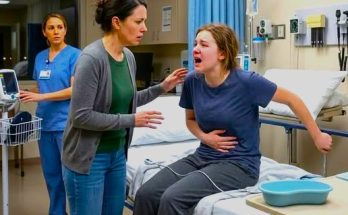
Emily cried without making much noise.
That was what hurt most.
She had become practiced at crying silently, the way some children learn to close doors softly when they know an adult is angry.
Dana asked whether she could continue.
Emily nodded.
I stayed beside her.
She told us Saturday had not been the first time her father had hurt her.
There had been grabbing.
Shoving.
A slap when I was at work.
A wrist twisted hard enough to leave bruises.
She had learned that the aftermath was often worse than the incident itself because Michael became kind.
He would order food.
Buy her something small.
Speak softly.
Then he would tell her she had pushed him too far.
“He always made it sound like I caused it,” she said.
I looked down at the hospital floor.
I had heard those explanations.
Not all of them.
Enough.
When he punched a wall, he said I had provoked him.
When he broke something, he said I had embarrassed him.
When he shouted at Emily, he said she was disrespectful.
Every event had an explanation.
Every explanation somehow ended with someone else being responsible.
Dana asked Emily when she had started recording him.
“Three months ago.”
“Why?”
Emily looked at me.
“Because I knew Mom wouldn't believe me.”
The words hurt.
They should have.
I had spent years thinking that if something were truly wrong, I would notice.
But noticing and admitting were not the same thing.
Sometimes I had noticed.
I had simply chosen the explanation that required the least courage.
Emily opened another recording.
Michael's voice came through the damaged speaker.
“You tell your mother I touched you and I'll tell everyone you attacked me.”
Emily's voice was small.
“I didn't do anything.”
“You're a child. Who do you think they're going to believe?”
The recording ended.
Dana immediately asked Emily not to delete anything.
She asked whether the original device could be preserved.
“Yes.”
I looked at the phone.
My daughter had not created those recordings to hurt her father.
She had created them because she had stopped believing anyone would protect her without proof.
That realization was almost unbearable.
The door opened.
A police officer entered.
He spoke quietly with Dana first.
Then he introduced himself and asked whether Emily was willing to give a statement.
She looked at me.
I nodded.
But I did not answer for her.
She said yes.
The officer asked what had happened Saturday.
Emily told him.
She described the kitchen.
The counter.
The punch.
The second blow.
The fall against the cabinet.
Then she described the following morning.
The pain had worsened.
She vomited.
She told Michael her stomach hurt where he had hit her.
He told her she was trying to avoid school.
Then he warned her not to tell me.
The officer wrote everything down.
When he asked why she had not told me immediately, she looked at me.
“He said Mom would leave him.”
The officer glanced at me.
I said, “That's true.”
Then I corrected myself.
“That's what he told her.”
The distinction mattered.
I wanted every word recorded accurately.
No more smoothing things over.
No more translating his behavior into softer language.
While the officer worked, another doctor came in.
The imaging results were back.
The problem was not what we had feared from the old family records.
There was no evidence of the inherited condition my ex-husband had suspected.
The abnormality was related to inflammation and injury.
The earlier pain had not been an unexplained family disease.
It had a much more immediate cause.
The doctor explained that the impact to her abdomen had caused internal injury that had worsened over time.
The nausea and vomiting had been warning signs.
Her appendix had perforated.
The old records had frightened us into looking backward.
The real danger had been in front of us.
Emily needed surgery.
Immediately.
I signed the consent forms with hands that would not stop shaking.
Her father tried to approach the bed.
Security stopped him.
“I'm her father.”
The guard remained where he was.
“You need to step back.”
Michael looked at me.
“Sarah.”
I did not answer.
“Please.”
Still nothing.
He lowered his voice.
“You know me.”
That sentence almost made me laugh.
Yes.
I knew him.
I knew the version he showed other people.
The dependable father.
The man who worked hard.
The man who hated conflict.
The man who said he would never hurt his family.
I also knew the man who had stood in kitchens and bedrooms and hallways making everyone else measure their words around him.
The man who had convinced me that his anger was something I caused.
The man who had convinced our daughter that truth was dangerous.
I turned away.
Emily was wheeled toward surgery.
She reached for me.
“Mom.”
“I’m here.”
“Don't let him take my phone.”
“I won't.”
“Promise?”
“I promise.”
The doors closed.
I stood there until I could no longer see the bed.
Then I sat against the hallway wall.
Dana found me a few minutes later.
I could not stop shaking.
“How did I not know?” I asked.
She sat beside me.
“You may have known pieces.”
I looked at her.
“But I didn't put them together.”
She didn't argue.
That was worse.
I pressed my palms against my face.
“She asked me last year if I was afraid of him.”
Dana waited.
“I laughed.”
“Why?”
“Because I was afraid.”
She nodded.
I stared at the floor.
“I told her he had a temper but loved us.”
“You were trying to survive too.”
“I was her mother.”
“Yes.”
“And I failed her.”
Dana was quiet.
Then she said, “What you do with the truth now still matters.”
The surgery lasted nearly two hours.
When the surgeon finally came out, I stood so quickly I almost knocked over the chair.
He said the appendix had perforated and the infection had spread.
But they had treated it.
She was stable.
She was expected to recover.
I thanked him until my voice broke.
Then I went into the restroom and threw up.
When I came back, the police officer was waiting.
He needed more information.
I told him about Michael controlling our money.
About the broken objects.
About the threats.
About the way he blocked doors.
About the time he had squeezed my wrist until bruises appeared.
The officer asked whether Michael had ever hit me.
I said no.
Then I stopped.
“Not with his fist.”
I described everything else.
For the first time, I heard those incidents outside my own head.
They sounded different when spoken aloud.
Less like marriage problems.
More like a pattern.
The officer asked whether I had evidence.
I told him about the phone.
He said investigators would handle it.
By the time Emily woke, Michael had been taken into custody.
I did not tell her immediately.
She was too weak.
She opened her eyes and whispered, “Is he gone?”
“Yes.”
“Really?”
“Yes.”
Her eyes closed.
“Good.”
I sat beside her.
The old phone was secured.
The recordings were preserved.
The statement had been taken.
The medical records were documented.
For the first time, the truth did not depend on whether Michael agreed with it.
Click here to continue reading: PART 7: After the Surgery, I Had to Face the Hardest Truth of All: My Daughter Had Asked for Help Long Before I Was Ready to Hear Her
The Words My Daughter Whispered From the Hospital Bed Made Me Realize Someone Had Been Hiding the Truth
Part 6 of 12