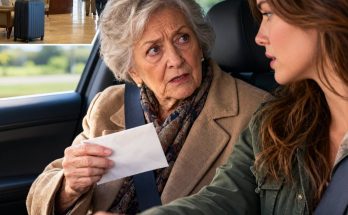
The years after the courthouse visit settled into a rhythm that neither of us had expected.
Grandma grew older, but she did not become smaller.
That was the distinction I learned to make.
Her garden changed first. She gave up the raised beds when bending became difficult and replaced them with large planters that sat waist-high along the back porch.
She complained about them for two weeks.
Then she admitted they were easier.
“I still don't like admitting I'm getting older,” she told me one morning.
“You don't have to.”
“Oh, I know.”
She adjusted a tomato plant.
“But the tomatoes don't care about my pride.”
She kept Grandpa's watch.
By then, the silver band had been polished twice, though she refused to replace the scratches.
“They belong there,” she said.
The watch had become part of her daily routine. Every morning she fastened it herself. Every evening she placed it in the wooden dish beside her bed.
Dad remained in her life, but carefully.
He visited occasionally.
He never entered without calling first.
He never asked about her finances.
He never mentioned the house unless Grandma brought it up.
Their conversations were sometimes warm and sometimes awkward.
They had no illusion that things were repaired.
But there was no longer a war.
That mattered.
Mom was different.
She remained distant for years.
She sent birthday cards.
She occasionally called.
Grandma answered when she wanted to.
There were no forced reunions.
No family dinners arranged to make everyone uncomfortable.
No pretending that a few apologies could rebuild what had been broken.
Grandma had learned that peace did not require closeness.
Sometimes peace was simply knowing the other person could no longer reach into your life and rearrange it.
I understood that better as time passed.
My own relationship with Dad changed too.
For a while, I couldn't look at him without remembering the recording.
The study.
The papers.
Mom practicing Grandma's signature.
Dad standing behind her.
That image had become permanently attached to him.
Eventually, though, another image joined it.
Dad sitting across from Grandma in that courthouse café, admitting that desperation had made him selfish.
It didn't erase the first image.
It complicated it.
People were more complicated than the worst thing they had done.
But complicated did not mean excused.
Grandma understood that better than anyone.
One afternoon, Dad came over with a box.
“I found these in storage.”
He placed it on the kitchen table.
Grandma opened it.
Inside were Grandpa's old woodworking plans.
She touched the top sheet.
“He kept all of these?”
“Yes.”
She smiled.
“He always said he would build half of them.”
“He built three.”
“Four.”
Dad smiled.
“The birdhouse doesn't count.”
“It does if birds lived in it.”
I watched them laugh.
It was a small moment.
But I knew how far they had come.
After Dad left, Grandma remained at the table.
“You were happy,” I said.
She looked at me.
“I was.”
“Does that surprise you?”
“No.”
She closed the box.
“Forgiveness doesn't mean every day becomes good.”
She ran her hand over the lid.
“It means some days are allowed to be good again.”
That sentence stayed with me.
Years passed.
The legal records eventually became old records.
The forged deed was corrected.
The financial repayment was completed.
The bank accounts remained under professional oversight.
The new estate documents were filed.
Grandma's choices became ordinary again.
That was exactly what she wanted.
Then, one rainy afternoon, I received a call from an unfamiliar number.
I almost ignored it.
I answered.
“Hello?”
“This is Oak Creek Assisted Living.”
My heart tightened.
“Is Grandma okay?”
There was a pause.
“She isn't here.”
I frowned.
“Then why are you calling?”
The woman explained that their records department was conducting an archival review.
They had found something connected to Grandma's admission attempt years earlier.
A document.
Something they had not known was important at the time.
I asked what it was.
“We would prefer to show it to her directly.”
I drove to Grandma's house.
She was sitting at the kitchen table, sorting photographs.
When I told her, she became very still.
“What kind of document?”
“They didn't say.”
She closed the photograph album.
“Then let's go.”
Oak Creek looked smaller than I remembered.
The lobby had been repainted.
The furniture had changed.
The front desk was different.
But the smell was the same.
Coffee.
Disinfectant.
Something warm from the kitchen.
A staff member brought us into a small office.
She placed a folder on the desk.
“We found this during a records audit.”
Grandma opened it.
Inside was a copy of the original intake paperwork.
Her name.
Her address.
Her insurance information.
Then she stopped.
I leaned closer.
There was a handwritten note attached to the admission packet.
Grandma read it twice.
“What does it say?”
She handed it to me.
The note had been written by a staff member on the day she arrived.
Patient repeatedly stated that she had not agreed to permanent placement. She requested that staff contact grandson Marcus Thorne. Patient appeared oriented and consistent in her account.
I looked at Grandma.
She smiled faintly.
“They believed me.”
“Yes.”
She took the paper back.
“That matters.”
The staff member nodded.
“We thought you might want the record.”
Grandma folded it carefully.
“Thank you.”
Outside, rain tapped against the windows.
We sat in the car without starting it.
I watched her hold the note.
“What are you thinking?”
“That I was right.”
“About what?”
“That day.”
She looked at the building.
“I wasn't confused.”
“I know.”
“I needed someone to believe me.”
I reached over and squeezed her hand.
“You had me.”
She looked at me.
“Eventually.”
I laughed.
“Fair.”
Then her expression softened.
“That note means more than you think.”
“Why?”
“Because there were people who believed me before you arrived.”
I hadn't considered that.
The story I carried had always been simple.
Grandma was abandoned.
I came.
I rescued her.
But the truth was more complicated.
She had spoken for herself.
Brenda had listened.
Another staff member had documented it.
The bank had protected her accounts.
The clerk at the courthouse had recognized the danger.
Her attorney had believed the evidence.
Piece by piece, people had helped restore her choices.
I had simply been the person who drove the 190 miles.
That distinction humbled me.
Grandma folded the note.
“I want to keep this.”
“Of course.”
She slipped it into her purse.
We drove home.
That night, she placed the note beside Grandpa's watch.
I asked why.
“Because both remind me that I was seen.”
The rain continued until midnight.
Neither of us knew then that the little note would become important again.
Not legally.
Not financially.
Personally.
Because several months later, Grandma began writing something.
She didn't tell me what it was.
I found out by accident.
I was visiting on a Sunday morning when I saw a notebook open on the dining table.
At the top of the page, she had written:
What I Want My Family To Know.
I closed it immediately.
“I wasn't reading.”
She looked at me.
“You were standing over it.”
“That's not the same thing.”
She smiled.
“I know.”
She closed the notebook.
“I'm writing things down.”
“For your estate?”
“No.”
“For me.”
She tapped the cover.
“I want you to understand what I couldn't explain when everything happened.”
I sat down.
“You can tell me now.”
“I know.”
She looked toward the window.
“But sometimes writing is easier.”
She returned to her notebook.
I didn't ask again.
That was another thing I had learned.
Love did not mean demanding access to every thought.
Sometimes it meant waiting.
Click here to continue reading: PART 10: Grandma’s Notebook Revealed Why She Had Stayed Silent for Months, and One Page Changed How I Remembered My Father
The Phone Call That Turned a Harmless Family Lunch Into a 190-Mile Drive I Could Not Afford to Delay
Part 9 of 12