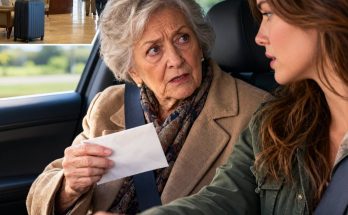
We drove directly to Grandma's bank.
The branch manager, David Vance, knew her well enough that he didn't ask her to explain the entire situation at the front counter.
He saw her face.
Then he saw mine.
“Eleanor?”
“I need your help, David.”
He led us into a private office.
The blinds were half-closed against the rain.
Grandma placed the deed on his desk.
David read it once.
Then again.
His expression became careful.
“What happened?”
“I was brought to an assisted-living facility today without agreeing to move there.”
David looked at me.
“Your parents?”
“Yes.”
He leaned back.
“I see.”
“No,” Grandma said quietly. “You don't.”
She reached into her purse.
“I need every transaction made from my accounts in the last several months.”
David nodded.
“I can pull the records.”
“And I want to know who authorized them.”
He didn't ask why.
He turned to his computer.
A few minutes later, he printed several pages.
The first amount was twelve thousand dollars.
Grandma looked at me.
“Do you recognize that?”
“No.”
David tapped the transaction.
“It was issued as a cashier's check.”
“To whom?”
He turned the screen toward us.
“Thorne Remodeling.”
My father's company.
Grandma's lips pressed into a thin line.
“What did he say it was for?”
“Nothing.”
David continued.
“The next transaction is eighteen thousand dollars transferred to a joint account.”
My mother's name was listed beside my father's.
I felt heat rise in my face.
“That's thirty thousand.”
David nodded.
Then he opened another transaction.
Twenty-five thousand dollars.
Oak Creek Assisted Living.
Grandma stared at the screen.
“They used my money to put me there.”
David folded his hands.
“The payment was entered as an advance residential-care expense.”
“Did I authorize it?”
“Your father initiated it under his power of attorney.”
Grandma looked down.
“What does the power of attorney actually allow?”
“Payment of legitimate expenses on your behalf. It doesn't give him unrestricted permission to transfer your assets to himself or use your money for unrelated purposes.”
Silence filled the room.
Grandma slowly removed her glasses.
“Then I want his authority revoked.”
David printed the necessary forms.
She signed each one without hesitation.
Her hand trembled only once.
When she finished, David placed fraud alerts on the accounts and gave us copies of the transaction records.
Outside, the rain had stopped.
The pavement reflected the lights from the storefronts.
My phone buzzed.
Mom.
Grandma looked at me.
“Answer.”
I put it on speaker.
“Where is she?” Mom demanded.
“She’s with me.”
A long breath came through the speaker.
“Marcus, your father and I are trying to handle a very difficult situation.”
“You left Grandma at Oak Creek.”
“We didn't leave her.”
“What would you call it?”
“We needed time.”
“Three hours?”
“We believed the staff could keep her comfortable.”
Grandma's expression didn't change.
“Why weren't you answering?”
Mom went quiet.
Then her voice became softer.
“Your grandmother isn't always clear about what's best for her anymore.”
Grandma leaned toward the phone.
“I was clear enough to visit the courthouse.”
Silence.
“And the bank,” she added.
The call ended.
I looked at her.
“You knew she would say that.”
Grandma shook her head.
“No.”
Then she smiled without humor.
“But I know your mother.”
We drove toward Grandma's house.
I expected her to ask me to take her home with me.
Instead, she said, “We're going to my house first.”
“Why?”
“The cameras.”
I looked at her.
“What cameras?”
“Your grandfather had them installed after the last burglary.”
I remembered seeing small black lenses around the exterior.
I'd never thought about them.
Grandma had.
She had apparently kept the recordings.
When we turned onto her street, I saw the moving truck before I saw the house.
It was parked across from the driveway.
Two men were carrying boxes through the garage.
A woman stood near the front walk, speaking into her phone.
Then I saw the sign.
COMING SOON.
My hands tightened around the steering wheel.
Grandma stared through the windshield.
“They were already selling it.”
Neither of us moved.
Finally, she whispered, “They were ready before they took me.”
We parked.
The woman with the phone saw us and froze.
One of the movers lowered a box.
I walked toward the driveway.
“Who hired you?”
The older mover looked uncomfortable.
“Mr. Thorne.”
“My father?”
“Yes.”
“When?”
He hesitated.
“Several days ago.”
Grandma heard him.
“Several?”
He nodded.
She looked at the house.
“Before the deed?”
The mover didn't answer.
That was answer enough.
Grandma tried her key.
It didn't work.
She stared at the lock.
“He changed it.”
The mover swallowed.
“A locksmith came this morning.”
“Who authorized that?”
“Mr. Thorne showed him the recorded deed.”
Grandma closed her eyes.
For a second, I thought she might collapse.
Instead, she turned toward the garden.
“Your grandfather kept a spare.”
She walked slowly around the side of the house.
Behind an old wooden support beam near the shed, she reached into a narrow gap.
Her fingers found a small metal box.
Inside was a key.
She held it up.
“Arthur never trusted modern locks.”
We entered through the kitchen.
The house looked wrong.
Photographs were missing from the walls.
Boxes lined the hallway.
Crystal glasses had been wrapped in newspaper.
Grandpa's tools were gone.
Grandma stood in the dining room and looked at the empty space where his favorite cabinet had been.
“They were taking our life apart.”
I didn't know what to say.
She pointed upstairs.
“Study.”
We climbed the stairs.
Grandpa's office smelled faintly of cedar and old paper.
Grandma moved a chair.
Then she knelt.
“Help me.”
Together we dragged a bookcase away from the wall.
A small metal safe was built into the floor.
I stared.
“I didn't know that existed.”
“Neither did your father.”
She opened it.
Inside were savings bonds, old military records, jewelry, family photographs, and several folders.
Then she lifted two small memory cards.
“The cameras.”
We used my laptop.
The first recordings were ordinary.
Grandma walking into the study.
My father carrying groceries.
My mother folding laundry.
Then we reached a recording from eight days earlier.
Dad entered alone.
He closed the door.
He began opening drawers.
One after another.
He searched through folders.
Pulled books from shelves.
Checked behind framed photographs.
He wasn't looking for something casually.
He was hunting.
After nearly twenty minutes, Mom entered.
The audio was faint.
But we could hear her.
“Did you find the deed?”
Dad shook his head.
“No.”
“What about Arthur's papers?”
“Nothing.”
Mom looked toward the hallway.
“She has to have them somewhere.”
Dad rubbed his forehead.
“It won't matter once the new deed is recorded.”
I stopped the video.
Grandma didn't move.
“What did he mean?”
She stared at the frozen image.
“I don't know.”
“You do.”
She shook her head.
“I suspected they wanted the house.”
I restarted the recording.
The next clip was from two days later.
Mom sat at Grandpa's desk.
Several blank sheets were spread before her.
Then she began writing Grandma's name.
Again.
And again.
Different sizes.
Different angles.
Different versions of the same signature.
Dad stood behind her.
He leaned forward.
Pointed at one.
“That one is closer.”
Mom tried again.
Grandma's hand moved to her mouth.
I watched her face.
She was no longer simply angry.
She looked betrayed.
A third recording began.
An unfamiliar woman entered the house.
Dad met her at the study door.
He carried a folder.
She stayed inside for less than fifteen minutes.
The timestamp was from the same period in which the deed claimed Grandma had appeared before a notary.
I looked at Grandma.
“That woman.”
She nodded.
“That's enough.”
“Enough for what?”
She reached for her phone.
“An attorney.”
I made copies of everything.
Four copies.
One for Grandma.
One for her lawyer.
One for the bank.
One for the police.
Then we called.
Before the attorney could finish asking questions, headlights swept across the kitchen wall.
A vehicle stopped hard in the driveway.
Dad.
Mom was beside him.
Grandma looked at me.
“Don't say anything until I do.”
The back door opened.
My father walked inside.
He stopped when he saw us.
“Mom?”
Grandma stood in the middle of her kitchen.
“Hello, Richard.”
His expression changed.
First surprise.
Then concern.
Then something that looked very much like calculation.
“You shouldn't be here.”
Grandma's voice remained level.
“This is my house.”
Dad glanced toward me.
“Marcus, you don't understand what's happening.”
I looked at the boxes stacked behind him.
“I understand enough.”
He stepped forward.
Mom whispered, “Eleanor, please. Don't make this worse.”
Grandma looked at her.
“You already did.”
Dad's eyes moved to the laptop.
He saw the paused video.
His face lost its color.
And for the first time since I had arrived, my father had nothing ready to say.
Click here to continue reading: PART 3: My Father Claimed Grandma Had Signed the Deed, Until We Played the Recording That Destroyed His Carefully Prepared Story
The Phone Call That Turned a Harmless Family Lunch Into a 190-Mile Drive I Could Not Afford to Delay
Part 2 of 12